
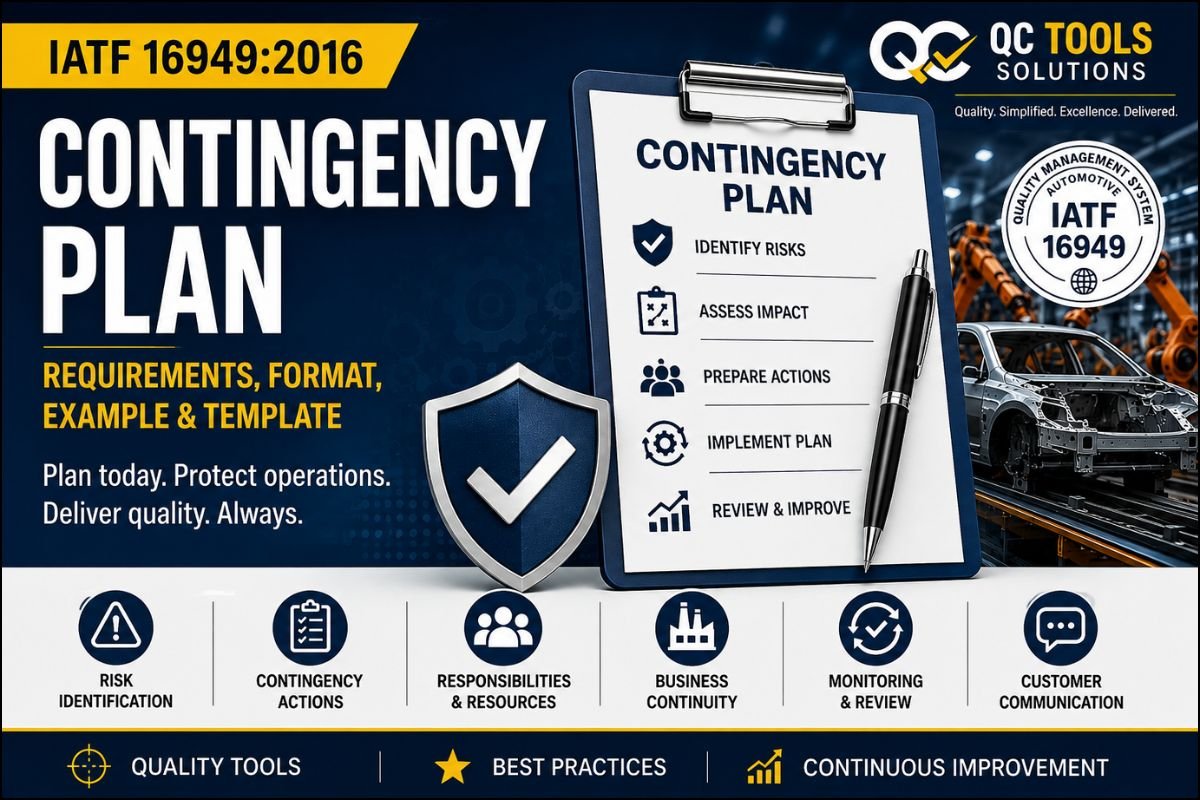
IATF 16949 Contingency Plan: What is It?
A Contingency plan as per IATF 16949 is a documented plan that defines how an organization will respond when an unexpected event disrupts manufacturing processes, infrastructure, equipment, resources, or supply chain operations and threatens its ability to maintain production and meet customer requirements.
For an automotive manufacturing company, a contingency plan is more than an emergency-response document. It is an important part of risk management, business continuity and customer-supply protection.
IATF 16949 clause 6.1.2.3 – Contingency plans require organizations to establish contingency plans based on relevant risks and customer impact. The requirement has subsequently been clarified through IATF Sanctioned Interpretation (SI) 3, establishing clearer expectations for planning. This guidance affects how organizations design, implement, and verify their contingency measures.
The current IATF 16949 SI page lists SIs 27–30 issued in November 2025, while the contingency-plan-specific SI 3 was revised in November 2024. (IATF Global Oversight) These entries help organizations align their practices with the standard’s contingency requirements.
The revised SI 3 is particularly important because it explicitly addresses pandemics, cybersecurity, employee training and awareness, contingency testing, annual multidisciplinary review and validation of the product after an emergency restart.
What is a Contingency Plan in simple words?
In simple terms:
A contingency plan tells an organization what to do when something unexpected happens that could interrupt production, affect product quality or prevent the company from meeting customer requirements.
An automotive supplier may have only one critical CNC machine for producing a customer component.
This is covered in the Contingency plan as per IATF 16949.
If that machine fails, the organization should already know:
- What is the potential impact?
- How long can production continue?
- Is an alternate machine available?
- Is another manufacturing location available?
- Is an approved external source available?
- How much safety stock is available?
- Who activates the contingency plan?
- Who communicates with the customer?
- How will product quality be verified?
- How will production be safely restarted?
These predefined actions constitute the organization’s contingency response.
IATF 16949 Contingency Plan Requirements
The primary IATF 16949 requirement is clause 6.1.2.3 – Contingency plans.
The organization is required to develop contingency plans for continuity of supply based on relevant risks. The revised SI 3 clarifies that the situations include, but are not limited to:
- Key equipment failures
- Interruption of externally provided products, processes and services
- Recurring natural disasters
- Fire
- Pandemics
- Utility interruptions
- Cyber-attacks on information technology systems
- labor shortages
- Infrastructure disruptions
The words “but not limited to” are important. An organization should not simply copy this list into its procedure and consider the requirement fulfilled. The organization needs to determine what risks are relevant to its own manufacturing processes, infrastructure, location, supply chain, technology and customers.
The contingency-planning system should also include:
- Customer and interested-party notification
- Periodic testing of contingency plans
- Cybersecurity contingency testing appropriate to the risk
- Annual review using a multidisciplinary team including top management
- Documented revisions and authorization
- Employee training and awareness
- Provisions for validating product conformity after emergency restart
The revised SI 3 specifically requires contingency plans to include appropriate employee training and awareness and states that the plans must be reviewed at least annually by a multidisciplinary team including top management.
What should a Manufacturing Company’s Contingency Plan cover?
A good contingency plan for a manufacturing company should be based on the organization’s actual risks rather than a generic template.
The following areas should normally be evaluated.
1. Critical Equipment Failure
Examples include:
- CNC machine breakdown
- Press failure
- Injection molding machine failure
- Furnace failure
- Welding equipment failure
- Critical testing equipment failure
- Tooling failure
- Compressor failure
- Automation or robot failure
Possible contingency measures include:
- Backup equipment
- Alternate production line
- Sister plant
- Approved external processing
- Critical spare parts
- Emergency maintenance support
- Temporary equipment
The organization should verify that the proposed alternative is actually capable of maintaining customer requirements.
2. Utility Interruption
Consider:
- Electricity failure
- Compressed-air failure
- Water interruption
- Gas interruption
- HVAC failure
- Internet/network interruption
Possible controls may include:
- DG backup
- UPS
- Auxiliary compressor
- Water storage
- Alternate utility source
- Emergency service provider
IATF FAQ 29 identifies examples such as backup infrastructure or equipment, contracted services, safety stock and auxiliary sources as possible alternative measures, depending on the situation.
3. Supplier Disruption
Supplier-related risks may include:
- Critical raw-material shortage
- Supplier shutdown
- Supplier quality problem
- Supplier capacity failure
- Transport disruption
- Supplier bankruptcy
- Natural disaster at a supplier location
Potential contingency measures include:
- Approved alternate supplier
- Safety stock
- Emergency logistics
- Supplier development
- Alternate manufacturing source
- Customer-approved temporary source, where required
A supplier contingency plan should consider not only supplier availability but also quality approval, capacity, tooling, logistics and customer requirements.
4. Natural Disasters
Depending on location, risks may include:
- Flood
- Earthquake
- Cyclone
- Severe storm
- Extreme weather
- Regional disaster
The organization should consider the impact on:
- Its own facility
- Employees
- Suppliers
- Utilities
- Logistics
- Warehouses
- Customers
A contingency plan should therefore look beyond the factory gate.
5. Fire
Fire response may involve evacuation and emergency safety procedures, but the IATF contingency-planning perspective also requires consideration of continuity of supply.
For example:
Fire → Safe evacuation → Damage assessment → Alternate production → Customer communication → Quality verification → Recovery → Normal production
The contingency plan should establish who takes each action and what evidence is required.
6. Cybersecurity Incident
Cybersecurity is now a significant part of IATF 16949 contingency planning.
The revised SI 3 specifically includes cyber-attack on information technology systems and gives examples of cyber-security contingency testing, including simulation of a cyber-attack, regular monitoring for specific threats, identification of dependencies and prioritization of vulnerabilities. Testing should be appropriate to the risk of customer disruption. It may be performed internally or subcontracted as appropriate.
For a modern manufacturing company, consider the possible loss of:
- ERP
- MES
- Production programs
- Network
- Servers
- Traceability data
- Inspection records
- Customer communication systems
- Production planning systems
A cyberattack could therefore become a production-continuity problem, not merely an IT problem.
7. Labor Shortage
Potential causes include:
- Pandemic
- High absenteeism
- labor strike
- Transportation disruption
- Skill shortage
- Sudden loss of critical personnel
Possible contingency measures include:
- Cross-training
- Multi-skilling
- Backup manpower
- Temporary workforce
- Alternate shifts
- Skill matrix
- Backup personnel for critical positions
The organization should identify positions where the absence of one person could significantly affect customer supply.
8. Infrastructure Disruption
Infrastructure risks may include:
- Building damage
- Road closure
- Warehouse disruption
- IT infrastructure failure
- Communication failure
- Transportation interruption
The organization should determine which infrastructure is essential for maintaining production and customer delivery.
Contingency Plan in Risk Management
A contingency plan and risk management are closely related, but they are not the same thing.
Risk management asks:
What could go wrong, how likely is it, and what would be the impact?
Contingency planning asks:
If it happens, what will we do?
For example:
| Risk | Likelihood | Impact | Contingency Action |
|---|---|---|---|
| CNC failure | Medium | High | Transfer production to alternate machine |
| Power failure | Medium | High | DG/backup power |
| Supplier shutdown | Low | High | Alternate approved supplier |
| Fire | Low | Very High | Alternate production location |
| Cyberattack | Medium | Very High | IT recovery and continuity plan |
| Labour shortage | Medium | Medium | Cross-trained manpower |
Therefore, the overall approach should be:
Risk Identification → Risk Evaluation → Contingency Planning → Testing → Review → Improvement
IATF FAQ 29 emphasizes risk analysis for manufacturing processes and essential equipment/infrastructure, development of contingency measures, regular review/testing/validation, employee awareness and compliance with customer requirements and CSRs.
Contingency Plan Format: What should it contain?
There is no single mandatory document format that every organization must use.
The format should be appropriate to the organization’s risks and customer requirements.
A practical contingency plan format can contain:
| Section | Information |
|---|---|
| Document Information | Document number, revision, date |
| Process/Area | Production, Maintenance, IT, Supply Chain, etc. |
| Risk/Event | Equipment failure, fire, cyberattack, supplier failure |
| Potential Impact | Production, quality and customer impact |
| Risk Level | Low, Medium or High |
| Trigger | Condition for activating the plan |
| Immediate Action | First response |
| Alternative Resource | Backup machine/source/location |
| Responsibility | Person responsible |
| Escalation | Internal escalation |
| Customer Notification | Who, when and how |
| Quality Controls | Inspection, segregation, traceability |
| Recovery | Restoration plan |
| Restart Validation | Product/process verification |
| Testing | Method, frequency and result |
| Training | Employee awareness/training |
| Review | Annual review |
| Approval | Authorized person |
Simple Contingency Plan Example
Scenario: Critical CNC Machine Failure
Risk: CNC machine failure
Potential impact: Production of Customer Part ABC may stop.
Trigger: Machine failure is expected to affect customer delivery or production cannot be restored within the defined response time.
Immediate Actions:
- Stop the machine safely.
- Inform Production and Maintenance.
- Identify affected material and WIP.
- Estimate recovery time.
- Inform Quality where product conformity may be affected.
- Evaluate customer-delivery impact.
Alternative Production:
- Transfer production to an approved alternate machine.
- Verify tooling availability.
- Verify CNC program availability.
- Confirm process parameters.
- Confirm operator competency.
- Confirm inspection capability.
Customer Communication:
If customer operations are affected, initiate the applicable customer-notification process and follow the relevant Customer Specific Requirements.
Quality Verification:
After transferring or restarting production:
- First-piece inspection
- Critical-dimension verification
- Process-parameter verification
- Traceability verification
- Additional inspection based on risk
Recovery:
Repair Machine A, verify its capability and return to production after appropriate validation.
This is considerably stronger than simply stating:
“In case of machine breakdown, Maintenance will repair the machine.”
A good contingency plan should explain how production continuity and product conformity will be protected.
Contingency Plan Testing
One of the most common weaknesses in contingency planning is having a document without evidence that the plan actually works.
IATF 16949 requires contingency plans to be periodically tested for effectiveness. The revised SI 3 provides examples such as simulations and gives additional clarification for cybersecurity testing.
Testing does not necessarily mean deliberately creating an actual production failure.
Depending on risk, testing can include:
- Tabletop exercise
- Simulation
- Emergency drill
- Backup-machine trial
- IT recovery test
- Communication test
- Alternate-supplier verification
- Generator test
- Emergency manpower simulation
For example, if the contingency plan says:
“Production will be transferred to Machine B.”
The organization should verify:
- Is Machine B available?
- Is the tooling available?
- Is the program available?
- Are trained operators available?
- Is inspection equipment available?
- Is capacity sufficient?
- Can customer requirements still be met?
The test should produce objective evidence, including what was tested, when it was tested, who participated, what happened, gaps identified and corrective/improvement actions.
Cybersecurity Contingency Plan Testing
The revised SI 3 deserves particular attention here.
Cybersecurity testing can include:
- Simulated cyberattack
- Threat monitoring
- Identification of system dependencies
- Vulnerability prioritization
- Recovery testing
The extent of testing should be based on the potential customer disruption.
For example, if production depends heavily on an MES system, the organization should understand:
What happens to production if MES becomes unavailable?
Questions may include:
- Can production continue?
- How will work instructions be accessed?
- How will traceability be maintained?
- How will inspection records be captured?
- How will production orders be managed?
- How will data be recovered?
- How will the system be validated before returning to normal operation?
The objective is not simply to demonstrate that the IT department has a cybersecurity policy. The organization needs to understand the manufacturing and customer-supply consequences of an IT disruption.
Annual Review of the Contingency Plan
IATF 16949 requires contingency plans to be reviewed at least annually by a multidisciplinary team, including top management, and updated as required.
A suitable review team may include:
- Top Management
- Quality
- Production
- Maintenance
- Purchase/Supply Chain
- HR
- IT
- Logistics
- EHS
- Engineering
During the review, ask:
- Have new risks emerged?
- Have manufacturing processes changed?
- Has new equipment been installed?
- Have customer requirements changed?
- Have suppliers changed?
- Have previous incidents exposed weaknesses?
- Were contingency tests effective?
- Are backup resources still available?
- Are employees aware of their responsibilities?
- Are customer contacts and CSRs current?
An annual review should be more than changing the revision date.
It should demonstrate that the organization has actually evaluated whether the contingency plan remains suitable and effective.
Employee Training and Awareness
Employee awareness is an important update in the revised SI 3.
The contingency plan must include the development and implementation of appropriate employee training and awareness.
Employees involved in contingency response should understand:
- Which contingency plan applies to them
- How the plan is activated
- Who they should contact
- What their responsibilities are
- How affected product is controlled
- How traceability is maintained
- What happens during restart
For example, if an alternate inspection method is identified in the contingency plan, relevant inspectors should already understand how and when to use it.
A contingency plan that employees cannot explain is unlikely to be an effective contingency plan.
Emergency Restart and Product Validation
A particularly important requirement is the validation of product after emergency restart.
The revised SI 3 states that contingency plans shall include provisions to validate that manufactured product continues to meet customer specifications after production restarts following an emergency in which production was stopped and the regular shutdown processes were not followed.
A practical restart checklist may include:
- Machine condition
- Tool condition
- Process parameters
- First-piece inspection
- Critical characteristics
- Measurement equipment
- Material identification
- Traceability
- Control Plan requirements
- Special characteristics
- Product testing
- Release authorization
The key question is:
How will you prove that the first product after an emergency restart is still conforming?
This should be clearly defined in the contingency plan.
Customer Notification Process
A contingency plan should define who communicates with the customer, when communication is required and what information must be provided.
The revised SI 3 requires the contingency plan to include a notification process for the customer and other interested parties regarding the extent and duration of situations that impact customer operations.
The process should identify:
- Customer contact
- Internal responsible person
- Escalation requirements
- Communication method
- Information to communicate
- Expected duration
- Supply impact
- Recovery plan
Applicable Customer Specific Requirements (CSRs) must also be considered.
For example, a customer may specify requirements regarding:
- Notification time
- Escalation
- Alternate manufacturing
- Emergency shipments
- Customer approval
- Temporary process/location changes
Therefore, a generic contingency plan should always be evaluated against the applicable customer requirements.
Common IATF 16949 Contingency Plan Audit Findings
1. Generic contingency plan
Example:
“In case of emergency, management will take appropriate action.”
Problem: There is no defined response.
2. Risk assessment is not linked to contingency planning
The organization has a risk register and a contingency plan, but there is no clear relationship between identified risks and the selected contingency actions.
3. No evidence of testing
The procedure says that contingency plans are tested annually, but there are no test records.
4. Employees are unaware
Employees cannot explain what they should do during a disruption.
5. Cybersecurity is omitted
The company depends on IT systems but has not considered how an IT/cyber disruption could affect manufacturing and customer supply.
6. Customer notification is unclear
Nobody knows who should contact the customer or when.
7. Alternate source has not been verified
The plan identifies an alternate supplier or machine but there is no evidence that its availability, capacity or capability has been verified.
8. Restart validation is missing
Production resumes after an emergency, but there is no defined evidence that product conformity was verified.
9. Annual review is ineffective
The document has a new revision date, but there is no evidence of meaningful multidisciplinary review.
10. Previous incidents were not used for improvement
A disruption occurred, but lessons learned were not incorporated into the contingency plan.
Contingency Plan vs Emergency Plan vs Business Continuity Plan
These terms are often confused.
| Plan | Main Purpose |
|---|---|
| Emergency Plan | Protect people, property and immediate safety |
| Contingency Plan | Maintain manufacturing and customer supply during disruption |
| Business Continuity Plan | Maintain broader organizational operations |
| Disaster Recovery Plan | Recover systems, infrastructure and data |
| Crisis Management Plan | Manage major organizational crises |
For IATF 16949, contingency planning should focus particularly on risks that could affect manufacturing continuity and customer requirements.
Recommended IATF 16949 Contingency Plan Template
A practical automotive contingency plan template can be structured into the following sections.
A. General Information
- Document number
- Revision
- Date
- Process/department
- Location
- Plan owner
B. Risk Identification
- Risk/event
- Internal or external risk
- Cause
- Probability
- Impact
- Risk level
- Customer impact
C. Contingency Response
- Trigger
- Immediate action
- Alternative resource
- Responsible person
- Escalation process
D. Customer Protection
- Customer impact
- Notification process
- Customer-specific requirements
- Delivery arrangements
E. Quality Protection
- Product identification
- Segregation
- Inspection
- Testing
- Traceability
- Product release
F. Recovery
- Recovery action
- Responsible person
- Required resources
- Return-to-normal criteria
G. Verification
- Test method
- Test frequency
- Test result
- Effectiveness
- Improvement action
H. Training and Awareness
- Employees involved
- Training date
- Awareness method
- Competency evidence
I. Review and Approval
- Annual review
- Multidisciplinary team
- Top management participation
- Revision history
- Authorization
IATF 16949 Contingency Plan Audit Checklist
Before an IATF audit, verify the following:
- Relevant internal and external risks have been identified
- Manufacturing processes and essential infrastructure have been evaluated
- Customer impact has been considered
- Critical equipment failures are addressed
- External supply interruptions are addressed
- Natural disasters are considered
- Fire is considered
- Pandemic risk is considered
- Utility interruptions are considered
- Cybersecurity disruption is considered
- Labor shortages are considered
- Infrastructure disruptions are considered
- Other organization-specific risks have been considered
- Customer notification process is defined
- Contingency plans are periodically tested
- Cybersecurity testing is appropriate to risk
- Employees have appropriate awareness/training
- Contingency plans are reviewed at least annually
- Top management participates in the review
- Revision and authorization records are maintained
- Emergency restart validation is defined
- Customer specifications are verified after emergency restart
- Test results and effectiveness evidence are available
- Lessons learned are incorporated into the plan
Frequently Asked Questions
What is a contingency plan in simple words?
A contingency plan is a predefined plan explaining what an organization will do when an unexpected event could interrupt production, affect quality or prevent it from meeting customer requirements.
What is the IATF 16949 clause for contingency planning?
The primary requirement is IATF 16949 clause 6.1.2.3 – Contingency plans.
Is a contingency plan mandatory in IATF 16949?
Yes. Organizations need to establish appropriate contingency plans based on relevant risks and customer impact and demonstrate that the plans are effective. IATF FAQ 29 specifically emphasizes development, implementation, review, testing and validation of contingency measures.
How often should an IATF contingency plan be reviewed?
The contingency plans must be reviewed at least annually using a multidisciplinary team including top management.
Does a contingency plan need to be tested?
Yes. IATF 16949 requires periodic testing for effectiveness. For cybersecurity, SI 3 provides additional examples of appropriate testing activities.
Is cybersecurity included in an IATF 16949 contingency plan?
Yes. Cyber-attacks on IT systems are specifically included in the revised SI 3, with testing expectations based on the risk of customer disruption.
Is pandemic risk included?
Yes. The revised SI 3 explicitly added pandemics to the examples of events requiring consideration. The list remains non-exhaustive.
Does the contingency plan require employee training?
Yes. The revised SI 3 requires appropriate employee training and awareness to be included in contingency plans.
What should happen after emergency production restart?
The organization should have provisions to validate that the manufactured product continues to meet customer specifications after restart when production was stopped due to an emergency and regular shutdown processes were not followed.
Is there a mandatory IATF contingency plan format?
IATF 16949 does not prescribe one universal document template. The organization should establish a format appropriate to its risks, manufacturing processes, infrastructure and customer requirements.
Final Takeaway
An effective IATF 16949 contingency plan is much more than a document listing possible emergencies.
It should answer five basic questions:
What can go wrong?
What will be the impact on our customer?
What will we do if it happens?
How will we verify that our response works?
How will we ensure that employees and management are prepared?
A strong contingency-planning system connects:
Risk Assessment → Contingency Plan → Alternative Resources → Customer Communication → Testing → Employee Awareness → Emergency Restart Validation → Annual Review → Continual Improvement
For an automotive manufacturing company, this transforms contingency planning from an audit-compliance document into a practical system for protecting production continuity, product quality and customer satisfaction.
The most important point is this:
A contingency plan is effective only when the organization can demonstrate that it works.
Having a PDF titled “Contingency Plan” is not enough. The organization should be able to demonstrate risk-based planning, defined responsibilities, alternative resources, customer communication, testing, employee awareness, annual multidisciplinary review and effective product validation after emergency restart.
Important Note
For current IATF information, organizations should verify the latest official IATF 16949 Sanctioned Interpretations and FAQs before using this article as an audit-preparation reference. The IATF website currently lists the latest IATF 16949 SIs as SI 27–30, issued and effective in November 2025.