
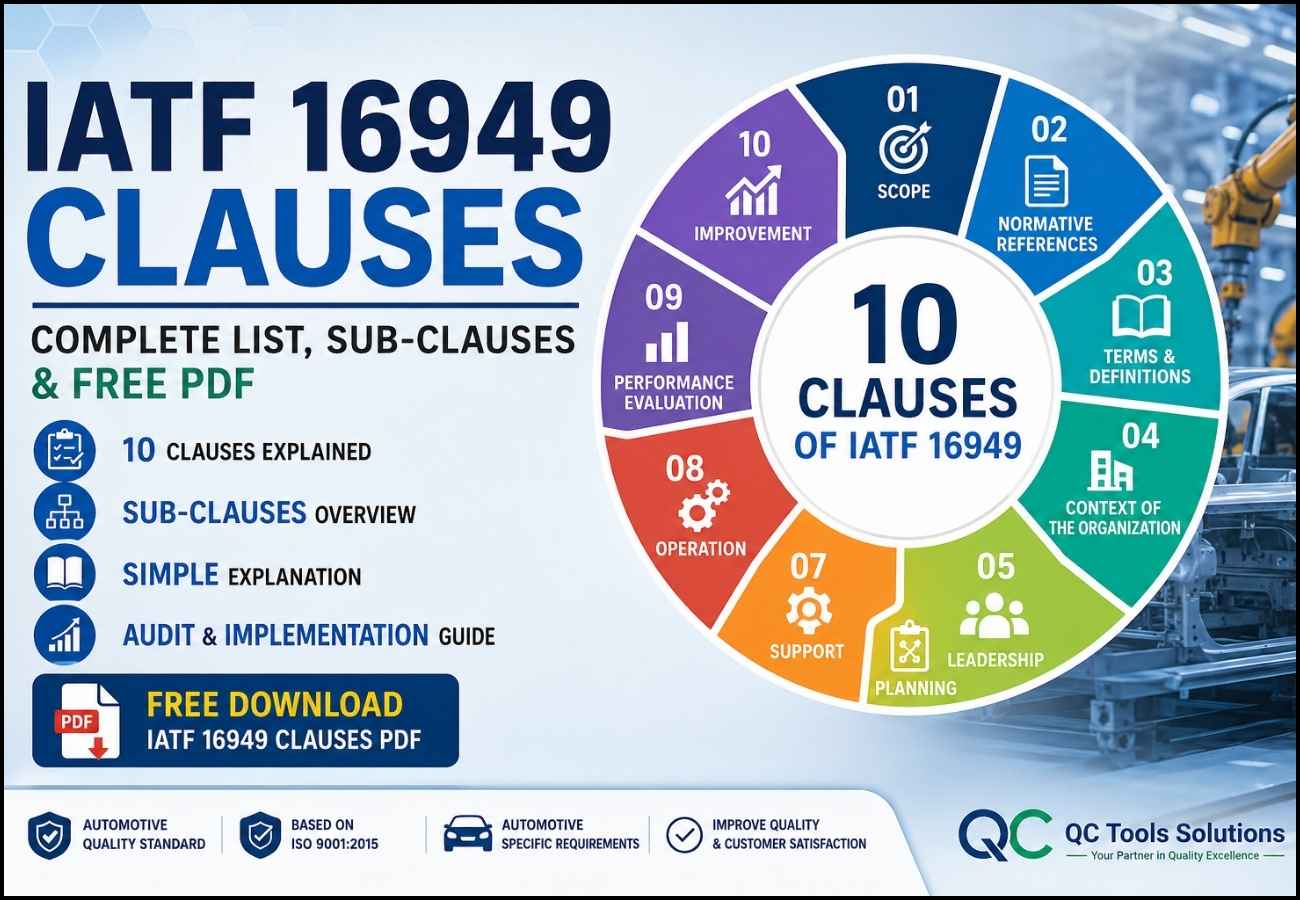
IATF 16949:2016 is the international Quality Management System (QMS) standard for the automotive industry. It is based on ISO 9001:2015 and adds automotive-specific requirements related to customer requirements, product safety, risk management, manufacturing processes, supplier management, traceability, problem solving and continual improvement.
This guide explains the 10 IATF 16949 clauses, important sub-clauses and automotive-specific requirements in simple language. It is useful for quality engineers, QMS professionals, internal auditors, IATF auditors, consultants, suppliers and students preparing for IATF 16949 implementation or audits.
Quick Answer: IATF 16949 has 10 main clauses. Clauses 1 to 3 provide the scope, references and definitions, while Clauses 4 to 10 contain the main Quality Management System requirements.
You can also download our IATF 16949 Clauses & Sub-Clauses Summary PDF for quick reference and audit preparation.
- What is IATF 16949?
- How Many Clauses are in IATF 16949?
- IATF 16949 10 Clauses List
- IATF 16949 Clauses and Sub-Clauses
- IATF 16949 Clause 1 – Scope
- IATF 16949 Clause 2 – Normative References
- IATF 16949 Clause 3 – Terms and Definitions
- IATF 16949 Clause 4 – Context of the Organization
- IATF 16949 Clause 5 – Leadership
- IATF 16949 Clause 6 – Planning
- IATF 16949 Clause 7 – Support
- IATF 16949 Clause 8 – Operation
- 8.5 – Production and Service Provision
- 8.6 – Release of Products and Services
- 8.7 – Control of Nonconforming Outputs
- IATF 16949 Clause 9 – Performance Evaluation
- IATF 16949 Clause 10 – Improvement
- 10.3 – Continual Improvement
- IATF 16949 Clause 10: Quick Summary
- IATF 16949 vs ISO 9001 Clauses
- Why is understanding IATF 16949 Clauses Important?
- IATF 16949 Clauses PDF
- IATF 16949 Certification and Audit Preparation
- Frequently Asked Questions About IATF 16949 Clauses
- 1. How many clauses are in IATF 16949?
- 2. What are the 10 clauses of IATF 16949?
- 3. What are the IATF 16949 clauses and sub-clauses?
- 4. What is IATF 16949 Clause 10?
- 5. What is the most important clause in IATF 16949?
- 6. Is IATF 16949 based on ISO 9001?
- 7. Can I download the IATF 16949 clauses PDF?
- 8. Is the IATF 16949 PDF available for free?
- 9. What is the difference between ISO 9001 and IATF 16949?
- 10. What is the difference between IATF clauses and IATF sub-clauses?
- Important IATF 16949 Update
- IATF Clause 4: Context of the Organisation
- Conclusion
- Need Help With IATF 16949 Implementation or Audit Preparation?
What is IATF 16949?
IATF 16949:2016 is an automotive Quality Management System standard developed by the International Automotive Task Force (IATF).
It builds on ISO 9001:2015 and adds requirements specifically relevant to the automotive supply chain.
The standard focuses on:
- Customer satisfaction
- Defect prevention
- Risk-based thinking
- Process effectiveness
- Product safety
- Customer-specific requirements
- Supplier quality
- Manufacturing process control
- Traceability
- Problem solving
- Continual improvement
Automotive organizations also use quality core tools and related methodologies such as:
- APQP
- PPAP
- FMEA
- MSA
- SPC
- Control Plan
- 8D Problem Solving
- Error Proofing
- Statistical techniques
Important: IATF 16949 requirements should always be considered together with applicable customer-specific requirements (CSRs) and the latest applicable IATF sanctioned interpretations (SIs) and FAQs.
How Many Clauses are in IATF 16949?
IATF 16949 has 10 main clauses.
The structure follows the 10-clause structure of ISO 9001:2015.
| Clause | Title | Main Focus |
|---|---|---|
| 1 | Scope | Scope of the standard |
| 2 | Normative References | Reference documents |
| 3 | Terms and Definitions | Definitions and terminology |
| 4 | Context of the Organization | QMS context and processes |
| 5 | Leadership | Leadership and customer focus |
| 6 | Planning | Risks, objectives and changes |
| 7 | Support | Resources, competence and documented information |
| 8 | Operation | Product and process realization |
| 9 | Performance Evaluation | Monitoring, audits and management review |
| 10 | Improvement | Corrective action and continual improvement |
Which clauses contain the main QMS requirements?
Clauses 4 to 10 contain the main requirements for establishing, implementing, maintaining and improving the automotive QMS.
Clauses 1 to 3 provide the scope, references and terminology.
IATF 16949 10 Clauses List
The 10 clauses of IATF 16949 are:
- Scope
- Normative References
- Terms and Definitions
- Context of the Organization
- Leadership
- Planning
- Support
- Operation
- Performance Evaluation
- Improvement
These clauses provide the framework for an Automotive Quality Management System.
IATF 16949 Clauses and Sub-Clauses
The following table provides a practical overview of the major clause structure.
| Main Clause | Important Areas / Sub-Clauses |
|---|---|
| Clause 4 | 4.1 Context of the organization, 4.2 Interested Parties, 4.3 QMS Scope, 4.4 QMS Processes |
| Clause 5 | 5.1 Leadership, 5.2 Quality Policy, 5.3 Roles & Responsibilities |
| Clause 6 | 6.1 Risks & Opportunities, 6.2 Quality Objectives, 6.3 Planning of Changes |
| Clause 7 | 7.1 Resources, 7.2 Competence, 7.3 Awareness, 7.4 Communication, 7.5 Documented Information |
| Clause 8 | 8.1 Operational Planning, 8.2 Customer Requirements, 8.3 Design, 8.4 Suppliers, 8.5 Production, 8.6 Release, 8.7 Nonconforming Outputs |
| Clause 9 | 9.1 Monitoring & Measurement, 9.2 Internal Audit, 9.3 Management Review |
| Clause 10 | 10.1 Improvement, 10.2 Nonconformity & Corrective Action, 10.3 Continual Improvement |
Note: This is a simplified reference guide and not a reproduction of the copyrighted IATF 16949 standard. Always refer to the officially licensed standard for the complete requirements and exact wording.
IATF 16949 Clause 1 – Scope
Clause 1 defines the scope and intended application of the standard.
It establishes the framework for an automotive Quality Management System and identifies the relationship between IATF 16949 and ISO 9001.
Key points
- Automotive quality management requirements
- Application to relevant organizations in the automotive supply chain
- Relationship with ISO 9001
- Applicable customer and regulatory requirements
The organization’s certification scope should clearly identify the applicable products, processes and manufacturing site.
IATF 16949 Clause 2 – Normative References
Clause 2 identifies normative references needed for understanding and applying the standard.
Organizations should ensure that applicable reference documents are identified and controlled.
IATF 16949 Clause 3 – Terms and Definitions
Clause 3 provides terminology and definitions used in the standard.
Automotive QMS terminology can include terms related to:
- Customer-specific requirements
- Manufacturing processes
- Product safety
- Special characteristics
- Supplier management
- Warranty
- Problem solving
Understanding these definitions is important for correct interpretation of IATF 16949 requirements.
IATF 16949 Clause 4 – Context of the Organization
Clause 4 establishes the foundation of the Quality Management System.
It requires the organization to understand its internal and external context, interested parties and QMS processes.
4.1 – Understanding the organization and its context
Identify internal and external issues that can affect the QMS.
4.2 – Interested parties
Determine relevant interested parties and their applicable requirements.
4.3 – Scope of the QMS
Define the boundaries and applicability of the Quality Management System.
Important automotive considerations include applicable customer-specific requirements.
4.4 – Quality Management System and its processes
The organization needs to establish, implement, maintain and continually improve its QMS and manage its processes effectively.
Automotive-specific areas include:
- Product and process conformity
- Product safety
- Process management
- Customer-specific requirements
IATF 16949 Clause 5 – Leadership
Clause 5 focuses on the responsibility and involvement of top management.
Top management must demonstrate leadership and commitment to the QMS.
5.1 – Leadership and commitment
Management should ensure that the QMS is integrated into business processes and that customer focus is maintained.
5.2 – Quality Policy
The organization establishes and communicates an appropriate quality policy.
5.3 – Organizational roles, responsibilities and authorities
Responsibilities and authorities must be clearly defined.
Automotive focus
Leadership should ensure that responsibilities related to:
- Product requirements
- Customer requirements
- Corrective action
- Product quality
- Process performance
are clearly assigned.
IATF 16949 Clause 6 – Planning
Clause 6 focuses on planning actions to address risks and opportunities, quality objectives and changes.
6.1 – Actions to Address Risks and Opportunities
Organizations should identify and address risks affecting the QMS.
Automotive organizations commonly use tools such as:
- FMEA
- Process risk analysis
- Contingency planning
- Risk registers
6.2 – Quality Objectives
Quality objectives should be measurable and relevant to the organization’s processes.
Examples include:
- Customer PPM
- Customer complaints
- On-time delivery
- Internal rejection
- Scrap
- Rework
- Process capability
- Supplier performance
6.3 – Planning of Changes
Changes affecting the QMS or processes should be planned and controlled.
Examples include:
- New machines
- New products
- New processes
- Process relocation
- Manpower changes
- Engineering changes
- Supplier changes
IATF 16949 Clause 7 – Support
Clause 7 addresses the resources and support needed to operate an effective QMS.
7.1 – Resources
Important areas include:
- People
- Infrastructure
- Plant and equipment
- Work environment
- Monitoring and measuring resources
- Organizational knowledge
Automotive examples
- Machine maintenance
- Calibration
- Measurement System Analysis (MSA)
- Laboratory controls
- Plant and facility planning
7.2 – Competence
The organization must ensure that people performing work affecting product and process quality are competent.
This includes:
- Training
- Qualification
- On-the-job training
- Internal auditor competency
- Second-party auditor competency
7.3 – Awareness
Employees should understand:
- Quality policy
- Quality objectives
- Their contribution to product quality
- Consequences of nonconformity
7.4 – Communication
Internal and external communication relevant to the QMS must be defined and controlled.
7.5 – Documented Information
This covers the creation, updating, control, retention and protection of QMS documented information.
Important automotive areas include:
- QMS documentation
- Record retention
- Engineering specifications
- Document control
IATF 16949 Clause 8 – Operation
Clause 8 is one of the most important sections for automotive manufacturing organizations.
It covers operational planning, customer requirements, product and process design, supplier management, production controls, product release and nonconforming outputs.
8.1 – Operational Planning and Control
The organization plans and controls processes required to achieve product and service conformity.
Automotive considerations include:
- Production planning
- Capacity planning
- Process controls
- Contingency planning
- Confidentiality
8.2 – Requirements for Products and Services
This section focuses on understanding and reviewing customer requirements.
Important areas include:
- Customer communication
- Review of customer requirements
- Customer-specific requirements
- Special characteristics
- Manufacturing feasibility
- Changes to customer requirements
8.3 – Design and Development
Where applicable, organizations need to control product and manufacturing process design and development.
Important areas include:
- Design planning
- Design inputs
- Manufacturing process design
- Special characteristics
- Design verification
- Design validation
- Prototype programme
- Product approval
- Design changes
Relevant automotive tools include APQP, DFMEA, PFMEA and Control Plan.
8.4 – Control of Externally Provided Processes, Products and Services
This section covers supplier quality management.
Important activities include:
- Supplier selection
- Supplier evaluation
- Supplier monitoring
- Supplier development
- Supplier audits
- Supplier QMS development
- Statutory and regulatory requirements
- Customer-directed sources
Supplier performance can be monitored using indicators such as:
- PPM
- Delivery performance
- Customer complaints
- Audit performance
- Rejection
- Corrective action effectiveness
8.5 – Production and Service Provision
This is a major area for manufacturing organizations.
Important automotive requirements include:
8.5.1.1 – Control Plan
The Control Plan defines how product and process characteristics are controlled during manufacturing.
8.5.1.2 – Standardized Work
Standardized work and operator instructions should support consistent process performance.
8.5.1.3 – Verification of Job Set-Ups
Set-up verification should be performed to ensure correct process conditions before production.
8.5.1.4 – Verification After Shutdown
Appropriate verification should be performed after production interruptions or shutdowns.
8.5.1.5 – Total Productive Maintenance
TPM activities help maintain equipment reliability and prevent unexpected equipment-related failures.
8.5.1.6 – Management of Production Tooling
Production tools, manufacturing equipment and inspection equipment should be properly managed.
8.5.1.7 – Production Scheduling
Production scheduling should support customer requirements and effective process control.
8.5.2 – Identification and Traceability
Organizations should establish appropriate identification and traceability controls.
Depending on the product and customer requirements, traceability may include:
- Batch number
- Lot number
- Date
- Machine
- Shift
- Operator
- Raw material
- Process parameters
8.5.6 – Control of Changes
Changes to manufacturing processes should be identified, reviewed, controlled and verified as applicable.
8.6 – Release of Products and Services
Products should be verified against defined acceptance criteria before release.
Automotive considerations may include:
- Inspection
- Testing
- Layout inspection
- Functional testing
- Appearance requirements
- Statutory and regulatory conformity
- Acceptance criteria
8.7 – Control of Nonconforming Outputs
Nonconforming products must be identified and controlled to prevent unintended use or delivery.
Important areas include:
- Customer authorization for concession
- Suspect product
- Reworked product
- Repaired product
- Customer notification
- Nonconforming product disposition
This is particularly important for automotive organizations because uncontrolled nonconforming product can lead to serious customer and field issues.
IATF 16949 Clause 9 – Performance Evaluation
Clause 9 focuses on monitoring, measurement, analysis, internal audits and management review.
9.1 – Monitoring, Measurement, Analysis and Evaluation
Organizations need to monitor and evaluate QMS and process performance.
Automotive organizations commonly monitor:
- Customer satisfaction
- Customer complaints
- PPM
- Scrap
- Rework
- Process capability
- OEE
- Delivery performance
- Supplier performance
Statistical tools
Organizations should identify and apply appropriate statistical tools.
Examples include:
- SPC
- Control Charts
- Process Capability
- Pareto Analysis
- Trend Analysis
- MSA
9.2 – Internal Audit
Internal audits help determine whether the QMS and processes conform to applicable requirements and are effectively implemented.
IATF 16949 includes different audit areas such as:
- Quality Management System audit
- Manufacturing process audit
- Product audit
Audit planning should consider process performance, risk, changes and previous audit results.
9.3 – Management Review
Top management periodically reviews the QMS to evaluate its suitability, adequacy and effectiveness.
Management review inputs can include:
- Customer satisfaction
- Process performance
- Product conformity
- Audit results
- Supplier performance
- Quality objectives
- Customer complaints
- Corrective actions
- Risks and opportunities
Management Review (MRM) Check Points
IATF 16949 Clause 10 – Improvement
Clause 10 is the improvement clause of IATF 16949.
It focuses on:
- Improvement opportunities
- Nonconformity
- Corrective action
- Problem solving
- Error-proofing
- Warranty management
- Customer complaints
- Continual improvement
10.1 – General
Organizations should identify opportunities for improvement and implement appropriate actions to improve the QMS, processes and customer satisfaction.
10.2 – Nonconformity and Corrective Action
When a nonconformity occurs, the organization should:
- React to the problem.
- Control and correct the problem.
- Determine the root cause.
- Take corrective action.
- Verify effectiveness.
- Update relevant risks and processes where appropriate.
- Retain appropriate documented information.
Common problem-solving methods
- 5 Why
- Fishbone / Ishikawa
- 8D
- Pareto Analysis
- Defect Analysis Report (DAR)
10.2.3 – Problem Solving
Automotive organizations need a structured problem-solving approach that addresses the root cause rather than only correcting the immediate problem.
An effective problem-solving process should include:
Problem → Containment → Root Cause → Corrective Action → Effectiveness → Prevention
10.2.4 – Error-Proofing
Error-proofing, or Poka-Yoke, helps prevent errors or detect them before defective products reach the customer.
Examples include:
- Sensors
- Interlocks
- Fixture poka-yoke
- Part presence detection
- Wrong-part prevention
- Automatic parameter verification
10.2.5 – Warranty Management Systems
Where applicable, warranty-related processes need to be managed systematically.
Warranty information can be used to identify recurring product and process problems.
10.2.6 – Customer Complaints and Field Failure Analysis
Customer complaints and field failures should be analyzed to identify root causes and implement effective corrective actions.
Lessons learned should be considered in relevant processes such as:
- FMEA
- Control Plan
- Work instructions
- Process controls
- Training
- Product and process development
10.3 – Continual Improvement
The organization should continually improve the suitability, adequacy and effectiveness of the QMS.
Continual improvement can include:
- Reducing scrap
- Reducing rework
- Improving productivity
- Improving process capability
- Reducing customer complaints
- Improving delivery performance
- Improving equipment effectiveness
- Reducing variation
- Preventing recurring problems
The objective is not simply to close audit findings but to create sustainable improvement in process and business performance.
IATF 16949 Clause 10: Quick Summary
| Area | Main Focus |
|---|---|
| 10.1 | Improvement opportunities |
| 10.2 | Nonconformity and corrective action |
| 10.2.3 | Problem solving |
| 10.2.4 | Error-proofing |
| 10.2.5 | Warranty management |
| 10.2.6 | Customer complaints and field failure analysis |
| 10.3 | Continual improvement |
Simple way to remember Clause 10:
Find the problem → Control it → Find the root cause → Correct it → Verify effectiveness → Prevent recurrence → Improve the process.
IATF 16949 vs ISO 9001 Clauses
IATF 16949 follows the same overall 10-clause structure as ISO 9001:2015, but adds automotive-specific requirements.
| ISO 9001 / IATF 16949 | Common Topic |
|---|---|
| 1 | Scope |
| 2 | Normative References |
| 3 | Terms and Definitions |
| 4 | Context |
| 5 | Leadership |
| 6 | Planning |
| 7 | Support |
| 8 | Operation |
| 9 | Performance Evaluation |
| 10 | Improvement |
What makes IATF 16949 different?
IATF adds automotive-specific requirements involving areas such as:
- Product safety
- Customer-specific requirements
- Manufacturing feasibility
- Special characteristics
- Product and process design
- Supplier development
- Control Plans
- FMEA
- Traceability
- Contingency planning
- Error-proofing
- Warranty management
- Customer complaint handling
- Automotive-specific audits
- Manufacturing process control
Therefore, IATF 16949 is not simply ISO 9001 with a different certificate. It contains additional automotive requirements that are important for organizations in the automotive supply chain.
Why is understanding IATF 16949 Clauses Important?
Understanding the clauses helps organizations to:
- Prepare for IATF certification
- Conduct effective internal audits
- Identify QMS gaps
- Prepare manufacturing process audits
- Improve supplier quality
- Reduce customer complaints
- Improve process performance
- Control manufacturing risks
- Implement corrective actions
- Improve employee awareness
- Prepare for customer audits
For quality professionals, understanding the relationship between IATF clauses and automotive core tools is especially important.
For example:
Clause 6 → Risk Management → FMEA
Clause 7 → Measurement → MSA
Clause 8 → Product & Process Control → APQP / PPAP / Control Plan
Clause 9 → Statistical Analysis → SPC
Clause 10 → Problem Solving → 8D / 5 Why / Poka-Yoke
IATF 16949 Clauses PDF
Free IATF 16949 Clauses & Sub-Clauses Summary PDF
For quick reference, you can download our simplified IATF 16949 Clauses & Sub-Clauses PDF.
The PDF is useful for:
- Quality Engineers
- QMS Engineers
- IATF Internal Auditors
- Supplier Quality Engineers
- Production Engineers
- Quality Managers
- Consultants
- Trainers
- Students
The PDF contains:
- IATF 16949 10-clause list
- Major sub-clause references
- Simple explanations
- Automotive QMS reference points
- Useful information for audit preparation
Download:
[Download IATF 16949 Clauses & Sub-Clauses PDF]
Important: This is a simplified educational/reference summary. It is not the official IATF 16949 standard PDF and does not replace the licensed standard.
IATF 16949 Certification and Audit Preparation
Understanding the clauses is only the first step.
During an IATF 16949 audit, auditors normally evaluate not only whether documented procedures exist, but also whether the processes are effectively implemented and producing the intended results.
A practical audit approach is:
Clause → Process → Requirement → Evidence → Effectiveness → Improvement
For example:
Clause 7.2 – Competence
An auditor may look at:
- Training needs
- Skill matrix
- Training records
- Competency evaluation
- OJT records
- Auditor competency
Clause 8.5 – Production
An auditor may examine:
- Control Plan
- PFMEA
- Work instructions
- Process parameters
- Inspection records
- Traceability
- Maintenance
- Poka-Yoke
- Change control
Clause 10.2 – Corrective Action
An auditor may examine:
- Customer complaint
- Containment
- Root cause
- Corrective action
- Effectiveness verification
- FMEA update
- Control Plan update
- Lessons learned
This process-based approach makes IATF implementation much more effective.
Frequently Asked Questions About IATF 16949 Clauses
1. How many clauses are in IATF 16949?
There are 10 main clauses in IATF 16949. Clauses 1–3 cover scope, references and definitions, while Clauses 4–10 contain the main QMS requirements.
2. What are the 10 clauses of IATF 16949?
The 10 clauses are:
- Scope
- Normative References
- Terms and Definitions
- Context of the Organization
- Leadership
- Planning
- Support
- Operation
- Performance Evaluation
- Improvement
3. What are the IATF 16949 clauses and sub-clauses?
IATF 16949 has 10 main clauses with detailed sub-clauses, particularly within Clauses 4–10. These cover areas such as context, leadership, planning, resources, production, supplier management, audits, corrective action and continual improvement.
For a quick reference, download the IATF 16949 Clauses & Sub-Clauses PDF above.
4. What is IATF 16949 Clause 10?
Clause 10 is Improvement.
It covers improvement opportunities, nonconformity and corrective action, problem solving, error-proofing, warranty management, customer complaints and continual improvement.
5. What is the most important clause in IATF 16949?
There is no single “most important” clause because the QMS works as an interconnected system.
However, Clause 8 – Operation is particularly important for automotive manufacturing because it covers product realization, supplier controls, production, process control, product release and nonconforming product.
6. Is IATF 16949 based on ISO 9001?
Yes. IATF 16949:2016 is based on ISO 9001:2015 and adds automotive-specific requirements.
7. Can I download the IATF 16949 clauses PDF?
Yes. You can download the simplified IATF 16949 Clauses & Sub-Clauses Summary PDF from this article.
The PDF is a reference/educational summary and is not the official copyrighted IATF standard.
8. Is the IATF 16949 PDF available for free?
A simplified clause summary can be provided for free as a reference. However, the official IATF 16949 standard should be obtained through authorized sources.
9. What is the difference between ISO 9001 and IATF 16949?
ISO 9001 is a generic Quality Management System standard applicable to many industries.
IATF 16949 builds on ISO 9001 and adds automotive-specific requirements related to areas such as product safety, customer-specific requirements, supplier management, manufacturing controls, FMEA, control plans, traceability, warranty and problem solving.
10. What is the difference between IATF clauses and IATF sub-clauses?
A clause is a major section of the standard, such as Clause 8 – Operation.
A sub-clause provides more specific requirements within that clause, such as 8.5.1.1 – Control Plan.
Important IATF 16949 Update
IATF 16949:2016 continues to be accompanied by Sanctioned Interpretations (SIs), FAQs and customer-specific requirements, so quality professionals should not rely only on an old clause summary.
Always check the latest official IATF information before using this article for certification or audit decisions.

IATF Clause 4: Context of the Organisation
- 4.1 Understanding the organization and its context.
- 4.2 Understanding the needs and expectations of interested parties.
- 4.3 Determining the scope of the quality management system.
- 4.3.1 Determining the scope of the quality management system-supplemental.
- 4.3.2 Customer-specific requirements (CSR)
- 4.4 Quality management system & its processes.
- 4.4.1 (ISO 9001:2015): The organization shall establish, implement, maintain and continually improve a quality management system.
- 4.4.1.1 Conformance of Products & Processes.
- 4.4.1.2 Product safety
- 4.4.2 (ISO 9001:2015): The organization shall maintain and retain documented information to support the operation of its processes.
IATF Clause 5: Leadership
- 5.1 Leadership and Commitment
- 5.1.1 General
- 5.1.1.1 Corporate responsibility
- 5.1.1.2 Process effectiveness & efficiency.
- 5.1.1.3 Process owners
- 5.1.2 Customer focus
- 5.2 Quality Policy
- 5.2.1 Establishing the Quality Policy.
- 5.2.2 Communicating the Quality Policy.
- 5.3 Organisational roles, responsibilities and authorities.
- 5.3.1 Organizational roles, responsibilities and authorities-supplemental.
- 5.3.2 Responsibilities and authorities for product requirements and corrective actions.
IATF Clause 6: Planning
- 6.1 Actions to address risks and opportunities
- 6.1.1 (ISO 9001:2015): The organization shall consider the issues (4.1) and requirements (4.2) and determine the risks and opportunities.
- 6.1.2 (ISO 9001:2015): The organization shall plan actions to address these risks and opportunities.
- 6.1.2.1 Risk analysis
- 6.1.2.2 Preventive actions
- 6.1.2.3 Contingency plans
- 6.2 Quality objectives and planning to achieve them
- 6.2.1 (ISO 9001:2015): The organization shall establish quality objectives at relevant functions, levels, and processes needed for the quality management system.
- 6.2.2 (ISO 9001:2015): The organization shall determine 4W1H when planning to achieve its objectives.
- 6.2.2.1 Quality objectives and planning to achieve them – supplemental.
- 6.3 Planning of changes
IATF Clause 7: Support
- 7.1 Resources
- 7.1.1 General (ISO 9001:2015): The organization shall determine and provide the resources needed for the establishment, implementation, maintenance and continual improvement of the QMS.
- 7.1.2 People (ISO 9001:2015): The organization shall determine and provide the personnel required for the effective implementation of the QMS.
- 7.1.3 Infrastructure (ISO 9001:2015): The organization shall determine, provide and maintain the infrastructure for the operation and to achieve conformity of product and service.
- 7.1.3.1 Plant, facility, & equipment planning
- 7.1.4 Environment for the operation of processes (ISO 9001:2015):
- 7.1.4.1 Environment for the operation of processes-supplemental
- 7.1.5 Monitoring & measuring resources
- 7.1.5.1 General (ISO 9001:2015): The organization shall determine and provide the resources needed to ensure valid and reliable results when monitoring.
- 7.1.5.1.1 Measurement system analysis (MSA)
- 7.1.5.2 Measurement traceability (ISO 9001:2015)
- 7.1.5.2.1 Calibration/verification records
- 7.1.5.3 Laboratory requirements
- 7.1.5.3.1 Internal laboratory
- 7.1.5.3.2 External laboratory
- 7.1.6 Organizational knowledge (ISO 9001:2015)
- 7.2 Competence (ISO 9001:2015)
- 7.2.1 Competence – supplemental
- 7.2.2 Competence – on-the-job training (OJT)
- 7.2.3 Internal Auditor Competency
- 7.2.4 Second-party auditor competency
- 7.3 Awareness (ISO 9001:2015): The organization shall ensure the persons doing work are aware of the quality policy and quality objectives.
- 7.3.1 Awareness – supplemental
- 7.3.2 Employee motivation & empowerment
- 7.4 Communication (ISO 9001:2015): The organization shall determine the internal and external communication relevant to the QMS.
- 7.5 Documented information
- 7.5.1 General (ISO 9001:2015): The organisation’s QMS shall include the documented information required by this international standard.
- 7.5.1.1 Quality Management System Documentation
- 7.5.2 Creating & updating (ISO 9001:2015)
- 7.5.3 Control of Documented Information
- 7.5.3.1 (ISO 9001:2015): The documented information shall be controlled and adequately protected.
- 7.5.3.2 (ISO 9001:2015): The organisation shall address the following activities as applicable distribution, storage, control of changes, retention and disposition.
- 7.5.3.2.1 Record retention
- 7.5.3.2.2 Engineering specifications
IATF Clause 8: Operation
- 8.1 Operational planning and control (ISO 9001:2015): The organization shall plan, implement and control the processes needed to meet the requirements for the provision of the products and services.
- 8.1.1 Operational planning and control – supplemental
- 8.1.2 Confidentiality
- 8.2 Requirements for products & services
- 8.2.1 Customer communication (ISO 9001:2015)
- 8.2.1.1 Customer communication – Supplemental
- 8.2.2 Determine the requirements for products & services (ISO 9001:2015)
- 8.2.2.1 Determine the requirements for products & services – Supplemental
- 8.2.3 Review of the requirements for products & services
- 8.2.3.1(ISO 9001:2015): The organization shall ensure that it can meet the requirements for products and services to be offered to the customers.
- 8.2.3.1.1 Review of the requirements for products & services – Supplemental
- 8.2.3.1.2 Customer-designated special characteristics
- 8.2.3.1.3 Organization manufacturing feasibility
- 8.2.3.2 (ISO 9001:2015): The organization shall retain documented information on the result of the review.
- 8.2.4 Changes to Requirements for Products and Services
- 8.3 Design & development of products & services
- 8.3.1 General (ISO 9001:2015): The organization shall establish, implement and maintain a design and development process that is appropriate to ensure the subsequent provision of products and services.
- 8.3.1.1 Design & development of products & services – supplemental
- 8.3.2 Design & development planning (ISO 9001:2015)
- 8.3.2.1 Design & Development Planning – supplemental
- 8.3.2.2 Product Design Skills
- 8.3.2.3 Development of products with embedded software
- 8.3.3 Design & development Inputs (ISO 9001:2015)
- 8.3.3.1 Product Design Input
- 8.3.3.2 Manufacturing Process Design Input
- 8.3.3.3 Special Characteristics
- 8.3.4 Design & development Control (ISO 9001:2015)
- 8.3.4.1 Monitoring
- 8.3.4.2 Design & development validation
- 8.3.4.3 Prototype programme (see also ISO 9001:2015, clause section 8.4)
- 8.3.4.4 Product approval process
- 8.3.5 Design & development Outputs (ISO 9001:2015)
- 8.3.5.1 Design & development outputs – supplemental
- 8.3.5.2 Manufacturing Process Design Output
- 8.3.6 Design & development Changes (ISO 9001:2015)
- 8.3.6.1 Design & development changes – supplemental
- 8.4 Control of externally provided processes, products and services
- 8.4.1 General (ISO 9001:2015): The organization shall ensure that externally provided products and services conform to requirements.
- 8.4.1.1 General – supplemental
- 8.4.1.2 Supplier selection process
- 8.4.1.3 Customer-directed sources (also known as “Directed-Buy”)
- 8.4.2 Type & extent of control (ISO 9001:2015)
- 8.4.2.1 Type & extent of control-supplemental
- 8.4.2.2 Statutory and regulatory requirements
- 8.4.2.3 Supplier Quality Management System Development
- 8.4.2.3.1 Automotive product-related software or automotive products with embedded software
- 8.4.2.4 Supplier monitoring
- 8.4.2.4.1 Secondary-party audits
- 8.4.2.5 Supplier development
- 8.4.3 Information for external providers (ISO 9001:2015)
- 8.4.3.1 Information for external providers – supplemental
- 8.5 Production and service provision
- 8.5.1 Control of production and service provision (ISO 9001:2015)
- 8.5.1.1 Control Plan
- 8.5.1.2 Standardized work – operator instructions and visual standards
- 8.5.1.3 Verification of job set-ups
- 8.5.1.4 Verification after shutdown
- 8.5.1.5 Total productive maintenance (TPM)
- 8.5.1.6 Management of production tooling and manufacturing test, inspection and equipment
- 8.5.1.7 Production scheduling
- 8.5.2 Identification and traceability (ISO 9001:2015)
- 8.5.2.1 Identification and traceability – supplemental
- 8.5.3 Property belonging to customer or external providers (ISO 9001:2015)
- 8.5.4 Preservation (ISO 9001:2015)
- 8.5.5 Post-delivery activities (ISO 9001:2015)
- 8.5.5.1 Feedback of information from the service
- 8.5.5.2 Service agreement with customer
- 8.5.6 Control of changes (ISO 9001:2015)
- 8.5.6.1 Control of changes – supplemental
- 8.5.6.1.1 Temporary change of process controls
- 8.6 Release of products and services (ISO 9001:2015)
- 8.6.1 Release of products and services – supplemental
- 8.6.2 Layout inspection and functional testing
- 8.6.3 Appearance items
- 8.6.4 Verification and acceptance of conformity of externally provided products and services
- 8.6.5 Statutory and regulatory conformity
- 8.6.6 Acceptance criteria (refer to section 9.1.1.1 also)
- 8.7 Control of Nonconforming Outputs
- 8.7.1 (ISO 9001:2015): The organization shall ensure that outputs that do not conform to their requirements are identified and controlled to prevent their unintended use or delivery.
- 8.7.1.1 Customer authorization for concession
- 8.7.1.2 Control of nonconforming products – customer-specific process
- 8.7.1.3 Control of suspect product
- 8.7.1.4 Control of Reworked Product
- 8.7.1.5 Control of Repaired Product
- 8.7.1.6 Customer notification
- 8.7.1.7 Nonconforming Product Disposition
- 8.7.2 (ISO 9001:2015): The organization shall retain documented information that describes the non-conformity, action taken and any concession obtained.
IATF Clause 9: Performance Evaluation
- 9.1 Monitoring, measurement, analysis and evaluation
- 9.1.1 General (ISO 9001:2015): The organisation shall determine what needs to be monitored and measured and the method by which the monitoring and measurement shall be performed.
- 9.1.1.1 Monitoring & measurement of manufacturing processes
- 9.1.1.2 Identification of statistical tools
- 9.1.1.3 Application of statistical concepts (SPC)
- 9.1.2 Customer satisfaction (ISO 9001:2015)
- 9.1.2.1 Customer satisfaction- supplemental
- 9.2 Internal audit
- 9.2.1 (ISO 9001:2015): The organisation shall conduct an internal audit at planned intervals to provide information on whether the QMS conforms to the requirements of the international standard.
- 9.2.2 (ISO 9001:2015): The organisation shall plan, establish, implement and maintain an audit program including the frequency, method, responsibilities, planning requirements and reporting.
- 9.2.2.1 Internal audit program
- 9.2.2.2 Quality Management System Audit
- 9.2.2.3 Manufacturing Process Audit
- 9.3 Management review
- 9.3.1 General (ISO 9001:2015): The organisation shall review the QMS at the planned interval to ensure its continuing suitability, adequacy, effectiveness and alignment with the strategic direction of the organisation.
- 9.3.1.1 Management review – supplemental
- 9.3.2 Management review inputs
- 9.3.2.1 Management review inputs – supplemental
- 9.3.3 Management review outputs (ISO 9001:2015)
- 9.3.3.1 Management review outputs- supplemental
IATF Clause 10: Improvement
- 10.1 General (ISO 9001:2015): The organization shall determine and select opportunities for improvement and implement any necessary actions to meet customer requirements.
- 10.2 Nonconformity and corrective action
- 10.2.1 (ISO 9001:2015): When a non-conformity occurs, including any arising from the complaints, take action to control and correct it.
- 10.2.2 (ISO 9001:2015): The organisation shall retain documented information as evidence of the nature of the non-conformities and any subsequent action taken and the result of any action taken.
- 10.2.3 Problem-solving
- 10.2.4 Error-proofing
- 10.2.5 Warranty Management Systems
- 10.2.6 Customer complaints and field failure test analysis
- 10.3 Continual improvement (ISO 9001:2015): The organisation shall continually improve the suitability, adequacy and effectiveness of the QMS.
- 10.3.1 Continual improvement – supplemental
You may like to know about:
ISO 45001 Clauses and Requirements (Occupational Health & Safety Management Systems)
Conclusion
Understanding the IATF 16949 clauses is essential for implementing and maintaining an effective Automotive Quality Management System.
The standard contains 10 main clauses, with Clauses 4 to 10 containing the core QMS requirements. These clauses cover everything from organizational context and leadership to planning, resources, manufacturing operations, audits, corrective action and continual improvement.
For automotive quality professionals, the real value comes from connecting the clauses with practical tools such as:
APQP → PPAP → FMEA → Control Plan → MSA → SPC → 8D → Poka-Yoke → Internal Audit → Continual Improvement
Use this article as a quick reference, download the IATF 16949 Clauses & Sub-Clauses PDF, and refer to the officially licensed standard and current IATF publications for detailed requirements.
Need Help With IATF 16949 Implementation or Audit Preparation?
QC Tools Solutions provides practical QMS consultancy and audit support for automotive manufacturing organizations.
Services include:
- IATF 16949 Consultancy
- ISO 9001 Consultancy
- IATF Internal Audit
- Manufacturing Process Audit
- Supplier Audit
- MSIL VSA Audit Support
- MACE Audit Support
- QMS Gap Assessment
- IATF 16949 Training
- Core Tools Training
- 8D / Problem Solving
- APQP, PPAP, FMEA, MSA & SPC Training
Contact QC Tools Solutions for practical IATF 16949 implementation and audit support.
This blog post is worth the read – trust us!
Thanks for best compliment
Good knowledge sharing
Thanks for your feedback
VERY IMPORTANT FOR AUTOMOTIVE INDUSTRY AUDITER & AUDITEE.
GOOD KNOWLEDGE OF IATF 16949.