
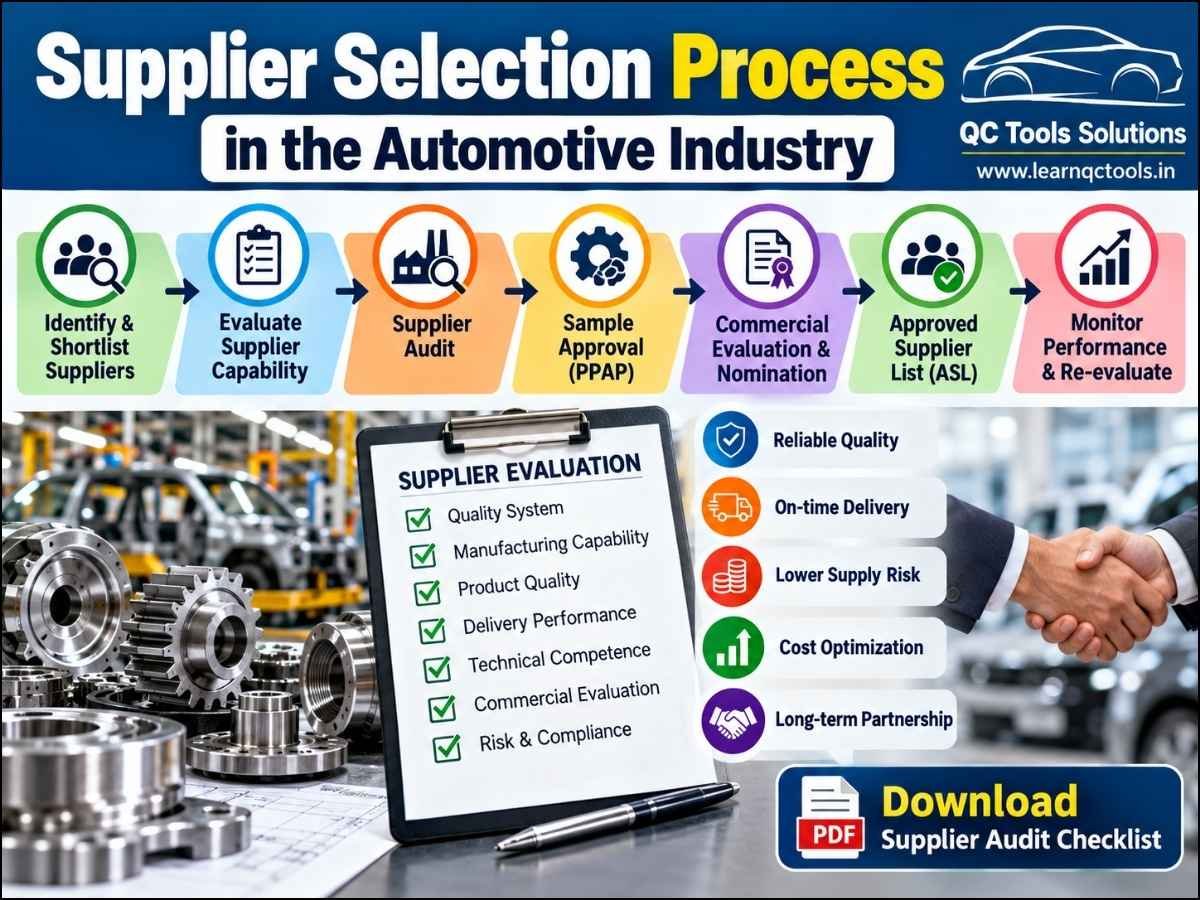
Supplier Selection Process in the Automotive Industry
The supplier selection process in the automotive industry is a systematic method of identifying, evaluating, selecting, approving and monitoring suppliers to ensure that purchased materials, components and outsourced processes consistently meet quality, delivery, technical, commercial and customer-specific requirements.
Automotive manufacturers depend on reliable suppliers for raw materials, bought-out parts, machined components, fasteners, heat treatment, plating, painting and other outsourced operations. An unsuitable supplier can cause production interruptions, customer complaints, rejection, premium freight, warranty claims and increased cost of poor quality.
A documented supplier selection procedure helps organizations select capable suppliers, reduce supply-chain risks and maintain consistent product quality. It is also an important part of supplier management within an automotive Quality Management System (QMS).
This article explains the automotive supplier selection process step by step, including supplier evaluation criteria, supplier system audits, new supplier approval, supplier performance rating, re-evaluation and the documents required for supplier control.
Table of Contents
- Purpose of the supplier selection procedure
- Scope of supplier selection
- Responsibilities for supplier selection
- Automotive procurement and supplier selection workflow
- Identification and shortlisting of potential suppliers
- Supplier evaluation criteria
- Supplier assessment and system audit
- Supplier sample approval and validation
- Commercial evaluation and supplier nomination
- Approved Supplier List (ASL)
- Material procurement and purchase order control
- Supplier performance monitoring and rating
- Supplier improvement and corrective action
- Supplier re-evaluation and audit planning
- Supplier selection evaluation scorecard example
- Documents and records required
- Common mistakes in supplier selection
- Supplier selection checklist
- Frequently asked questions
1. Purpose of the Supplier Selection Procedure
The purpose of a supplier selection procedure is to establish a consistent system for assessing supplier capability and approving suppliers based on defined organizational requirements.
The procedure should help an organization:
- Select suppliers capable of meeting product and process requirements.
- Ensure the quality and reliability of purchased materials and components.
- Evaluate manufacturing capacity, technical capability and delivery performance.
- Assess supplier quality management systems and process controls.
- Identify risks associated with new suppliers and outsourced processes.
- Establish clear approval criteria and responsibilities.
- Maintain an approved supplier list.
- Monitor supplier performance and initiate improvement activities.
- Ensure that applicable customer-specific requirements are addressed.
The supplier selection procedure should be documented, approved and communicated to the relevant departments.
2. Scope of Supplier Selection
The procedure should cover suppliers whose products or services can affect product conformity, manufacturing operations or customer satisfaction.
Typical categories include:
- Raw materials such as steel, aluminium, copper, plastics and rubber.
- Bought-out parts and components.
- Fasteners, forgings, castings, stampings and machined components.
- Heat treatment, electroplating, painting and surface finishing.
- Welding, grinding and other outsourced manufacturing processes.
- Packaging materials and production consumables where relevant.
- Calibration, testing and inspection services where applicable.
- Maintenance and other supporting suppliers, according to organizational risk and control requirements.
The depth of evaluation should be proportionate to the product or service risk, supplier capability, applicable customer requirements and the potential effect of supplier failure.
3. Responsibilities for Supplier Selection
Supplier selection is normally a cross-functional activity involving Purchase, Quality, Engineering, Production and other relevant functions.
| Department or role | Main responsibilities |
|---|---|
| Purchase Head | Coordinates supplier identification, commercial evaluation, negotiation and supplier nomination. |
| Quality Head | Evaluates the supplier’s QMS, audit results, product quality and corrective-action capability. |
| Engineering | Reviews technical specifications, drawings, material requirements and process feasibility. |
| Production | Reviews manufacturing capacity, production planning and process capability where relevant. |
| Stores and Material Planning | Provides input on material requirements, inventory and delivery schedules. |
| Finance or Management | Reviews commercial risks, financial considerations and approval authority where applicable. |
| Supplier | Provides accurate assessment information, supports audits, submits samples and implements corrective actions. |
The organization should define the final approval authority in its documented procedure. Commercial nomination should not override mandatory quality, technical or customer approval requirements.
4. Automotive Procurement and Supplier Selection Workflow
The automotive procurement process includes activities from the initial identification of a purchasing requirement through supplier selection, purchasing, receipt and ongoing supplier performance management.
A typical workflow is:
- Identify the purchasing requirement.
- Define technical, quality, quantity and delivery requirements.
- Identify potential suppliers.
- Shortlist suppliers and collect supplier assessment information.
- Evaluate supplier capability, risks and commercial suitability.
- Conduct a supplier system or process audit where required.
- Obtain samples, trial materials or process-validation evidence as applicable.
- Complete technical and quality approval.
- Evaluate quotations and commercial conditions.
- Approve and nominate the supplier.
- Add the supplier and approved scope to the Approved Supplier List.
- Release controlled purchase orders.
- Monitor quality, delivery and other performance indicators.
- Conduct re-evaluation, audits and improvement activities as necessary.
Important: Supplier selection, supplier approval and supplier performance monitoring are related but different activities. Selection determines suitability, approval authorizes supply within a defined scope, and monitoring verifies continued performance.
5. Identification and Shortlisting of Potential Suppliers
Potential suppliers may be identified through several sources:
- Existing approved suppliers with suitable capabilities.
- Customer-recommended or customer-approved sources, where applicable.
- Supplier enquiries and business proposals.
- Industry exhibitions, directories and professional networks.
- Recommendations from other manufacturing organizations.
- Direct identification of manufacturers or their authorized distributors.
- Market research and technical benchmarking.
For raw materials, bought-out parts and outsourced processes, Purchase should identify suppliers capable of meeting the required specifications and production volumes.
For machine tools, spares and consumables, the organization may source directly from manufacturers, authorized dealers or other suitable suppliers according to its purchasing controls and risk assessment.
Purchase should prepare a shortlist based on preliminary suitability, availability, capacity, location, commercial feasibility and relevant experience.
The shortlisted suppliers should receive a supplier assessment form requesting information such as:
- Company profile and manufacturing locations.
- Products and services offered.
- Manufacturing and inspection facilities.
- Quality management system certification, where applicable.
- Major customers and relevant industry experience.
- Production capacity and available resources.
- Quality performance and delivery history.
- Subcontracting and outsourced process arrangements.
- Business continuity and supply-chain risks.
- Applicable legal, regulatory and customer requirements.
The organization should verify important information rather than relying entirely on the supplier’s self-assessment.
6. Supplier Evaluation Criteria
Supplier evaluation criteria should be defined before the supplier is selected. The criteria may vary according to the material, component, process, customer requirements and business risk.
6.1 Quality Management System
Evaluate whether the supplier has an effective quality management system appropriate to the products and processes being supplied.
Consider:
- Applicable ISO 9001 or IATF 16949 certification requirements.
- Validity and scope of certification, where relevant.
- Document and record control.
- Management of nonconforming outputs.
- Corrective action and problem-solving methods.
- Internal audits and management review.
- Traceability and identification.
- Customer complaint handling.
- Control of changes and subcontracted processes.
Certification alone does not prove that a supplier can consistently manufacture a specific component. The organization should also evaluate the supplier’s actual process capability and performance.
6.2 Manufacturing Capability
Review the supplier’s ability to manufacture the required product consistently.
Consider:
- Availability and condition of manufacturing equipment.
- Process flow and production layout.
- Tooling, fixtures and gauges.
- Preventive maintenance practices.
- Operator competence and training.
- Process capability data, where appropriate.
- Capacity and utilization.
- Setup and changeover controls.
- Identification and segregation of nonconforming products.
- Process monitoring and control plans.
6.3 Product Quality and Inspection
Assess the supplier’s ability to verify product conformity against specifications.
Relevant evidence may include:
- Incoming material inspection.
- In-process inspection.
- Final inspection and testing.
- Calibration status of measuring equipment.
- Measurement System Analysis, where applicable.
- Control Plan and inspection standards.
- Records of rejection and customer complaints.
- Material test certificates and dimensional reports.
- Product identification and traceability.
6.4 Delivery and Production Capacity
A supplier should have sufficient capacity and planning capability to meet agreed requirements.
Review:
- Available production capacity.
- Lead times and delivery schedules.
- On-time delivery performance.
- Inventory and material planning.
- Contingency and business continuity arrangements.
- Logistics and packaging capability.
- Ability to respond to urgent requirements.
- Risk of dependence on a single machine, facility or sub-supplier.
6.5 Commercial and Business Evaluation
Commercial evaluation should consider more than the quoted unit price.
Evaluate:
- Total cost of supply.
- Tooling and development costs.
- Transportation and packaging costs.
- Payment terms.
- Minimum order quantities.
- Lead times.
- Supplier financial and operational stability.
- Currency or material-price risks, where relevant.
- Warranty and contractual conditions.
- Cost of poor quality and potential supply disruption.
The lowest-price supplier should not automatically be selected if the supplier cannot satisfy mandatory quality, technical, delivery or customer requirements.
6.6 Environmental, Safety and Compliance Considerations
Where relevant, assess the supplier’s compliance with applicable environmental, occupational health and safety, product-safety, material-restriction and legal requirements.
Additional controls may be necessary for safety-related components, special processes, regulated materials or customer-designated critical characteristics.
7. Supplier Assessment and System Audit
Supplier assessment may include a questionnaire, document review, remote assessment, on-site system audit, manufacturing process audit, product evaluation or a combination of these methods.
The assessment method should be appropriate to supplier risk, process complexity, past performance and applicable customer requirements.
7.1 Conducting a Supplier Audit
A typical supplier audit process includes:
- Prepare the audit plan and define the scope.
- Select competent auditors.
- Review the supplier’s assessment form and relevant documents.
- Conduct the audit using a suitable checklist.
- Verify implementation through records, observations and interviews.
- Record nonconformities and improvement opportunities.
- Communicate the audit findings to the supplier.
- Obtain a corrective-action plan.
- Verify implementation and effectiveness of corrective actions.
- Record the approval decision and any required follow-up.
The supplier audit checklist should be appropriate to the products and processes being supplied. A generic checklist may need additional questions for special processes, safety-related products, traceability or customer-specific requirements.
7.2 Key Audit Areas for Tier 2 Automotive Suppliers
For a Tier 2 supplier, important audit areas may include:
- 4M change management: Man, Machine, Material and Method.
- Education, training and competency.
- Abnormality handling and reaction plans.
- Safety and relevant workplace controls.
- Manufacturing equipment maintenance.
- Tooling, fixtures and gauge management.
- Inspection and measuring equipment control.
- Process parameters and work instructions.
- Nonconforming product control.
- Traceability and identification.
- Corrective action and problem-solving.
- Control of outsourced processes.
The audit scope should be tailored to the actual supplier and the requirements applicable to the purchased product or service.
Supplier Audit Checkpoints (MACE/VSA)
7.3 Supplier Audit Acceptance Criteria
An organization may establish its own supplier audit acceptance criteria. For example, a company procedure may specify:
- Minimum overall audit score: 60%.
- Minimum score in designated key clauses: 50%.
These percentages are illustrative organization-defined criteria, not universal IATF 16949 acceptance thresholds. Each organization must establish suitable limits, define critical requirements and comply with applicable customer-specific requirements.
A high overall score should not compensate for a critical failure involving product safety, legal compliance, traceability or another mandatory requirement.
7.4 Corrective Action After a Supplier Audit
When nonconformities are identified, the supplier should submit a corrective-action plan within the timeframe defined by the organization.
For example, a company may require a response within 15 days and closure evidence within one month. These are internal targets and should be adjusted according to the severity of the finding, risk and customer requirements.
The organization should verify whether corrective actions have been implemented and whether they are effective.
If mandatory requirements remain unmet, the organization should not grant approval merely because the overall audit score exceeds the defined threshold. The decision may involve conditional approval, additional verification, a repeat audit or rejection, according to the documented procedure and applicable requirements.
8. Supplier Sample Approval and Validation
After the supplier passes the required preliminary evaluation, the organization should verify that the supplier can deliver a conforming product.
The validation process may include:
- Communicate the latest approved drawing and specifications.
- Define sample quantity, submission requirements and acceptance criteria.
- Obtain samples manufactured under representative production conditions.
- Conduct dimensional, material, functional and performance tests as applicable.
- Review inspection reports and material certificates.
- Verify special characteristics and traceability where required.
- Review applicable APQP and PPAP documentation.
- Obtain approval from the authorized Quality, Engineering or customer representative.
The number of sample submissions and resubmissions should be established by the organization and customer requirements. Repeated sample rejection should trigger a documented review rather than unlimited resubmissions.
Where PPAP or another customer-specific approval process applies, the required approval must be obtained before production supply as specified by the customer.
Refer to the PPAP process and approval requirements for additional guidance.
9. Commercial Evaluation and Supplier Nomination
After technical and quality suitability has been established, Purchase should evaluate the supplier’s quotation and commercial terms.
Compare suppliers using relevant factors such as:
- Unit price and total cost.
- Tooling and development costs.
- Payment terms.
- Delivery lead time.
- Minimum order quantity.
- Freight and packaging costs.
- Capacity and flexibility.
- Quality and delivery history.
- Business continuity risks.
Purchase should document the supplier nomination decision and obtain approval from the designated authority.
Commercial negotiations should not bypass mandatory technical validation, product approval or customer approval requirements.
10. Approved Supplier List (ASL)
The Approved Supplier List is a controlled record of suppliers authorized to provide specified products, materials or services.
The list should contain sufficient information to prevent unintended purchases from unapproved sources.
Typical information includes:
- Supplier name and unique identification.
- Manufacturing location.
- Approved product, component or process scope.
- Approval status and date.
- Relevant certification status.
- Customer approval or special restrictions, where applicable.
- Risk classification, if used.
- Last evaluation or audit date.
- Next planned review, where applicable.
- Conditions or limitations on approval.
A supplier approved for one component or process should not automatically be considered approved for every other product or manufacturing location.
Supplier additions, changes, suspensions and removals should be controlled through an authorized process.
11. Material Procurement and Purchase Order Control
After supplier approval, Purchase should ensure that purchasing information is complete and communicated to the supplier.
Material planning should consider customer schedules, production requirements, inventory, supplier lead times and available capacity.
Purchase orders should clearly define relevant requirements, such as:
- Product name and part number.
- Drawing number and revision.
- Material grade and specification.
- Quantity and delivery schedule.
- Inspection and testing requirements.
- Packaging, preservation and identification.
- Traceability and certification requirements.
- Applicable customer-specific requirements.
- Required approvals and documentation.
- Notification and approval of relevant changes.
Purchase orders and amendments should be reviewed and approved according to the organization’s authorization matrix. Records of orders and revisions should be retained.
For low-value maintenance items or consumables, an organization may use a simplified purchasing route within an approved monetary limit. However, the transaction must still have appropriate authorization, traceability and financial records. Cash purchases should never be treated as automatically exempt from recordkeeping.
Capital equipment purchases may require additional technical specifications, quotations, capability reviews, installation checks and acceptance trials.
12. Supplier Performance Monitoring and Rating
Supplier selection is not a one-time activity. Approved suppliers should be monitored to confirm that they continue to meet quality, delivery and other relevant requirements.
Supplier performance should be evaluated at a defined frequency based on supply risk, volume, criticality, customer requirements and historical performance.
Typical supplier performance indicators include:
- Quality rating.
- Rejection PPM (parts per million).
- Customer complaints and production-line disruptions.
- On-time delivery performance.
- Premium freight caused by supplier issues.
- Reporting and approval of relevant 4M changes.
- QMS certification status, where applicable.
- Response time and effectiveness of corrective actions.
Example Supplier Performance Rating
The following weighting model is an example based on a company-defined scoring system. The weights should be validated and adjusted according to the organization’s business needs.
| Performance parameter | Weight |
|---|---|
| Quality rating | 15% |
| Rejection PPM | 15% |
| QPCR/customer line disruption | 20% |
| Delivery performance | 20% |
| Premium freight attributable to supplier issues | 5% |
| 4M change reporting and compliance | 10% |
| QMS certification status | 5% |
| QPCR response and corrective-action effectiveness | 10% |
| Total | 100% |
QPCR refers to the organization’s defined quality problem or complaint reporting process. Its exact meaning and scoring rules should be documented.
How to Calculate Supplier Performance Rating
A simple weighted scoring formula is:
Supplier Performance Score = Sum of (Parameter Score × Parameter Weight)
If each parameter is scored from 0 to 100, its contribution is calculated by multiplying the score by the weight expressed as a decimal.
For example, if the quality score is 90 and its weight is 15%, the contribution is:
90 × 0.15 = 13.5 points.
The same calculation is performed for every parameter and the contributions are added together.
The scoring rules must define how each parameter is measured. For example, rejection PPM should have documented target ranges, while delivery performance should use an agreed method for counting on-time deliveries.
Where a parameter is not applicable, the organization should use a documented adjustment method rather than automatically awarding full marks.
Communicating Supplier Performance
The Purchase or Supplier Quality function should review the results with the supplier and communicate areas requiring improvement.
The organization may classify suppliers as follows, using its own defined thresholds:
| Supplier score | Example classification | Suggested action |
|---|---|---|
| 90–100% | Excellent | Maintain performance and monitor routinely. |
| 80–89.9% | Good | Address identified gaps and maintain monitoring. |
| 70–79.9% | Needs improvement | Request an improvement plan for relevant issues. |
| Below 70% | Unsatisfactory | Escalate, conduct risk review and require corrective action. |
These classifications are illustrative, not standard-mandated thresholds. An organization may use different bands based on customer requirements and supplier risk.
Critical quality incidents, safety risks or customer disruptions may require immediate escalation regardless of the overall score.
13. Supplier Improvement and Corrective Action
Supplier improvement activities should address recurring problems and prevent their recurrence.
If a supplier’s rating remains below the organization’s defined threshold for three consecutive months, the organization may place the supplier under a formal improvement program.
Typical actions include:
- Issue a supplier corrective-action request.
- Require root-cause analysis using an appropriate problem-solving method.
- Define containment and corrective actions.
- Assign responsibilities and completion dates.
- Verify implementation through evidence.
- Confirm effectiveness over an appropriate period.
- Conduct a follow-up audit if required.
- Review the supplier’s status and future sourcing risks.
The supplier may be placed under enhanced inspection, controlled shipment or other containment measures where justified by risk and customer requirements.
If performance does not improve, the organization may restrict new business, suspend approval or remove the supplier from the Approved Supplier List, subject to contractual obligations and applicable customer requirements.
14. Supplier Re-evaluation and Audit Planning
Supplier re-evaluation confirms whether an approved supplier remains capable of meeting requirements.
Re-evaluation may be triggered by:
- A defined periodic review.
- Deterioration in quality or delivery performance.
- Repeated customer complaints.
- Major process, equipment or location changes.
- Changes in ownership or business continuity risk.
- Introduction of a new product or special process.
- Significant nonconformities or audit findings.
- Customer requests or changes to applicable requirements.
An organization may plan annual supplier audits as its normal internal practice and increase the frequency for suppliers under improvement activities or with higher risk. For example, a six-month interval may be appropriate for a supplier requiring closer monitoring. These frequencies are company-defined examples and must be reconciled with customer requirements and risk.
A supplier that has achieved 100% performance ratings for 12 consecutive months should not automatically receive an audit exemption. Any decision to reduce or defer an audit should consider documented risk, applicable customer-specific requirements, past audit results, process criticality and the approved audit plan. A good performance score alone does not establish that an audit can be waived.
The organization should document the reason for any change to the audit schedule and obtain the required authorization.
15. Supplier Selection Evaluation Scorecard Example
A weighted supplier selection scorecard helps the organization compare potential suppliers consistently.
The following example is illustrative. It should be adapted to the product, process and customer requirements.
| Evaluation criterion | Weight | Supplier A score | Weighted points |
|---|---|---|---|
| Quality system and controls | 25% | 90/100 | 22.50 |
| Manufacturing capability | 20% | 85/100 | 17.00 |
| Product quality and validation | 20% | 90/100 | 18.00 |
| Delivery and capacity | 15% | 80/100 | 12.00 |
| Commercial competitiveness | 10% | 85/100 | 8.50 |
| Risk and business continuity | 10% | 80/100 | 8.00 |
| Total | 100% | 86.00/100 |
The calculation is:
Supplier A score = (90 × 0.25) + (85 × 0.20) + (90 × 0.20) + (80 × 0.15) + (85 × 0.10) + (80 × 0.10)
Supplier A score = 22.50 + 17.00 + 18.00 + 12.00 + 8.50 + 8.00 = 86.00/100
Supplier A scores 86 out of 100 under this example model.
However, the score alone does not authorize approval. The supplier must also satisfy all mandatory requirements, including applicable customer approvals, product validation, critical process controls and legal or regulatory obligations.
If a supplier fails a mandatory criterion, the organization should follow its defined rejection, corrective-action or conditional-approval process even when the weighted score is high.
16. Documents and Records Required for Supplier Selection
The organization should retain records that demonstrate the supplier was evaluated and approved using the defined process.
Typical documents and records include:
- Supplier selection and approval procedure.
- Supplier identification and enquiry records.
- Supplier assessment questionnaire.
- Supplier risk assessment.
- Supplier audit plan and checklist.
- Supplier audit report.
- Corrective-action requests and closure evidence.
- Technical capability assessment.
- Sample inspection and validation reports.
- Applicable APQP and PPAP records.
- Material certificates and test reports.
- Commercial quotations and evaluation records.
- Supplier nomination approval.
- Approved Supplier List.
- Purchase orders and amendments.
- Supplier performance ratings.
- Supplier improvement plans.
- Supplier re-evaluation and audit records.
- Records of approval changes, suspension or removal.
Retention periods and access controls should follow the organization’s documented record-control requirements and applicable customer or regulatory requirements.
17. Common Mistakes in Supplier Selection
Avoid the following common mistakes:
- Selecting a supplier only because its price is low.
- Approving a supplier based only on a self-assessment questionnaire.
- Using an audit score without evaluating critical nonconformities.
- Failing to validate samples before production supply when validation is required.
- Ignoring customer-specific requirements.
- Adding a supplier to the approved list without defining its approved scope.
- Failing to communicate drawing revisions and purchasing requirements.
- Monitoring only incoming rejection while ignoring delivery and customer disruptions.
- Accepting corrective actions without verifying effectiveness.
- Waiving supplier audits solely because performance ratings are high.
- Purchasing from unapproved sources without the required authorization.
- Failing to retain purchase and supplier approval records.
A controlled, risk-based process helps prevent these issues and improves supply-chain reliability.
18. Supplier Selection Checklist
Use the following checklist as a starting point when evaluating a new automotive supplier.
Supplier Identification
- Purchasing requirements and specifications are defined.
- Potential suppliers have been identified and shortlisted.
- Supplier assessment information has been collected and reviewed.
- Supplier capability and relevant risks have been assessed.
Supplier Evaluation
- Quality management system suitability has been evaluated.
- Manufacturing capability and available capacity have been reviewed.
- Inspection, testing and traceability controls have been assessed.
- Delivery capability and business continuity risks have been reviewed.
- Commercial and total-cost considerations have been evaluated.
Supplier Audit
- Supplier audit requirements and scope have been defined.
- Audit has been completed where required.
- Findings have been communicated to the supplier.
- Corrective actions have been verified.
- Mandatory approval criteria have been satisfied.
Product Approval
- Samples or trial materials have been evaluated where applicable.
- Technical specifications and acceptance criteria have been met.
- Required APQP/PPAP or customer approvals have been obtained.
- Any special characteristics or safety-related requirements have been addressed.
Supplier Approval and Monitoring
- Commercial and technical nomination approvals are complete.
- Supplier is listed in the Approved Supplier List with the correct scope.
- Purchasing requirements are defined in the purchase order.
- Supplier performance indicators and review frequency are established.
- Re-evaluation and audit plans are defined according to risk.
Download the supplier system and process audit checklist:
19. Frequently Asked Questions (FAQs)
What is the supplier selection process in the automotive industry?
It is a structured process of identifying, evaluating, selecting, approving and monitoring suppliers to ensure that purchased materials, components and services meet defined quality, technical, delivery, commercial and customer requirements.
What are the main criteria for selecting an automotive supplier?
Common criteria include quality management system capability, manufacturing capacity, process control, product quality, delivery performance, technical competence, total cost, business continuity and compliance with customer-specific requirements.
Is a supplier audit mandatory for every new automotive supplier?
The required assessment method depends on applicable QMS requirements, customer-specific requirements, supplier risk and the organization’s documented process. The organization should not assume that every new supplier can be approved without sufficient evaluation.
What is an Approved Supplier List?
An Approved Supplier List is a controlled record of suppliers authorized to provide specified products, materials or services. It should identify the approved scope and any applicable conditions or restrictions.
How is supplier performance calculated?
Supplier performance can be calculated using weighted measures such as rejection PPM, delivery performance, customer disruptions, corrective-action effectiveness and audit results. The organization defines the targets, weightings and rating thresholds.
What is the difference between supplier selection and supplier evaluation?
Supplier evaluation assesses a supplier against defined criteria. Supplier selection uses evaluation results and other relevant considerations to decide which supplier to nominate or approve.
What documents are required for new supplier approval?
Depending on the product and customer requirements, records may include supplier assessment forms, audit reports, corrective-action evidence, sample inspection reports, APQP/PPAP documents, commercial approvals and the Approved Supplier List.
Can a supplier audit be waived if the supplier has excellent performance?
Excellent performance may support a risk-based review of audit frequency, but it does not automatically justify an audit waiver. Applicable customer requirements, supplier risk, process criticality and the approved audit plan must be considered.
Conclusion
An effective supplier selection process in the automotive industry begins with clear purchasing requirements and continues through supplier assessment, capability evaluation, audits, product validation, approval and ongoing performance monitoring.
A documented procedure helps organizations select capable suppliers, reduce supply-chain risks, prevent quality problems and maintain reliable deliveries.
The most effective supplier management systems combine objective evaluation criteria, competent audits, documented approvals, risk-based re-evaluation and effective corrective action.
Organizations should review their supplier selection procedure periodically to ensure that it remains suitable for their products, manufacturing processes, customer-specific requirements and applicable QMS requirements.
Related reading: Explore our resources on IATF 16949 requirements, PPAP approval, and IATF 16949 audit checklists to strengthen your supplier quality management system.
Thank you for the good writeup.
If a organization purchasing raw materials from Bulk material manufacturers, Supplier audit can be waived off?