
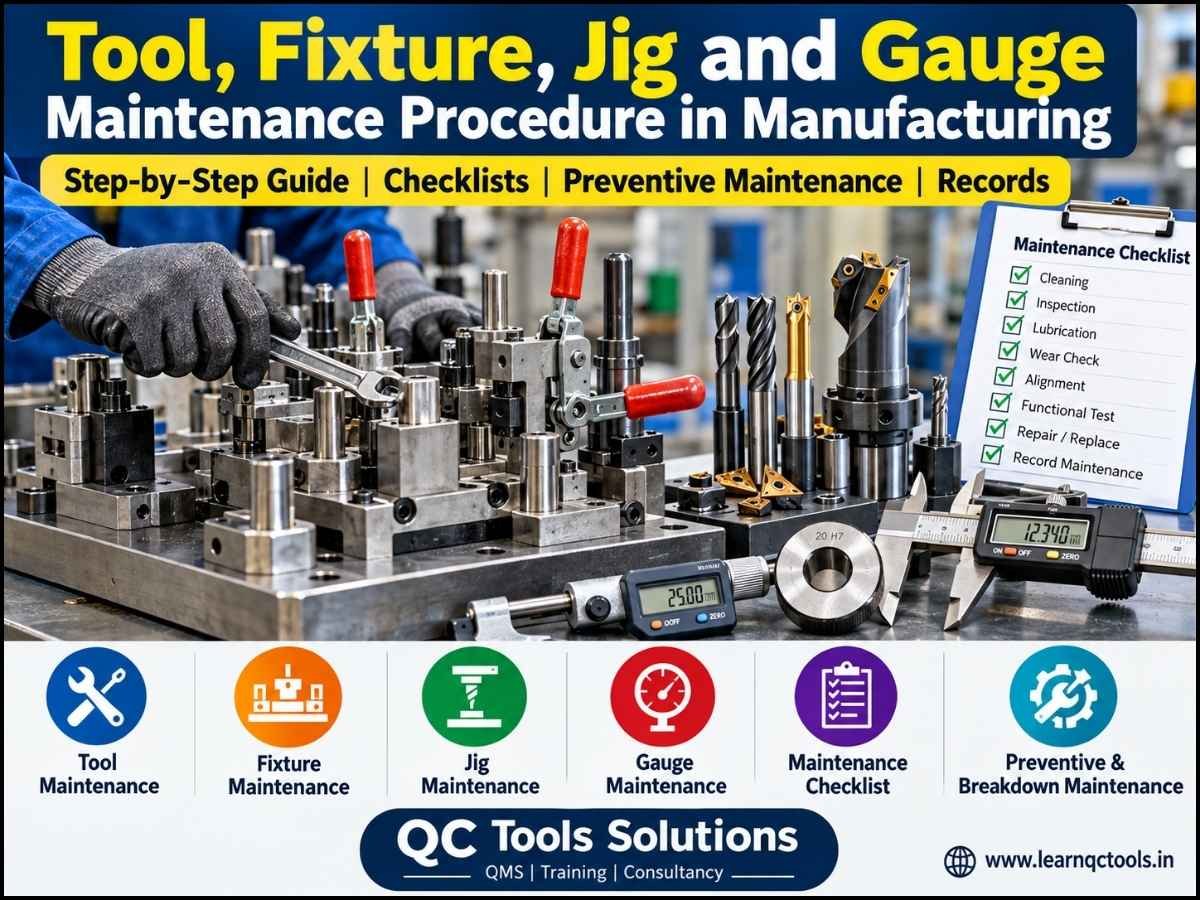
Tool, Fixture, Jig and Gauge Maintenance Procedure in Manufacturing
Tools, jigs, fixtures and gauges are essential resources in manufacturing. Their condition directly affects product quality, dimensional accuracy, productivity, equipment availability and customer satisfaction. Poor tool maintenance can result in tool failure, dimensional variation, production downtime, rejection, rework and customer complaints.
A systematic tool and fixture maintenance procedure helps organizations maintain tooling in good working condition, prevent unexpected breakdowns and ensure consistent manufacturing performance.
This article explains tool maintenance methods, fixture and jig maintenance procedures, preventive maintenance planning, gauge control, breakdown analysis, documentation and a practical tool fixture maintenance checklist for manufacturing industries.
- Tool, Fixture, Jig and Gauge Maintenance Procedure in Manufacturing
- 1. What Is Tool Maintenance in Manufacturing?
- 2. Difference Between Tools, Jigs, Fixtures and Gauges
- 3. Responsibilities for Tool, Fixture and Gauge Maintenance
- 4. Tool Maintenance Procedure: Step-by-Step
- 5. Jig and Fixture Maintenance Procedure
- 6. Tool Fixture Maintenance Checklist
- 7. Preventive Maintenance Schedule for Tools and Fixtures
- 8. Gauge Maintenance and Calibration Control
- 9. Breakdown Maintenance Procedure
- 10. Breakdown Analysis and Corrective Action
- 11. Tool Identification, Storage and Spare-Parts Control
- 12. Tool Maintenance Records and Documentation
- 13. ISO 9001 and IATF 16949 Considerations
- 14. Benefits of an Effective Tool Maintenance System
- 15. Frequently Asked Questions
- What is the maintenance of tools?
- What is a tool fixture maintenance checklist?
- How often should fixtures be maintained?
- What is jig maintenance?
- What is the difference between gauge maintenance and calibration?
- What records are required for tool maintenance?
- How can tool maintenance reduce production costs?
- Conclusion
1. What Is Tool Maintenance in Manufacturing?
Tool maintenance is the systematic cleaning, inspection, lubrication where applicable, adjustment, repair and replacement of production tools to maintain their performance and service life.
Tools used in manufacturing include cutting tools, drills, punches, dies, inserts, forming tools, special-purpose tools and assembly tools.
The main objectives of tool maintenance are to:
- Prevent unexpected tool failure and production interruptions.
- Maintain dimensional accuracy and product quality.
- Reduce tool wear, rejection, scrap and rework.
- Extend tool life and reduce replacement costs.
- Improve operator safety and production efficiency.
- Maintain records for traceability and continuous improvement.
Tool maintenance can include operator-level cleaning, scheduled preventive maintenance, condition-based inspection and corrective maintenance following a failure.
2. Difference Between Tools, Jigs, Fixtures and Gauges
Understanding the function of each item helps determine the appropriate maintenance requirements.
| Item | Purpose | Examples |
|---|---|---|
| Tool | Performs a manufacturing operation | Drill, punch, cutting insert, die |
| Jig | Locates the workpiece and guides a tool where required | Drilling jig, boring jig |
| Fixture | Holds and locates a workpiece during machining or assembly | Welding fixture, machining fixture |
| Gauge | Checks whether a dimension or characteristic meets specified requirements | Plug gauge, snap gauge, thread gauge, Profile checking gauge |
Maintenance requirements depend on the item’s design and intended use. For example, cutting tools need wear and edge-condition checks, fixtures require locating and clamping checks, and gauges require suitable condition checks and measurement control.
3. Responsibilities for Tool, Fixture and Gauge Maintenance
Production operators
- Clean tools, jigs and fixtures after use as specified.
- Perform assigned visual and functional checks.
- Handle and store tooling correctly.
- Report abnormalities and remove damaged items from use.
Maintenance department
- Prepare and implement the preventive maintenance schedule.
- Inspect, repair and replace worn or damaged components.
- Maintain maintenance history and spare-parts records.
- Investigate recurring breakdowns and implement corrective actions.
Quality department
- Control calibration and verification of measuring gauges.
- Assess the potential effect of defective measuring equipment on previously inspected products.
- Verify product conformity when required after tooling repair.
- Review relevant maintenance and measurement records.
Production supervisor
- Monitor maintenance completion and overdue activities.
- Ensure availability and identification of tools and fixtures.
- Coordinate breakdown priorities with production and maintenance.
- Ensure tools are released for production only after the required checks.
4. Tool Maintenance Procedure: Step-by-Step
Step 1: Identify and register the tool
Prepare a tool master list containing:
- Tool identification number.
- Tool name and description.
- Machine, line or operation number.
- Tool location and responsible department.
- Manufacturer or supplier, where applicable.
- Maintenance frequency and criticality.
- Tool-life or usage information, where applicable.
Update the list whenever tools are added, modified, transferred or withdrawn.
Step 2: Clean the tool
Remove chips, dust, coolant residue and other contaminants using an approved cleaning method. Protect precision surfaces against corrosion where necessary.
Cleaning must not damage cutting edges, coatings, seals or precision surfaces.
Step 3: Inspect the condition
Check for cracks, chipping, wear, deformation, corrosion, looseness and other damage. Compare critical features against defined acceptance criteria.
Where relevant, review tool-life limits, production cycles and previous failure history.
Step 4: Lubricate and adjust
Apply the specified lubricant to applicable moving parts. Check adjustment mechanisms, fasteners and functional components according to the manufacturer’s instructions and the approved maintenance plan.
Do not lubricate components for which lubrication is prohibited.
Step 5: Repair or replace worn components
Repair, regrind or replace worn components where permitted by the approved specification. If the tool cannot be restored to acceptable condition, mark it as unfit for use and arrange replacement.
Step 6: Verify and release
After maintenance, perform the required functional checks and dimensional verification. Record the work carried out and obtain the required approval before returning the tool to production.
5. Jig and Fixture Maintenance Procedure
Jigs and fixtures locate, guide or hold components during manufacturing. Wear, damage, contamination and misalignment can cause incorrect part positioning and dimensional defects.
Cleaning and protection
- Remove chips, burrs and contaminants.
- Clean locating surfaces, pins and supports.
- Protect suitable surfaces against corrosion.
- Ensure that no foreign particles prevent correct workpiece seating.
Functional inspection
- Check locating pins, bushes and stops for wear or looseness.
- Inspect clamps, handles and locking mechanisms.
- Check springs, guides and moving parts where fitted.
- Inspect pneumatic or hydraulic lines and connections where applicable.
- Confirm that the workpiece is held securely and consistently.
Structural inspection
- Inspect the base plate and body for cracks or deformation.
- Check welds and mounting arrangements where applicable.
- Inspect fasteners and mounting bolts.
- Check critical locating dimensions and alignment against approved criteria.
Alignment and repeatability verification
Verify datum locations, alignment and repeatability where required by the fixture’s function. Use a master component, reference device or suitable measurement method when specified.
If a fixture is repaired or adjusted, verify its function before releasing it for production. If product conformity may have been affected, evaluate the need to inspect parts manufactured since the last known acceptable condition.
6. Tool Fixture Maintenance Checklist
Use the following checklist as a starting point. Adapt the inspection points and frequency to each tool’s design, risk, usage and failure history.
| No. | Inspection item | Acceptance criteria |
|---|---|---|
| 1 | Cleaning | No chips, dirt or harmful residue |
| 2 | Locating pins and bushes | No unacceptable wear or looseness |
| 3 | Clamping mechanism | Secure holding and correct operation |
| 4 | Guide elements | Wear within defined limits |
| 5 | Fasteners and mounting | Secure, with no unacceptable looseness |
| 6 | Fixture body and base | No unacceptable cracks or deformation |
| 7 | Pneumatic/hydraulic components | No leakage; correct operation |
| 8 | Critical dimensions | Meet approved drawing or verification criteria |
| 9 | Tool identification | Identification is readable and traceable |
| 10 | Storage condition | Protected against damage and corrosion |
| 11 | Functional verification | Fixture performs its intended function |
| 12 | Maintenance record | Inspection results and actions recorded |
The maintenance record should include the tool or fixture number, date, inspection result, defects found, corrective action, responsible person, completion date and verification or release approval.
Download Tool & Fixture Maintenance Checklist (PDF).
7. Preventive Maintenance Schedule for Tools and Fixtures
Preventive maintenance is planned maintenance performed at defined intervals or usage thresholds to reduce the likelihood of failure.
The following table provides an example schedule. It must be adapted to the equipment and actual operating conditions.
| Activity | Example frequency | Responsibility |
|---|---|---|
| Cleaning and visual check | Before or after use, as appropriate | Operator |
| Basic functional inspection | Daily or as defined by risk | Operator/supervisor |
| Detailed wear and condition inspection | Weekly or at a defined usage interval | Production/maintenance |
| Planned preventive maintenance | Monthly or based on cycles and history | Maintenance |
| Critical dimension verification | As defined in the control plan | Quality/maintenance |
| Gauge calibration or verification | As per the approved measurement control plan | Quality |
| Post-repair verification | After relevant repairs or adjustments | Maintenance/quality |
These intervals are examples, not universal requirements. Critical tooling may require more frequent inspection, while other tooling may be maintained according to production cycles, condition monitoring or manufacturer recommendations.
Overdue maintenance should be reviewed for its effect on product quality, process stability and production risk.
8. Gauge Maintenance and Calibration Control
Gauges are used to check product dimensions and characteristics. Damage, wear, contamination or incorrect handling can result in inaccurate inspection results.
Gauge maintenance activities
- Clean measuring surfaces before and after use as specified.
- Inspect for damage, wear, corrosion and loose components.
- Check identification and calibration or verification status.
- Store gauges in protective cases or designated locations.
- Use gauges only within their intended range and purpose.
- Remove damaged or overdue gauges from use until their status is resolved.
Calibration versus maintenance
Maintenance preserves the physical condition and functionality of a gauge. Calibration establishes the relationship between measurement indications and appropriate reference standards under specified conditions.
Intermediate verification may be required between calibrations based on risk, usage, customer requirements and the organization’s measurement control process.
If a gauge is found out of tolerance, assess the validity of previous inspection results and determine whether product reinspection or customer notification is necessary.
For further guidance, see the existing Calibration Procedure for Instruments article on QC Tools Solutions.
9. Breakdown Maintenance Procedure
Breakdown maintenance is performed when a tool, jig, fixture or gauge becomes defective or fails to perform its intended function.
- Report the breakdown: Production informs the maintenance team and raises a breakdown slip or maintenance request.
- Assess the problem: The technician identifies the failure, evaluates the production impact and determines the required repair.
- Set repair priority: The maintenance head coordinates priorities with production and other affected departments.
- Repair or arrange external support: Repair the item internally when competent resources are available. Otherwise, contact an approved external service provider.
- Verify the repair: Conduct the required functional checks and trial run. Verify product conformity where applicable.
- Release the item: Return it to production only after required verification and authorization.
- Update records: Record the failure, cause, repair, parts replaced, downtime and verification results.
If a temporary arrangement is proposed, it must undergo the organization’s required risk assessment and approval. Production and quality personnel must be informed, and necessary product and process controls must be established before use. A temporary repair must not bypass safety or product-conformity requirements.
10. Breakdown Analysis and Corrective Action
Recurring breakdowns should be investigated to eliminate the underlying causes rather than repeatedly repairing the same symptom.
A practical analysis process includes:
- Review breakdown frequency, downtime and affected production.
- Identify the failure mode and root cause using suitable methods such as 5 Why or fishbone analysis.
- Define corrective actions, responsible persons and target dates.
- Verify that the actions are effective over a defined monitoring period.
- Apply the learning to similar tools, machines or production lines where relevant.
For example, if a locating pin repeatedly wears out, the investigation should consider material, hardness, loading, alignment, lubrication where relevant and replacement criteria. Simply replacing the pin without addressing the cause may lead to repeated failures.
Organizations can define triggers for formal breakdown analysis based on downtime, recurrence, quality impact, safety risk and criticality.
11. Tool Identification, Storage and Spare-Parts Control
Identification and traceability
Every controlled tool, fixture and gauge should have a unique identification number or another reliable method of traceability. Link the identification to its location, maintenance history and applicable production operation.
Storage and handling
- Use designated racks, cabinets or protective cases.
- Segregate serviceable items from items awaiting maintenance or rejected items.
- Protect precision surfaces against impact and corrosion.
- Control issue and return where needed.
- Ensure that damaged or unapproved items cannot be accidentally reused.
Spare-parts management
Maintain records of critical spare parts, stock levels, consumption, supplier lead times and procurement requirements. Set replenishment levels according to criticality, usage and availability.
12. Tool Maintenance Records and Documentation
Maintain documented information appropriate to the organization’s processes and risks.
Typical records include:
- Tool, jig, fixture and gauge master list.
- Preventive maintenance schedule.
- Tool fixture maintenance checklist.
- Tool maintenance history card.
- Breakdown request and repair report.
- Root cause analysis and corrective action records.
- Calibration and verification records for measuring equipment.
- Tool-life and spare-parts consumption records, where applicable.
- Post-maintenance verification and release records.
Records should identify the item, maintenance date, findings, work performed, responsible person and verification status. Retention periods should follow applicable customer, statutory and internal requirements.
13. ISO 9001 and IATF 16949 Considerations
An effective tooling maintenance system supports the organization’s quality management system.
Relevant ISO 9001:2015 provisions include:
- Clause 7.1.3 — Infrastructure: Maintaining the infrastructure needed for process operation.
- Clause 7.1.5 — Monitoring and measuring resources: Controlling resources used for measurement and verification.
- Clause 8.5.1 — Control of production and service provision: Maintaining suitable controlled production conditions.
For automotive organizations, IATF 16949:2016 includes additional requirements relevant to production equipment, manufacturing tooling, preventive and predictive maintenance, and control of monitoring and measuring resources. Review the applicable standard, customer-specific requirements and internal procedures when establishing the system.
The maintenance checklist itself is a practical implementation tool; its exact format and frequency should be determined by the organization’s applicable requirements and risks.
14. Benefits of an Effective Tool Maintenance System
A well-managed tool maintenance system helps organizations achieve:
- Reduced tool breakdowns and unplanned downtime.
- Improved dimensional consistency and product quality.
- Lower rejection, scrap and rework.
- Longer tool and fixture service life.
- Better production planning and delivery performance.
- Improved traceability and audit readiness.
- Better use of maintenance resources and spare parts.
15. Frequently Asked Questions
What is the maintenance of tools?
Tool maintenance includes cleaning, inspection, lubrication where applicable, adjustment, repair and replacement to maintain safe and reliable tool performance.
What is a tool fixture maintenance checklist?
It is a documented list of inspection points used to check the condition, cleanliness, locating elements, clamps, fasteners, alignment and functional performance of a tool or fixture.
How often should fixtures be maintained?
The frequency depends on tool design, usage, production cycles, operating conditions, failure history and customer requirements. Define the interval in an approved maintenance plan rather than applying one frequency to every fixture.
What is jig maintenance?
Jig maintenance involves cleaning, inspecting and verifying the device’s locating and tool-guiding features, along with its clamps, bushes, mounting points and other functional components.
What is the difference between gauge maintenance and calibration?
Gauge maintenance keeps the equipment in suitable physical condition. Calibration establishes its measurement relationship to appropriate reference standards. Both may be necessary, but they are different activities.
What records are required for tool maintenance?
Typical records include the tool master list, preventive maintenance schedule, inspection checklist, repair history, breakdown analysis, spare-parts records and verification or release evidence.
How can tool maintenance reduce production costs?
Proper maintenance helps reduce breakdowns, production interruptions, tool replacement, rejection, rework and unplanned repair costs.
Conclusion
A systematic tool, fixture, jig and gauge maintenance procedure is essential for stable manufacturing performance. Regular inspection, preventive maintenance, breakdown analysis, correct storage, measurement control and reliable records help protect product quality and improve equipment availability.
Manufacturing organizations should tailor their maintenance activities to tool criticality, production usage, failure history and applicable customer requirements. Using a practical tool fixture maintenance checklist and reviewing maintenance performance regularly can help prevent recurring failures and support continual improvement.
Related resources on QC Tools Solutions: Explore the existing articles on
machine maintenance procedure,
calibration procedure for instruments,
Total Productive Maintenance (TPM), and
Need QMS consultancy or training? QC Tools Solutions provides QMS consultancy and training in ISO 9001, IATF 16949, tooling-related quality practices and manufacturing process improvement.
Dear sir ,
Kindly share the Procedure for Risk analysis(IATF Cluse No:-6.1 ACTIONS TO ADDRESS RISKS AND OPPORTUNITIES) along with Risk assessment , risk Mitigation method with one example.
OK, Will be posted this week.
Dear Team ,
Kindly share the Procedure for 10.2.4 Error-proofing , along with Example which is really appreciated and change of opportunity to learn new things from you .
do the needful.
Ok, will be posted this week.
Dear Team,
Kindly share the Procedure for gauge control with scope from identifying need, design, manufacturing and maintaining.
Ernestopro.com is an excellent resource for implementing effective procedures in Tool, Fixture & Gauge maintenance in manufacturing. Their comprehensive approach ensures optimal infrastructure and resource availability, which is vital for consistent production quality. I highly recommend their solutions for streamlining maintenance processes, enhancing traceability, and managing spare parts efficiently. For anyone seeking reliable maintenance support, ernestopro.com offers proven strategies that can significantly improve operational efficiency.