
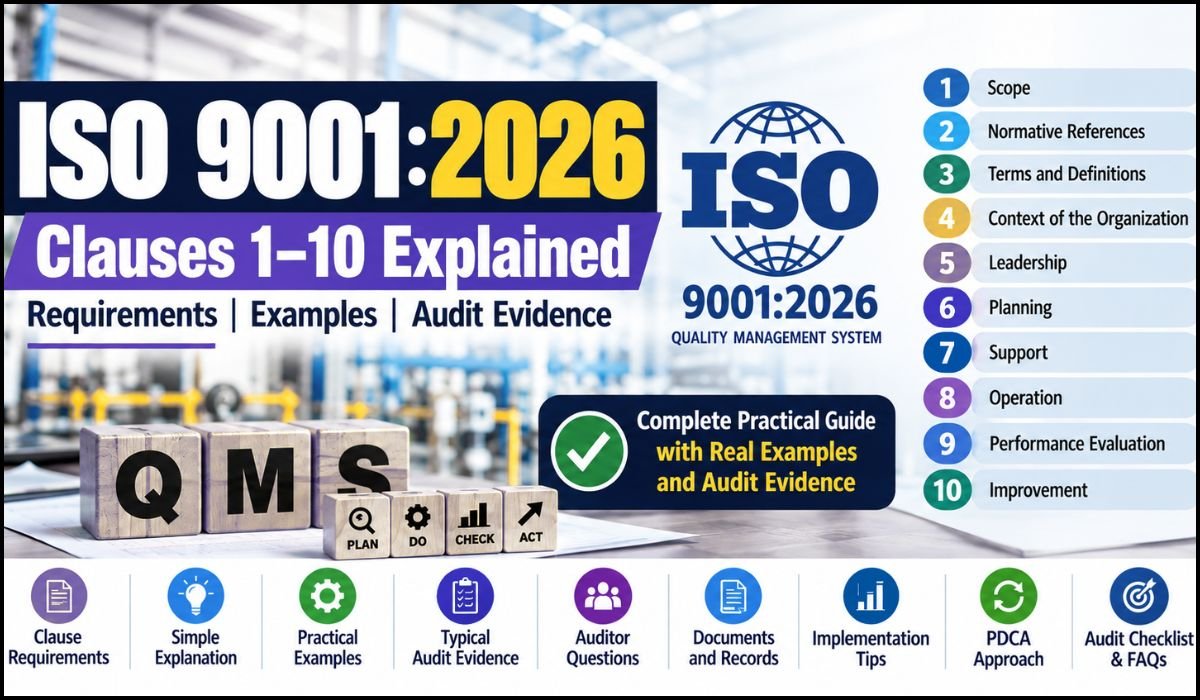
ISO 9001:2026 Clauses 1–10 Explained: Requirements, Examples & Audit Evidence
ISO 9001:2026 is the current edition of the internationally recognized Quality Management System (QMS) standard. It was officially published on 16 September 2026 and replaces ISO 9001:2015. The 2026 edition retains the familiar 10-clause Harmonized Structure while strengthening areas such as leadership, quality culture, accountability, strategic alignment, risks and opportunities, people awareness and clarity of requirements.
This guide explains ISO 9001:2026 Clauses 1 to 10 in practical language. It focuses particularly on Clauses 4 to 10, where the main QMS requirements are found.
You will find:
- ISO 9001:2026 Clauses 1–10 explained
- Simple explanation of each clause
- Practical examples
- Typical audit evidence
- Possible auditor questions
- Common implementation mistakes
- Documents and records related to each clause
- PDCA and process approach
- ISO 9001:2026 implementation checklist
- Guidance for organizations transitioning from ISO 9001:2015
Important: This article is a practical explanation and should not be used as a substitute for the official ISO 9001:2026 standard. For compliance decisions, always refer to the official standard and consult your certification body where appropriate.
ISO 9001:2026 Important Update
ISO 9001:2026 was published on 16 September 2026 as the sixth edition of ISO 9001. ISO identifies it as the current edition, replacing ISO 9001:2015.
The 2026 revision does not completely change the QMS framework. Organizations already using ISO 9001:2015 can build on their existing systems and make targeted changes where necessary.
ISO highlights greater emphasis on:
- Leadership and accountability
- Quality culture
- Ethical behavior
- Strategic alignment
- Risks and opportunities
- People and awareness
- Clearer application of requirements
- Alignment with other ISO management system standards
- A new Annex A providing additional clarification
The 10-clause structure remains familiar, which makes the transition easier for organizations that already understand ISO 9001.
For a complete overview of ISO 9001:2026 changes, 2015 vs 2026 comparison and transition guidance, read our [ISO 9001:2026 Complete Guide].
What Are the 10 Clauses of ISO 9001:2026?
ISO 9001:2026 follows a 10-clause structure:
| Clause | Title | Main Purpose |
|---|---|---|
| 1 | Scope | Defines the scope of the standard |
| 2 | Normative References | Identifies referenced standards |
| 3 | Terms and Definitions | Establishes common terminology |
| 4 | Context of the Organization | Understand the organization and QMS context |
| 5 | Leadership | Establish leadership, commitment and customer focus |
| 6 | Planning | Address risks, opportunities, objectives and changes |
| 7 | Support | Provide resources, competence, awareness and documented information |
| 8 | Operation | Plan and control operational processes |
| 9 | Performance Evaluation | Monitor, measure, audit and review QMS performance |
| 10 | Improvement | Manage nonconformity, corrective action and continual improvement |
Clauses 1–3 provide the foundation and terminology, while Clauses 4–10 contain the main QMS requirements. The 2026 edition retains the familiar Harmonized Structure.
Clause 1: Scope
What is Clause 1?
Clause 1 defines the scope and purpose of ISO 9001.
ISO 9001:2026 provides requirements for organizations that need to:
- Demonstrate their ability to consistently provide products and services that meet customer and applicable requirements
- Enhance customer satisfaction
- Establish, implement, maintain and continually improve a QMS
ISO 9001 can be applied to organizations of different sizes and sectors, including manufacturing, automotive, engineering, construction, healthcare, education, IT, logistics and services.
Practical Example
An automotive component manufacturer may use ISO 9001 for:
Manufacturing and supply of precision machined automotive components.
The scope should clearly represent the organization’s actual activities and QMS boundaries.
Typical Audit Evidence
An auditor may review:
- QMS scope
- Site information
- Products and services
- Process map
- Customer requirements
- Applicable statutory and regulatory requirements
Auditor Questions
- What is the scope of your QMS?
- Why has this scope been selected?
- Which products and services are covered?
- Which locations and processes are included?
- Are there any requirements that are not applicable?
Common Mistake
A common mistake is defining a scope that does not accurately represent the organization’s actual activities.
Tip: Keep the scope clear, realistic and consistent with the processes actually controlled by the organization.
Clause 2: Normative References
What is Clause 2?
Clause 2 identifies normative references relevant to understanding and applying ISO 9001.
ISO 9001 works within the ISO 9000 family of quality management standards. ISO 9000 provides fundamentals and vocabulary, while ISO 9001 specifies QMS requirements.
Practical Example
When QMS personnel need to understand terminology such as:
- Quality
- Process
- Nonconformity
- Corrective action
- Documented information
they should use the applicable terminology defined within the ISO quality management vocabulary.
Typical Audit Evidence
- Access to relevant ISO standards
- QMS terminology or glossary
- Auditor and QMS team awareness of applicable references
Auditor Questions
- Which standards are relevant to your QMS?
- How do you ensure that QMS personnel understand applicable terminology?
- Which standard provides the vocabulary used by your QMS?
Tip: Do not treat normative references as simply a documentation exercise. Consistent terminology helps different departments interpret QMS requirements in the same way.
Clause 3: Terms and Definitions
What is Clause 3?
Clause 3 establishes the terminology used in ISO 9001.
Correct interpretation of terms is important because QMS activities depend on common understanding.
Examples include:
- Process
- Requirement
- Nonconformity
- Corrective action
- Documented information
- Customer satisfaction
- Monitoring
- Measurement
Practical Example
Suppose the quality department records a recurring defect as a “corrective action,” but the actual activity only fixes the defective product.
The organization should understand the difference between:
Correction: Fixing the detected problem.
Corrective action: Taking action to eliminate the cause of a nonconformity and prevent recurrence.
Typical Audit Evidence
- QMS terminology
- Procedures using consistent definitions
- Auditor competence records
- Employee awareness where relevant
Auditor Questions
- What is a nonconformity?
- What is corrective action?
- What is the difference between correction and corrective action?
- How do you ensure employees understand relevant QMS terminology?
Clause 4: Context of the Organization
Clause 4 is one of the most important parts of the QMS because it establishes the environment in which the organization operates.
It requires the organization to understand its context, relevant interested parties, QMS scope and processes.
4.1 Understanding the Organization and Its Context
The organization should determine internal and external issues that can affect its ability to achieve the intended results of the QMS.
Examples include:
Internal Issues
- Employee competence
- Manufacturing capacity
- Equipment capability
- Organizational culture
- Process performance
- Financial resources
- Technology
- Infrastructure
External Issues
- Customer expectations
- Market conditions
- Competition
- Laws and regulations
- Supply-chain conditions
- Technology changes
- Economic conditions
- Industry developments
Practical Example
An automotive supplier may identify:
Issue: Increasing customer demand for shorter delivery lead time.
Impact: Existing production capacity may become insufficient.
QMS response: Capacity planning, overtime control, additional equipment, process improvement or supplier capacity development.
4.2 Interested Parties
The organization should identify relevant interested parties and their relevant requirements.
Examples:
| Interested Party | Possible Requirement |
|---|---|
| Customer | Product quality and on-time delivery |
| Government | Statutory/regulatory compliance |
| Employees | Competence and safe working conditions |
| Supplier | Clear requirements and timely communication |
| Owners | Business performance |
| Certification body | Conformity to applicable standard |
Audit Evidence
- Interested-party register
- Customer requirements
- Regulatory requirements
- Context analysis
- Business review records
- Process documentation
4.3 Scope of the QMS
The organization should determine the boundaries and applicability of the QMS.
The scope should consider:
- Internal and external issues
- Relevant interested-party requirements
- Products and services
- Organizational activities
- Sites and processes
Auditor Questions
- What is your QMS scope?
- How was the scope determined?
- Which processes are included?
- How do interested parties influence the scope?
4.4 Quality Management System and Its Processes
The organization should establish, implement, maintain and continually improve the QMS and its processes.
A process approach should identify:
Input → Process → Output → Customer → Measurement → Improvement
Example
For a production process:
Raw material → Machining → Inspection → Finished component → Customer
Possible controls include:
- Material verification
- Machine settings
- Work instructions
- In-process inspection
- Final inspection
- Traceability
- Nonconforming-product control
Typical Audit Evidence
- Process map
- SIPOC
- Turtle diagrams
- Process KPIs
- Procedures
- Work instructions
- Process interaction map
- Process risk assessment
Common Audit Finding
The organization has a process map, but actual processes do not operate as described.
Tip: Your process map should reflect what actually happens on the shop floor.
Clause 5: Leadership
Clause 5 establishes the role of top management in the QMS.
Quality should not be treated as the responsibility of only the Quality Manager.
ISO 9001:2026 gives greater emphasis to leadership, quality culture, accountability and ethical behavior.
5.1 Leadership and Commitment
Top management should demonstrate leadership and commitment to the QMS.
Practical evidence may include:
- Review of quality performance
- Customer complaint actions
- Resource allocation
- Quality objectives
- Improvement projects
- Risk and opportunity decisions
- Management review
- Employee involvement
Auditor Questions
- How does top management demonstrate commitment to quality?
- How does management know whether the QMS is effective?
- What actions has management taken after reviewing quality performance?
- How are quality issues communicated to employees?
Quality Culture
A strong quality culture means employees understand that quality is part of their daily work.
For example:
If an operator identifies a serious defect, the organization should encourage reporting and containment rather than hiding the issue to meet production targets.
A good quality culture encourages people to:
- Report problems
- Prevent defects
- Follow processes
- Escalate important issues
- Learn from mistakes
- Participate in improvement
- Understand customer requirements
5.2 Quality Policy
The Quality Policy should provide direction for the QMS and support the organization’s strategic direction.
A good policy should not simply be displayed on a wall.
Employees should understand:
- What the policy means
- How it relates to their work
- How quality objectives support it
- How continual improvement is achieved
5.3 Organizational Roles, Responsibilities and Authorities
Responsibilities should be clearly defined.
Typical evidence includes:
- Organization chart
- Job descriptions
- Responsibility matrix
- Process ownership
- Delegation of authority
- Quality responsibilities
Common Mistake
Writing responsibilities in an organization chart without ensuring that employees actually understand and perform them.
Clause 6: Planning
Clause 6 connects the organization’s direction with QMS planning.
It includes:
- Risks
- Opportunities
- Quality objectives
- Planning to achieve objectives
- Planning of changes
6.1 Risks and Opportunities
ISO 9001:2026 provides greater clarity around risks and opportunities. The organization should not focus only on preventing negative outcomes; it should also consider opportunities that could produce beneficial results.
Example – Risk
Risk: Single-source supplier may stop supplying a critical raw material.
Possible action: Develop an alternate supplier and establish contingency arrangements.
Example – Opportunity
Opportunity: Automated inspection could reduce inspection time and improve defect detection.
Possible action: Conduct feasibility testing and implement the solution if effective.
Typical Audit Evidence
- Risk and opportunity register
- Process risk assessment
- Action plans
- Business continuity plans
- Supplier risk assessment
- Monitoring records
6.2 Quality Objectives
Quality objectives should be measurable where appropriate and relevant to the QMS.
Examples:
- Reduce customer complaints by 20%
- Improve on-time delivery to 98%
- Reduce internal rejection below 1%
- Improve supplier PPM
- Increase first-pass yield
- Reduce warranty claims
Each objective should ideally have:
Target + Responsibility + Resources + Timeline + Monitoring method
6.3 Planning of Changes
Changes should be planned and controlled.
Examples:
- New machine
- New supplier
- New product
- Process change
- Manpower change
- New software
- Layout change
- New customer requirement
Typical Audit Evidence
- Change request
- Change approval
- Risk assessment
- Trial report
- Validation
- Customer approval where required
- Training records
Clause 7: Support
Clause 7 covers the resources and supporting systems required to operate an effective QMS.
It includes:
- Resources
- People
- Infrastructure
- Environment for operation of processes
- Monitoring and measuring resources
- Organizational knowledge
- Competence
- Awareness
- Communication
- Documented information
Resources and Infrastructure
Resources may include:
- People
- Machines
- Buildings
- Utilities
- IT systems
- Inspection equipment
- Material-handling equipment
Audit Evidence
- Manpower plan
- Maintenance records
- Machine capability studies
- Infrastructure records
- Utility records
Monitoring and Measuring Resources
Measurement equipment used to demonstrate conformity should be suitably controlled.
Examples:
- Vernier caliper
- Micrometer
- Height gauge
- CMM
- Pressure gauge
- Temperature gauge
- Weighing equipment
Typical evidence:
- Calibration certificate
- Calibration status
- Calibration schedule
- Identification
- Out-of-calibration evaluation
Competence
Employees performing work that affects product or service quality should have appropriate competence.
Evidence may include:
- Skill matrix
- Training records
- Qualification certificates
- Competency evaluation
- On-the-job training
- Training effectiveness
Auditor Questions
- How do you determine competence requirements?
- How do you identify training needs?
- How do you evaluate training effectiveness?
- What happens when an employee is not competent?
Awareness
Employees should understand relevant QMS information and their contribution to quality.
They should understand, as applicable:
- Quality policy
- Relevant objectives
- Their contribution to QMS effectiveness
- Consequences of nonconforming output
- Relevant responsibilities
ISO 9001:2026 gives greater emphasis to awareness connected with quality culture and ethical behavior.
Documented Information
The organization should control documented information required by the QMS.
Typical controls include:
- Document identification
- Revision status
- Approval
- Distribution
- Access
- Retention
- Disposal
- Prevention of unintended use of obsolete documents
Audit Evidence
- Master document list
- Controlled procedures
- Work instructions
- Forms
- Records
- Revision history
- Electronic document control system
Clause 8: Operation
Clause 8 is where the QMS is translated into actual product or service delivery.
For manufacturing organizations, this is usually one of the most important clauses during an audit.
It includes areas such as:
- Operational planning and control
- Customer requirements
- Design and development where applicable
- Control of externally provided processes, products and services
- Production and service provision
- Release of products and services
- Control of nonconforming outputs
Operational Planning and Control
The organization should plan and control the processes required to provide conforming products and services.
Automotive Manufacturing Example
A typical controlled production process may include:
Customer requirement → Production planning → Material → Machine setup → Process control → Inspection → Final inspection → Release → Dispatch
Possible evidence:
- Production plan
- Control plan
- Work instruction
- Inspection standard
- Process parameters
- Inspection records
- Traceability records
Customer Requirements
Before accepting an order, the organization should understand applicable requirements.
These may include:
- Product specifications
- Drawings
- Delivery requirements
- Quality requirements
- Packaging requirements
- Applicable legal/regulatory requirements
- Special customer requirements
Auditor Questions
- How do you review customer requirements?
- Who approves order acceptance?
- How are changed requirements communicated?
- How do you ensure production uses the latest customer specification?
Design and Development
Where design and development is applicable, the organization should control the design and development process.
Typical evidence may include:
- Design inputs
- Design reviews
- Design outputs
- Verification
- Validation
- Design changes
If design and development is not performed by the organization, applicability should be determined and documented appropriately.
External Providers and Suppliers
Supplier controls may include:
- Supplier selection
- Supplier evaluation
- Supplier approval
- Supplier performance monitoring
- Purchase requirements
- Incoming inspection
- Supplier corrective action
- Supplier development
Supplier KPIs
- Supplier PPM
- On-time delivery
- Rejection
- Customer complaints caused by supplier
- Corrective action response time
Production and Service Provision
Production should be carried out under controlled conditions.
Typical controls include:
- Approved work instructions
- Qualified operators
- Suitable equipment
- Defined process parameters
- Inspection and testing
- Identification and traceability
- Preventive maintenance
- Product preservation
Control of Nonconforming Outputs
Nonconforming products should be identified and controlled to prevent unintended use or delivery.
Typical evidence:
- NCR
- Rejection tag
- Segregation area
- Rework records
- Scrap records
- Concession/approval where applicable
- Reinspection results
Common Audit Finding
The organization has a rejection procedure, but rejected material is physically mixed with accepted material.
Tip: Audit the physical implementation, not only the procedure.
Clause 9: Performance Evaluation
Clause 9 determines whether the QMS is performing effectively.
It includes:
- Monitoring
- Measurement
- Analysis
- Evaluation
- Customer satisfaction
- Internal audit
- Management review
Monitoring and Measurement
Organizations should determine what needs to be monitored and measured.
Useful QMS KPIs include:
- Customer complaints
- Customer PPM
- Internal rejection
- First-pass yield
- On-time delivery
- Supplier PPM
- Cost of poor quality (COPQ)
- Process capability
- Corrective-action closure
- Audit findings
Important Tip
Don’t collect KPIs only because the auditor may ask for them.
Use KPIs to make decisions.
A good KPI should answer:
What is happening, why is it happening, and what action should management take?
Customer Satisfaction
Customer satisfaction can be evaluated using information such as:
- Customer complaints
- Customer scorecards
- Customer feedback
- Returns
- Warranty data
- Delivery performance
- Customer surveys
- Repeat business
Internal Audit
Internal audits should determine whether the QMS:
- Conforms to applicable requirements
- Is effectively implemented
- Is maintained
- Achieves intended results
A good internal audit should go beyond checking whether documents exist.
Example
Instead of asking:
“Do you have a work instruction?”
Ask:
“Show me how this process is performed and demonstrate how you ensure the current work instruction is being followed.”
Then verify actual records and results.
Typical Internal Audit Evidence
- Audit programme
- Audit plan
- Checklist
- Audit reports
- Auditor competence
- Findings
- Corrective actions
- Effectiveness verification
Management Review
Management review provides top management with an opportunity to evaluate QMS performance and determine necessary actions.
Typical inputs include:
- Customer satisfaction
- Quality objectives
- Process performance
- Product/service conformity
- Nonconformities
- Corrective actions
- Audit results
- Supplier performance
- Resource adequacy
- Risks and opportunities
- Improvement opportunities
Typical Evidence
- Management review agenda
- Presentation/dashboard
- Minutes
- Decisions
- Action plans
- Follow-up records
Clause 10: Improvement
Clause 10 focuses on improving the suitability, adequacy and effectiveness of the QMS.
It includes:
- Improvement opportunities
- Nonconformity
- Corrective action
- Continual improvement
Nonconformity and Corrective Action
When a nonconformity occurs, the organization should:
- React to the problem.
- Control and correct it where applicable.
- Deal with consequences.
- Determine whether action is needed to eliminate the cause.
- Implement appropriate corrective action.
- Review whether the action was effective.
- Update relevant QMS information where necessary.
Example
Problem: Customer received components with incorrect dimensions.
Immediate correction: Contain and inspect affected stock.
Root cause: Incorrect machine offset entered after setup change.
Corrective action: Introduce setup verification and independent parameter confirmation.
Effectiveness: Monitor subsequent production lots and confirm recurrence has been prevented.
Root Cause Tools
Useful tools include:
- 5 Why
- Fishbone diagram
- Pareto analysis
- Fault tree analysis
- 8D
- Process analysis
- Data analysis
Audit Evidence
- Customer complaint
- NCR
- Root cause analysis
- Corrective action
- Action implementation
- Effectiveness verification
- Trend analysis
Continual Improvement
Continual improvement can include:
- Kaizen
- Poka-Yoke
- Process optimization
- Waste reduction
- Cost reduction
- Automation
- Cycle-time reduction
- Rejection reduction
- Customer satisfaction improvement
- Supplier improvement
A mature QMS does not wait for an audit finding before improving.
ISO 9001:2026 Audit Evidence by Clause
The following table can be used as a practical starting point for internal audit preparation.
| Clause | Typical Audit Evidence |
|---|---|
| 4 | Context analysis, interested parties, QMS scope, process map |
| 5 | Quality policy, organization chart, responsibilities, management actions |
| 6 | Risks, opportunities, quality objectives, change-management records |
| 7 | Training, competence, calibration, infrastructure, document control |
| 8 | Customer review, supplier controls, production records, inspection, traceability |
| 9 | KPI trends, customer satisfaction, internal audits, management review |
| 10 | NCR, RCA, CAPA, effectiveness verification, improvement projects |
Important: This is a practical evidence list, not a complete list of mandatory documented information. The evidence required by an organization depends on its processes, risks, products, services and applicable requirements.
ISO 9001:2026 Auditor Questions – Quick Checklist
During an audit, auditors may ask questions such as:
Clause 4
- What are the organization’s major internal and external issues?
- Who are your relevant interested parties?
- What is the QMS scope?
- What are your key QMS processes?
Clause 5
- How does top management demonstrate leadership?
- How is quality culture promoted?
- How is the Quality Policy communicated?
- Who is responsible for each QMS process?
Clause 6
- What are your major risks?
- What opportunities have you identified?
- How are quality objectives established?
- How are changes planned?
Clause 7
- How do you determine competence?
- How do you evaluate training effectiveness?
- How is measuring equipment calibrated?
- How do employees understand their contribution to quality?
Clause 8
- How do you control production?
- How do you review customer requirements?
- How do you evaluate suppliers?
- How do you control nonconforming products?
- How do you ensure traceability?
Clause 9
- Which KPIs do you monitor?
- How do you measure customer satisfaction?
- How do you conduct internal audits?
- How does management review QMS performance?
Clause 10
- How do you handle nonconformities?
- How do you determine root cause?
- How do you verify corrective-action effectiveness?
- What improvement projects have been implemented?
ISO 9001:2026 Documents and Records – Practical List
The exact documented information required depends on the organization’s QMS, but organizations commonly maintain evidence such as:
- QMS scope
- Quality Policy
- Quality objectives
- Process information
- Organizational roles and responsibilities
- Context and interested-party information
- Risk and opportunity information
- Competence records
- Training records
- Calibration records
- Supplier evaluation records
- Customer requirement records
- Production records
- Inspection records
- Traceability records
- Product release records
- Nonconformity records
- Corrective-action records
- Internal audit records
- Management review records
- KPI/performance records
- Improvement records
Do not create documents simply because an auditor might expect a particular format.
The better approach is:
Document what is needed to control the process and retain evidence where it is necessary to demonstrate effective implementation.
ISO 9001:2026 PDCA Model
ISO 9001 can be understood using the Plan–Do–Check–Act (PDCA) cycle.
PLAN
Clauses 4, 5 and 6
Understand the organization, leadership direction, risks, opportunities and objectives.
DO
Clauses 7 and 8
Provide resources and operate controlled processes.
CHECK
Clause 9
Monitor, measure, audit and review performance.
ACT
Clause 10
Correct problems and continually improve.
This creates a continuous improvement loop:
Context → Planning → Support → Operation → Performance Evaluation → Improvement → Better Planning
The purpose is not merely to maintain certification. The purpose is to create a QMS that consistently produces effective results.
ISO 9001:2026 Implementation Checklist
Use this checklist as a practical starting point when reviewing your QMS:
Context
- ☐ Define QMS scope
- ☐ Review internal issues
- ☐ Review external issues
- ☐ Identify relevant interested parties
- ☐ Identify relevant requirements
- ☐ Review QMS processes
- ☐ Review process interactions
Leadership
- ☐ Review leadership involvement
- ☐ Review Quality Policy
- ☐ Confirm customer focus
- ☐ Define responsibilities and authorities
- ☐ Evaluate quality culture
- ☐ Evaluate leadership actions on quality issues
Planning
- ☐ Identify risks
- ☐ Identify opportunities
- ☐ Define quality objectives
- ☐ Establish action plans
- ☐ Review change-management controls
Support
- ☐ Review manpower and resources
- ☐ Review infrastructure
- ☐ Review work environment
- ☐ Review measuring equipment
- ☐ Review competence
- ☐ Review training effectiveness
- ☐ Review employee awareness
- ☐ Review communication
- ☐ Review documented information
Operation
- ☐ Review customer requirements
- ☐ Review operational planning
- ☐ Review design and development where applicable
- ☐ Review supplier controls
- ☐ Review production/service controls
- ☐ Review identification and traceability
- ☐ Review product/service release
- ☐ Review nonconforming output controls
Performance Evaluation
- ☐ Review QMS KPIs
- ☐ Review customer satisfaction
- ☐ Conduct internal audits
- ☐ Review audit findings
- ☐ Conduct management review
- ☐ Monitor corrective actions
- ☐ Analyze trends
Improvement
- ☐ Control nonconformities
- ☐ Conduct root cause analysis
- ☐ Implement corrective actions
- ☐ Verify effectiveness
- ☐ Identify improvement opportunities
- ☐ Implement continual improvement projects
ISO 9001:2026 Transition for Existing ISO 9001:2015 Organizations
Organizations certified to ISO 9001:2015 do not need to discard their existing QMS and start again.
A practical transition approach is:
1. Obtain and understand ISO 9001:2026
Use the official standard as the primary source.
2. Conduct a gap analysis
Compare the current QMS with the 2026 requirements.
3. Identify necessary changes
Focus on areas such as:
- Leadership
- Quality culture
- Strategic alignment
- Risks and opportunities
- Awareness
- Documented information
- Relevant QMS processes
4. Update the QMS
Change procedures, forms and records only where necessary.
5. Train employees
Explain what the changes mean for their actual jobs.
6. Conduct an internal audit
Verify implementation and effectiveness.
7. Review with top management
Review transition status, resources, risks, training and actions.
8. Coordinate with the certification body
Agree on the appropriate transition audit arrangements.
ISO/TC 176 transition guidance states that organizations already certified to ISO 9001:2015 have until 30 September 2029 to complete their transition. From 31 March 2028, new and initial accredited certifications may only be issued to ISO 9001:2026.
For the full transition timeline and 2015-vs-2026 discussion, see our ISO 9001:2026 Complete Guide.
ISO 9001:2015 vs ISO 9001:2026 – What Does This Mean for the Clauses?
The overall clause structure remains familiar.
| Area | ISO 9001:2015 | ISO 9001:2026 |
|---|---|---|
| Clause structure | 10-clause structure | 10-clause structure retained |
| Customer focus | Core principle | Remains central |
| Process approach | Core approach | Remains central |
| Leadership | Required | Greater emphasis |
| Quality culture | Less explicit | Greater visibility |
| Risks and opportunities | Risk-based thinking | Greater clarity |
| Strategic alignment | Addressed through QMS planning | Stronger emphasis |
| People awareness | Required | Greater emphasis on culture and ethical behaviour |
| Annex A | Previous structure | New clarification-oriented Annex A |
| Climate change | Added through 2024 amendment | Carried forward |
This is a high-level comparison, not a substitute for reading the official standard. ISO itself describes the 2026 edition as building on the established framework rather than replacing the fundamental QMS approach.
Common ISO 9001 Audit Mistakes
Many organizations have documented QMS procedures but still receive audit findings because implementation is weak.
Common problems include:
1. Quality is treated as the Quality Department’s responsibility
Quality should be integrated into normal business management.
2. Risk registers are prepared only for audits
Risks should support real decision-making.
3. Quality objectives are not monitored
A target without measurement and action is not effective management.
4. Training is completed, but effectiveness is not evaluated
Attendance is not the same as competence.
5. Internal audits check documents rather than processes
Auditors should verify implementation and effectiveness.
6. Corrective actions address symptoms
Root cause should be investigated and effectiveness verified.
7. Management review becomes a routine presentation
Management review should produce meaningful decisions and actions.
8. Supplier performance is not actively monitored
Supplier problems can directly affect customer satisfaction.
9. Obsolete documents remain available at points of use
Document control must work in practice.
10. Employees cannot explain how their work affects quality
This can indicate a weakness in awareness and quality culture.
How to Prepare for an ISO 9001:2026 Audit
Before an audit, conduct a practical readiness review.
Ask:
- Can employees explain the Quality Policy?
- Do employees understand relevant quality objectives?
- Can process owners explain their process KPIs?
- Are risks and opportunities actively managed?
- Are quality objectives being achieved?
- Are customer complaints analyzed?
- Are suppliers monitored?
- Are measuring instruments calibrated?
- Are internal audits effective?
- Are corrective actions closed and verified?
- Does management act on QMS performance?
- Can employees demonstrate their contribution to quality?
- Is quality culture visible in daily operations?
- Are process records complete and traceable?
- Are improvement actions producing measurable results?
The best preparation is not creating documents immediately before the audit.
It is making sure that the QMS is actually working every day.
Frequently Asked Questions About ISO 9001:2026 Clauses
How many clauses are there in ISO 9001:2026?
ISO 9001:2026 has 10 clauses. Clauses 1–3 provide the scope, references and terminology, while Clauses 4–10 contain the main QMS requirements.
Which ISO 9001 clauses contain the main requirements?
The main QMS requirements are in Clauses 4-10.
What are the 10 clauses of ISO 9001:2026?
They are:
- Scope
- Normative References
- Terms and Definitions
- Context of the Organization
- Leadership
- Planning
- Support
- Operation
- Performance Evaluation
- Improvement
What is the most important ISO 9001 clause?
There is no single “most important” clause. Clauses 4–10 work together as a management system.
However, Clause 4 establishes the context, Clause 5 establishes leadership, Clause 6 provides planning, Clause 8 controls operations, Clause 9 evaluates performance and Clause 10 drives improvement.
What changed in ISO 9001:2026?
The 2026 edition strengthens and clarifies areas including leadership, quality culture, accountability, strategic alignment, risks and opportunities, people awareness and application of requirements. It retains the established 10-clause structure.
Does ISO 9001:2026 replace ISO 9001:2015?
Yes. ISO 9001:2026 is the current edition and replaces ISO 9001:2015.
Do ISO 9001:2015 certified organizations need to start again?
No. Existing organizations should build on their current QMS and make the necessary changes based on a gap assessment.
What is the ISO 9001:2026 transition deadline?
Organizations already certified to ISO 9001:2015 have until 30 September 2029 to complete their transition under the published ISO/TC 176 transition guidance.
When will new ISO 9001 certifications be issued to the 2026 edition?
Under the ISO/TC 176 transition guidance, from 31 March 2028, new and initial accredited certifications may only be issued to ISO 9001:2026.
Is ISO 9001 certification mandatory?
ISO 9001 certification is generally voluntary. However, a customer, contract, regulator or other interested party may require an organization to demonstrate conformity or certification.
What documents are required for ISO 9001?
The exact documented information depends on the organization’s processes and requirements. Common evidence includes QMS scope, Quality Policy, objectives, process information, risk information, competence records, calibration records, operational records, audit records, management review records and corrective-action records.
Is ISO 9001:2026 completely different from ISO 9001:2015?
No. ISO 9001:2026 builds on the established framework. Core concepts such as customer focus, process approach, risk-based thinking and continual improvement remain important.
Where can I learn about the complete ISO 9001:2026 changes?
Read our ISO 9001:2026 Complete Guide for the overall revision, major changes, 2015-vs-2026 comparison and transition guidance.
Conclusion
ISO 9001:2026 should not be viewed simply as a new certification requirement.
It is an opportunity to make the Quality Management System more closely connected with:
- Business strategy
- Leadership
- Quality culture
- Customer requirements
- Risks and opportunities
- Employee involvement
- Process performance
- Continual improvement
The 10-clause structure remains familiar, but organizations should pay particular attention to the revised edition’s stronger emphasis on leadership, quality culture, accountability, strategic alignment, risks and opportunities and clearer application of requirements.
For a successful QMS, remember this simple flow:
Context → Leadership → Planning → Support → Operation → Performance Evaluation → Improvement
The objective is not simply to pass an ISO audit.
The objective is to build a QMS that helps the organization consistently meet customer requirements, control processes, make better decisions and continually improve performance.
Related ISO 9001 Resources
- ISO 9001:2026 – Complete Guide to the New ISO 9001 Standard
- Risk and Opportunity in ISO 9001
- Quality Objectives: Examples and Implementation
- Management Review Meeting (MRM)
- Internal Audit Checklist ISO 9001
- Root Cause Analysis – 5 Why and Fishbone
- Corrective Action and Continual Improvement
- ISO 9001 Document and Record Control
- ISO 9001 vs IATF 16949
Download ISO 9001:2026 Clause Checklist
Want a practical ISO 9001:2026 audit-readiness checklist?
Download our clause-wise checklist covering:
- Clauses 4–10
- Key requirements
- Audit evidence
- Auditor questions
- Documents and records
- Implementation checks
- Transition preparation
[Download the ISO 9001:2026 Clause Checklist – PDF]
About QC Tools Solutions
QC Tools Solutions provides practical QMS and quality improvement guidance for manufacturing and other organizations, including ISO 9001, IATF 16949, internal audits, quality tools, process improvement and QMS implementation.
Author: Mukesh Kumar
QMS Consultant | ISO 9001 & IATF 16949 | Quality & Manufacturing Professional
Official reference: For exact requirements, always consult the current ISO 9001:2026 standard and your certification body.
Awesome post! Really enjoyed reading it.