
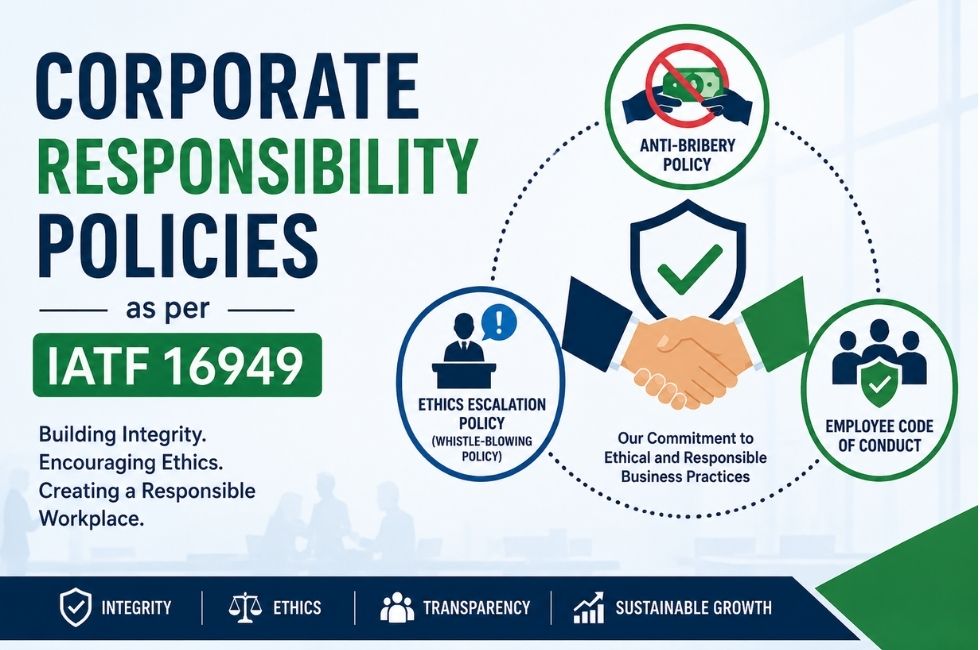
Every organization should have clear corporate responsibility policies to build a transparent, ethical, and professional work culture.
As per IATF 16949 requirements, companies must define and implement certain important policies within their Quality Management System (QMS).
The three key policies are:
- Anti-Bribery Policy
- Ethics Escalation Policy (Whistle-Blowing Policy)
- Employee Code of Conduct
These policies help organizations maintain integrity, improve employee trust, and ensure ethical business practices.
What is Corporate Responsibility in IATF 16949?
According to IATF 16949 clause 5.1.1.1, organizations must establish and implement corporate responsibility policies.
The purpose is to ensure that the company operates honestly, responsibly, and ethically at all levels.
A strong corporate responsibility system helps:
- Build customer confidence
- Improve workplace culture
- Prevent unethical practices
- Support long-term business growth
Anti-Bribery Policy
An anti-bribery policy helps organizations prevent corruption and maintain fair business practices.
Every employee is responsible for preventing, identifying, and reporting any form of bribery or unethical activity.

Our Commitment
We are committed to:
- Maintaining a clean and transparent business process
- Avoiding any form of bribery or corruption
- Not offering or accepting bribes from any government or private authority
- Accepting business meals or invitations only when they are work-related and appropriate
- Avoiding gifts, cash, vouchers, jewelry, or any valuable items that may influence business decisions
- Reporting any bribery attempt immediately to management or the ethics team
- Encouraging suppliers and business partners to follow ethical business practices
Employees should avoid any activity that may create doubt about their honesty or integrity.
Ethics Escalation Policy (Whistle-Blowing Policy)
An ethics escalation policy gives employees a safe way to report unethical behavior, policy violations, or any suspected misconduct.
If an employee notices any issue that goes against company policies, they should immediately inform their supervisor, in-charge, or management.
This system is also known as a whistle-blowing policy.
Escalation Procedure
- Complaints can be reported verbally or in writing
- The person reporting the issue is called a whistleblower
- The whistleblower’s identity will remain confidential
- False complaints made with bad intentions may lead to disciplinary action
This policy helps create a workplace where employees feel safe to speak up without fear.
Employee Code of Conduct
An employee code of conduct defines expected behavior and workplace discipline for all employees.
It helps maintain professionalism, safety, and respect within the organization.
Basic Employee Conduct Guidelines
Employees should:
- Follow company rules and safety requirements
- Treat others respectfully and professionally
- Report to work free from alcohol or drugs
- Inform supervisors in advance if unable to attend work
- Avoid violence, threats, or misconduct in the workplace
- Protect company property and confidential information
A good code of conduct creates a positive and disciplined working environment.
Conclusion
Corporate responsibility policies are not just audit requirements — they are essential for building an ethical and sustainable organization.
By implementing anti-bribery policies, whistle-blowing systems, and employee conduct guidelines, companies can strengthen their culture, improve compliance, and build long-term trust with customers and employees.
For organizations implementing IATF 16949, these policies are an important step toward a strong Quality Management System.