
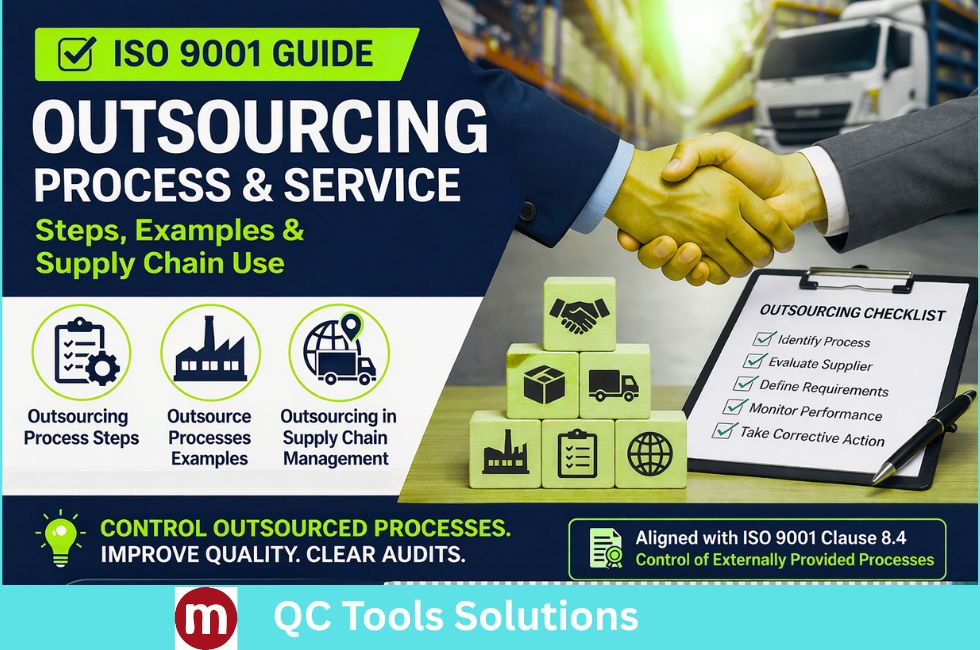
Outsourcing is widely used in industries to reduce cost and improve efficiency. In ISO 9001, outsourced processes must be controlled to ensure product quality. In this guide, you will learn outsourcing process steps, real examples, and how outsourcing works in supply chain management.
Proper control of outsourced processes is also closely linked with measurement accuracy, which you can understand better in this calibration procedure guide.
What is Outsourcing Process?
Outsourcing process refers to assigning a specific activity or service to an external provider while maintaining responsibility for quality and compliance.
ISO 9001 Requirement for Outsourced Processes
As per Clause 8.4 – Control of externally provided processes:
- Organization must ensure control over outsourced processes
- Supplier must be evaluated and approved
- Performance must be monitored
- Records must be maintained
Objectives of Outsourcing
- Reduce cost
- Improve efficiency
- Focus on core activities
- Access expert services
Outsourcing Process Steps
- Identify process to outsource
- Analyze risk and impact on quality
- Select and evaluate supplier
- Define requirements and agreement
- Monitor supplier performance
- Take corrective actions
Outsource Processes Examples
- Heat treatment process
- Painting and coating
- Calibration services
- Transport and logistics
- IT support services
Example:
If a company outsources heat treatment, it must ensure supplier capability and monitor quality results.
Outsourcing Process in Supply Chain Management
Outsourcing in supply chain involves assigning logistics activities such as transportation, warehousing, and distribution to external providers.
Benefits:
- Cost reduction
- Improved flexibility
- Better service efficiency
Data analysis and supplier performance improvement can also be supported using tools explained in this Measurement System Analysis (MSA) guide.
Outsourcing Control Table
| Step | Activity | Responsibility |
|---|---|---|
| 1 | Identify process | Management |
| 2 | Supplier selection | Purchase |
| 3 | Define agreement | QA + Purchase |
| 4 | Monitoring | QA |
| 5 | Review performance | Management |
Important Audit Points
- Approved supplier list available
- Supplier evaluation records
- Defined criteria for selection
- Monitoring and review system
Common Mistakes in outsourcing
- Selecting supplier only on cost
- No evaluation system
- Lack of monitoring
- No proper agreement
- Ignoring risk impact
Procedure :
Identified outsourced processes & services :
The organization has the following outsourced processes and services :
Powder Coating, Zinc Plating, ED Coating, Calibration, Shearing, Maintenance of Plant and Machinery, Machining of Parts, Press Working (Job Work), Plastic Molding (Job Work), Heat Treatment of Tools, Logistics and testing of Raw Material etc
Note: Outsourcing processes and services can change from company to company.
Control of outsourced processes and services :
Calibration :
Calibration of measuring equipment is done only outside the NABL-accredited lab as per the calibration plan.
Maintenance of Plant and Machinery:
Maintenance is done by approved service centers if required of some equipment like DG sets, Compressors and Special purpose machines (SPM). Preventive maintenance is done as per the preventive maintenance plan.
Logistics / Transportation :
Transport vehicles are used by an approved transport agency.
Testing of raw material :
Testing of raw material is done by NABL approved / Customer’s nominated laboratory.
Outsource Processes:
- Powder Coating,
- Zinc Plating,
- ED Coating,
- Shearing,
- Machining of Parts,
- Press Working (Job Work),
- Plastic Molding (Job Work),
- Heat Treatment of Tools
- The suppliers are selected according to their ability to process material that meets our requirements. After supplier selection and approval by the Top Management, they are considered as approved suppliers.
- The suppliers are evaluated yearly through a checklist.
In case any supplier does not meet any requirement, it is issued a ‘customer complaint form (QPCR)’ to fill in which it analyses the root causes, proposes corrective and preventive actions and sends back to us. Our organization evaluates the CAPA proposed and if satisfied, closes the report.
Conclusion
A controlled outsourcing process helps organizations maintain quality, reduce cost, and meet ISO 9001 requirements. Even when processes are outsourced, responsibility for quality remains with the organizat