
A business plan in the manufacturing industry is not just a document—it is a living system that drives production targets, quality performance, cost control, and continuous improvement. Many organizations create excellent plans but fail during execution. The real challenge is not planning, but implementation on the shop floor.
This guide explains how to implement a business plan in a manufacturing environment using practical steps, real examples, KPIs, and proven quality tools. It is designed especially for factory managers, quality professionals, and business owners who want measurable results.
What is a Business Plan in Manufacturing?
A business plan in manufacturing defines how a company will achieve its production, quality, cost, delivery, and growth objectives. It translates strategic goals into operational actions across departments like production, quality, maintenance, and supply chain.
In simple terms, it answers three key questions:
What do we want to achieve?
How will we achieve it?
How will we measure success?
Unlike service industries, manufacturing business plans must align closely with shop floor realities such as machine capacity, manpower, process capability, and rejection levels.
Why Business Plan Implementation Fails in Factories
Most manufacturing companies do not fail in planning—they fail in execution. Some common reasons include lack of clarity, poor ownership, and weak monitoring systems.
One major issue is that plans remain at the top management level and never reach operators or supervisors. Another problem is setting targets without defining measurable KPIs. In many cases, review systems are either missing or ineffective, leading to delayed corrective actions.
There is also a disconnect between departments. For example, production targets may not align with quality capabilities, resulting in increased rejection or rework. Without structured tracking and accountability, even the best business plans lose effectiveness.
Step-by-Step Implementation of Business Plan in Manufacturing
Step 1: Define Clear Strategic Objectives
Start by defining clear and measurable business objectives. These should be aligned with company vision and customer requirements.
Examples include reducing rejection rates, improving on-time delivery, increasing production output, or reducing cost per unit. Avoid vague goals. Instead of saying “improve quality,” define it as “reduce rejection from 5% to 2% within six months.”
Objectives should be SMART—Specific, Measurable, Achievable, Relevant, and Time-bound.
Step 2: Break Down Objectives into Departmental Targets
Once strategic objectives are defined, break them down into departmental targets. Each department should clearly understand its role in achieving overall goals.
For example, if the company goal is to reduce rejection:
The quality department focuses on root cause analysis
Production focuses on process control, productivity increase
Maintenance ensures machine stability
Stores ensures correct material handling
This step ensures alignment across the organization.
Step 3: Assign Responsibility and Ownership
Every target must have a clear owner. Without accountability, execution becomes weak.
Assign responsibilities at different levels:
Top management for strategic direction
Department heads for execution
Supervisors for daily monitoring
Operators for process control
Define roles clearly so that there is no confusion about who is responsible for results.
Step 4: Define KPIs and Measurement System
Key Performance Indicators (KPIs) are essential for tracking progress. Each objective must be linked to measurable KPIs.
Examples of KPIs in manufacturing include:
Rejection percentage
Overall Equipment Effectiveness (OEE)
Production output per shift
On-time delivery percentage
Customer complaints
Define how each KPI will be measured, how frequently it will be reviewed, and who will monitor it.
Step 5: Align with Production and Process Planning
Business plans must be realistic and aligned with actual production capabilities. This includes machine capacity, manpower availability, and process limitations.
If the plan requires increased production, ensure that machines can handle the load. If quality targets are strict, ensure process capability is adequate.
This step avoids unrealistic expectations and execution failure.
Step 6: Implement Daily and Monthly Review System
Regular review is the backbone of implementation. Without review, there is no control.
Daily reviews should focus on operational KPIs like production, rejection, and downtime. Monthly reviews should focus on strategic targets and overall performance.
Use visual management tools such as dashboards and charts to make data easily understandable. Encourage discussions based on data rather than assumptions.
Step 7: Take Corrective and Preventive Actions
Whenever deviations are observed, take immediate corrective action. Use structured problem-solving methods to identify root causes.
For example:
Use Pareto analysis to identify major issues
Use Fishbone diagrams for root cause analysis
Implement corrective actions and monitor effectiveness
Preventive actions should also be taken to avoid recurrence of problems.
Real Example from Manufacturing Industry
Consider an automotive component manufacturing company facing high rejection rates.
Initial situation:
Rejection rate was 5%
Customer complaints were increasing
Production losses were high
Business plan objective:
Reduce rejection from 5% to 2% within six months
Implementation steps:
Quality team performed Pareto analysis and identified major defect types
Production team reviewed process parameters and improved control
Maintenance team ensured machine calibration and stability
Operators were trained on standard operating procedures
Results:
Rejection reduced to 2.8% in four months
Customer complaints reduced significantly
Production efficiency improved
This example shows how structured implementation leads to measurable results.
Tools Used in Business Plan Implementation
Effective implementation requires the use of quality and management tools. These tools help in data analysis, decision making, and problem solving.
Common tools include:
Pareto analysis to identify major problems
Fishbone diagram for root cause analysis
Control charts for process monitoring
Check sheets for data collection
Histograms for data distribution analysis
These tools are part of the 7 QC Tools and are widely used in manufacturing industries.
Lean tools such as Kaizen and Poka Yoke can also support implementation by reducing waste and preventing errors.
KPI Dashboard Example
A KPI dashboard helps track performance in a structured way. It provides clarity and supports decision making.
Typical KPI dashboard in manufacturing includes:
Rejection rate with target and actual values
Production output per shift
Machine downtime
OEE percentage
Customer complaints
Each KPI should have defined targets, review frequency, and responsible person.
For example:
Rejection target less than 1% reviewed daily by quality team
OEE target above 85% reviewed weekly by production team
On-time delivery target above 95 percent reviewed monthly by supply chain team
This structured approach ensures continuous monitoring and improvement.
Common Mistakes in Implementation
Many organizations make similar mistakes during implementation.
One common mistake is lack of follow-up. Plans are created but not reviewed regularly. Another issue is setting unrealistic targets without considering ground realities.
Some companies fail to involve shop floor employees. Without their participation, execution becomes difficult. Data collection is often inconsistent, leading to wrong conclusions.
Another major mistake is ignoring root cause analysis. Instead of solving problems permanently, temporary fixes are applied.
Avoiding these mistakes can significantly improve implementation success.
How ISO 9001 Supports Business Plan Implementation
ISO 9001 provides a strong framework for implementing business plans in manufacturing.
Clause 6 focuses on planning and requires organizations to define objectives and actions.
Clause 9 emphasizes performance evaluation through monitoring and measurement.
The process approach in ISO 9001 ensures alignment across departments. Risk-based thinking helps identify potential issues before they occur.
Internal audits and management reviews (MRM) ensure that plans are regularly evaluated and improved.
By aligning business plans with ISO 9001 requirements, organizations can achieve better control and consistency.
Advanced Strategies for Better Implementation
To further improve effectiveness, organizations can adopt advanced strategies.
- Digital dashboards can provide real-time data visibility. This helps in faster decision making. Automation can reduce manual errors and improve efficiency.
- Cross-functional teams can improve coordination between departments. Regular training ensures that employees understand their roles and responsibilities.
- Benchmarking against industry standards can help identify improvement opportunities.
- Continuous improvement culture is essential. Encourage employees to suggest improvements and participate in problem-solving activities.
Procedure
Identify all the internal and external issues that affect the company’s business policies and objectives as informed by Top Management and approved by the MD. The typical issues may consist of:
- Need and Expectations of interested parties.
- Market-related issues.
- Growth Projections of the Plant and Facilities Plan.
- Human resources development.
- Design & Development Plans
- Projected sales figure.
- Quality Objectives.
- Customer Satisfaction Plan
- Quality of Product
- Productivity
- Next 03 Year Business Strategy
- Target defined Profit vs. Investment
- Customer feedback strategy
- Employee vs Management Strategy planning with business growth.
Decideshort-term and long-term goals according to the organization’s requirements, considering the above-mentioned issues, company-level data, and available resources. Then, set the Company’s Policies and departmental objectives.
- Communicate the contents of the business plan to the concerned personnel.
- Prepare an action plan to achieve the goals in consultation with the Plant Head.
- Initiate action to implement the plans and send monthly progress data to the Plant Head for discussion.
- Monitor the progress on business plans.
Review the progress on the business plan monthly and quarterly for short-term and long-term goals, respectively. Also, review the provision of resources where required.
Turtle Diagram
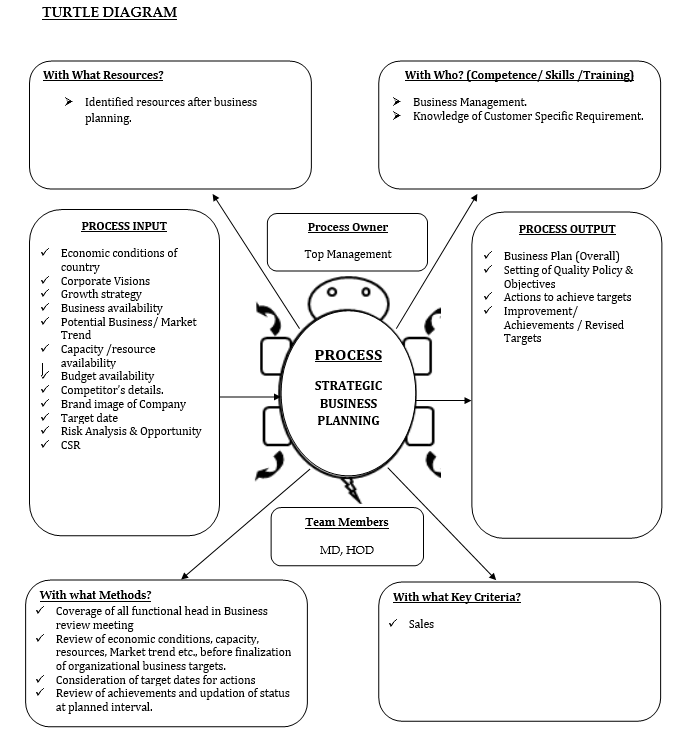
Process Input
- Economic conditions of the country
- Corporate Visions
- Growth strategy
- Business availability
- Potential Business/ Market Trend
- Capacity /resource availability
- Budget availability
- Competitor’s details.
- Brand image of the company
- Target date
- Risk Analysis & Opportunity
- CSR
Process Output
- Business Plan (Overall)
- Setting of Quality Policy & Objectives
- Actions to achieve targets
- Improvement/ Achievements / Revised Targets
With What Resources?
- Identified resources after business planning.
With Who? (Competence/ Skills /Training)
- Business Management.
- Knowledge of Customer Specific Requirement.
With what Methods?
- Coverage of all functional heads in the Business Review meeting
- Review of economic conditions, capacity, resources, Market trend etc., before finalization of organizational business targets.
- Consideration of target dates for actions
- Review of achievements and update of status at the planned interval.
With what Key Criteria?
- Sales
Conclusion
Implementing a business plan in the manufacturing industry requires more than documentation. It demands clear objectives, structured execution, continuous monitoring, and strong leadership.
By breaking down goals into actionable steps, assigning responsibilities, tracking KPIs, and using quality tools, organizations can achieve significant improvements in performance.
Real success comes from consistent execution and continuous improvement. When properly implemented, a business plan becomes a powerful tool for growth, efficiency, and customer satisfaction.
If you apply the step-by-step approach explained in this guide, you can transform your business plan from a static document into a dynamic system that drives real results on the shop floor.
Struggling to Execute Your Manufacturing Business Plan?
Don’t let your strategy fail at the implementation stage. Get expert guidance on QMS, process improvement, and ISO certification.
👉 Partner with QC Tools Solutions and achieve measurable results faster.
Normally I do not read article on blogs however I would like to say that this writeup very forced me to try and do so Your writing style has been amazed me Thanks quite great post
Your blog post was really enjoyable to read, and I appreciate the effort you put into creating such great content. Keep up the great work!
Give a round of applause in the comments to show your appreciation!
Could you provide guidance on integrating Lean Manufacturing principles into the operational strategy to enhance efficiency and reduce waste? Additionally, how can we effectively align our production planning with market demand forecasts to ensure optimal resource utilisation?
Pretty nice post. I just stumbled upon your blog and wished to say that I’ve truly
enjoyed surfing around your blog posts. In any case I will
be subscribing to your rss feed and I hope you write again very soon!
This writing has the rare gift of making complex ideas feel both accessible and profoundly meaningful.
Perfect work you have done, this web site is really cool with good info .
Hello There. I found your blog using msn. This is a very well written article. I will make sure to bookmark it and return to read more of your useful information. Thanks for the post. I’ll definitely return.
Your blog has quickly become one of my favorites I am constantly impressed by the quality and depth of your content