
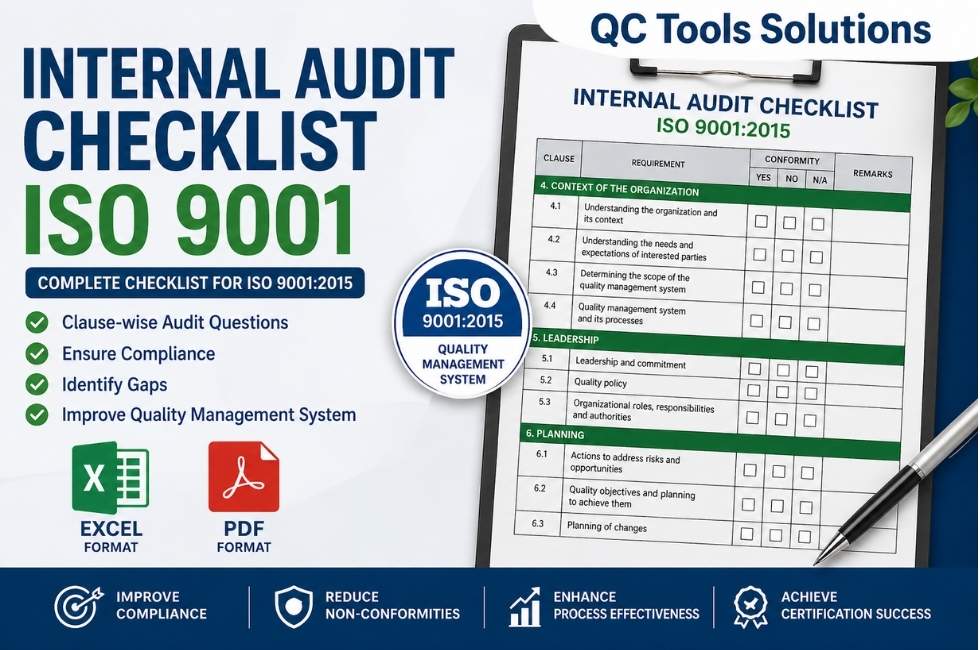
If your organization is certified to International Organization for Standardization ISO 9001 or planning certification, conducting internal audits is essential. One of the easiest ways to perform an effective audit is by using a well-structured Internal Audit Checklist ISO 9001. If you need an effective Internal Audit Checklist ISO 9001, this guide provides a ready-to-use checklist in Excel and PDF format with clause-wise questions for ISO 9001:2015 compliance.
A checklist helps auditors verify compliance, identify gaps, improve processes, and prepare for certification or surveillance audits. In this article, you will learn what an internal audit checklist is, why it is important, what it should include, and download your ISO 9001 Internal Audit Checklist in Excel and PDF format.
What Is an Internal Audit Checklist ISO 9001?
An Internal Audit Checklist ISO 9001 is a practical document used during internal audits to verify whether your Quality Management System (QMS) meets the requirements of ISO 9001:2015.
It includes questions related to:
- Context of the organization
- Leadership and quality policy
- Risk and opportunities
- Documented information
- Operations control
- Customer satisfaction
- Monitoring and measurement
- Nonconformity and corrective action
- Continual improvement
It acts as a guide so auditors do not miss important clauses or process controls during the Internal Audit.
Why Is an Internal Audit Checklist important?
Using a checklist provides several benefits:
1. Systematic Auditing
Ensures all applicable ISO 9001 clauses are covered.
2. Saves Time
Auditors can work faster with pre-prepared questions.
3. Better Compliance
Helps identify missing records, weak controls, or nonconformities.
4. Evidence-Based Audits
Allows objective verification using records and observations.
5. Readiness for Certification Audits
Prepares the organization for external certification or surveillance audits.
ISO 9001 Internal Audit Checklist Main Sections
A complete checklist generally covers these clauses:
| Clause | Topic |
|---|---|
| 4 | Context of organization |
| 5 | Leadership |
| 6 | Planning |
| 7 | Support |
| 8 | Operation |
| 9 | Performance evaluation |
| 10 | Improvement |
Sample Internal Audit Checklist Questions
Clause 4 – Context of Organization
- Has the organization identified internal and external issues?
- Have interested parties been determined?
- Is the QMS scope defined?
Clause 5 – Leadership
- Is quality policy established and communicated?
- Are responsibilities and authorities assigned?
Clause 6 – Planning
- Are risks and opportunities identified?
- Are quality objectives measurable?
Clause 7 – Support
- Are employees competent for their roles?
- Are training records maintained?
- Is document control effective?
Clause 8 – Operation
- Are customer requirements reviewed?
- Is production/service provision controlled?
- Are outsourced processes monitored?
Clause 9 – Performance Evaluation
- Are internal audits planned?
- Is customer satisfaction monitored?
- Is management review (MRM) conducted?
Clause 10 – Improvement
- Are nonconformities corrected?
- Is Root cause analysis done?
- Are continual improvements implemented?
Download Internal Audit Checklist ISO 9001 Excel & PDF
If you are looking for ready-to-use formats, you can download:
✅ Internal Audit Checklist ISO 9001 Excel Format
✅ Internal Audit Checklist ISO 9001 PDF Format
These formats are useful for:
- Manufacturing companies
- Service organizations
- Small businesses
- Automotive suppliers
- Job work units
- Traders with QMS systems
Why Excel Format is useful
Excel checklist offers practical advantages:
- Easy editing and customization
- Add department-wise sheets
- Status tracking (Open / Closed)
- Auto summary reports
- Easy evidence recording
Why PDF Format is useful
PDF version is ideal when:
- You need printable format
- Share controlled copy internally
- Use on mobile during audits
- Standardized fixed checklist required
How to Use the checklist effectively
Step 1: Define Audit Scope
Select department or process such as Purchase, Production, Quality, HR, Store, Maintenance.
Step 2: Review Applicable Clauses
Map checklist questions with process requirements.
Step 3: Collect Evidence
Use records, interviews, observations, and samples.
Step 4: Record Findings
Mention:
- Conformity
- Observation
- Opportunity for improvement
- Nonconformity
Step 5: Follow Corrective Actions
Track closure with target dates.
Common Mistakes during Internal Audits
Avoid these mistakes:
- Only checking documents, not actual implementation
- Asking generic questions only
- No evidence recorded
- Ignoring process performance data
- Delayed corrective actions
- Copy-paste reports every audit cycle
Best Practices for ISO 9001 Internal Audits
- Use process approach, not clause-only approach
- Focus on risks and customer satisfaction
- Audit actual effectiveness
- Rotate auditors for impartiality
- Use trend analysis of findings
- Verify previous audit actions
Who Needs this Checklist?
This checklist is highly useful for:
- ISO Coordinators
- QA Managers
- Internal Auditors
- Management Representatives
- Consultants
- SMEs preparing certification
Frequently Asked Questions
Is internal audit mandatory in ISO 9001?
Yes, clause 9.2 of ISO 9001 requires internal audits at planned intervals.
Can small companies use a simple checklist?
Yes. Checklist complexity should match business size and process risk.
How often should internal audits be conducted?
Usually annually, half-yearly, or risk-based frequency.
Can I use Excel checklist for certification preparation?
Yes, Excel checklists are excellent for gap analysis and readiness audits.
Get Ready-to-Use Internal Audit Checklist ISO 9001
If you need a professional Internal Audit Checklist ISO 9001 in Excel and PDF, ready for immediate use, you can use our editable formats for faster implementation and audit readiness.
Conclusion:
A strong Internal Audit Checklist ISO 9001 improves compliance, identifies weaknesses early, and strengthens your Quality Management System. Whether you run a factory, office, or service company, using a structured checklist saves time and improves audit results.