
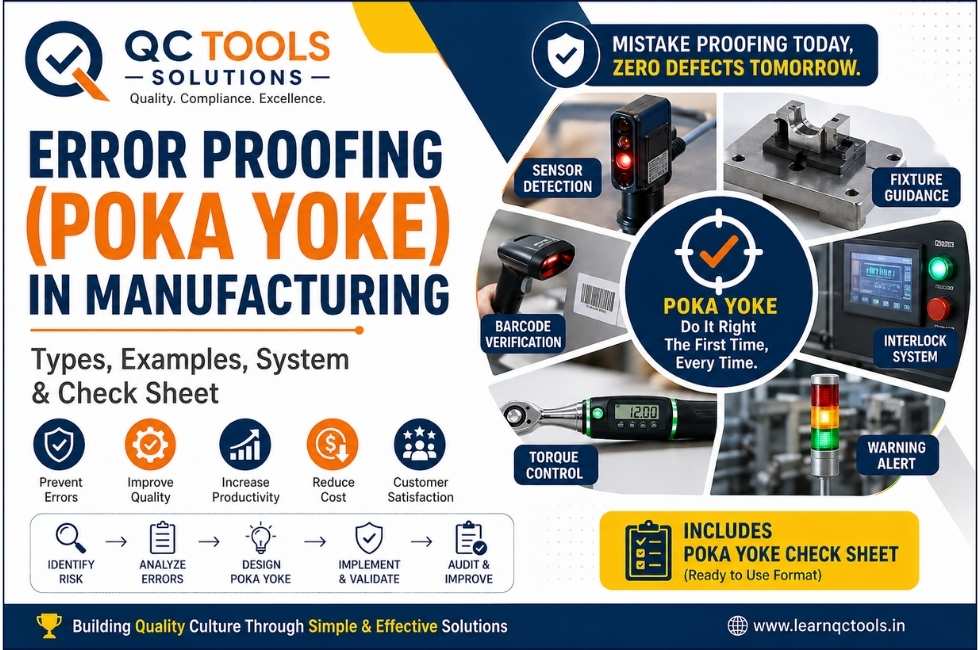
Error proofing, also known as Poka Yoke, is one of the most powerful quality tools used in manufacturing to eliminate defects at the source. In today’s competitive industry, organizations cannot afford rework, rejection, or customer complaints. Instead of detecting defects after they occur, error proofing ensures that mistakes are either prevented or immediately detected before they turn into defects.
This article provides a complete understanding of poka yoke including its meaning, types, real-life examples, implementation system, and a practical check sheet format.
- What is Error Proofing (Poka Yoke)?
- Why Error Proofing is important in Manufacturing
- Types of Poka Yoke (Based on Detection Method)
- Types of Poka Yoke (Based on Function)
- Real-Life Poka Yoke Examples
- Error Proofing System (Step-by-Step Implementation)
- Benefits of Error Proofing System
- Common Mistakes in Poka Yoke Implementation
- Integration with Quality Systems
- Real Industry Insight
- Poka Yoke Process for manufacturing:
- Conclusion
What is Error Proofing (Poka Yoke)?
Error proofing is a systematic approach used to prevent human errors or detect them instantly during the process. The term “Poka Yoke” originates from Japanese, where “Poka” means mistake and “Yoke” means prevention.
In simple words, error proofing means designing a process in such a way that it becomes impossible to make mistakes or easy to detect them immediately.
For example, a mobile charger can only be inserted in one direction. This is a simple poka yoke that prevents incorrect usage.
In manufacturing, error proofing ensures:
- Correct part is used
- Correct orientation is maintained
- Correct sequence is followed
- Missing operations are avoided
Why Error Proofing is important in Manufacturing
In most industries, defects are caused not by machines but by human errors such as:
- Forgetting a step
- Using the wrong component
- Incorrect assembly
- Wrong settings
Error proofing is important because it directly addresses these issues at the root cause.
Key benefits include:
- Reduction in defects and rework
- Improved product quality and consistency
- Lower inspection and quality costs
- Increased productivity
- Improved customer satisfaction
- Enhanced process reliability
A well-known principle in quality management states:
“Errors are inevitable, but defects are preventable.”
Error proofing is the practical application of this philosophy.
Types of Poka Yoke (Based on Detection Method)
Understanding types of poka yoke is essential for both implementation and SEO ranking. There are three main types:
1. Contact Method
This method detects abnormalities based on physical attributes such as shape, size, or color.
Example:
- A fixture designed so that only the correct part fits
- Sensors detecting missing components
- Color coding for different parts
This is widely used in assembly operations to prevent incorrect part installation.
2. Fixed Value Method
This method ensures that a predefined number of actions or parts are completed.
Example:
- Counting bolts to ensure all are fitted
- Torque tools with preset limits
- Packaging systems that count items
If the count does not match, the process is stopped or flagged.
3. Motion-Step Method
This method ensures that the correct sequence of operations is followed.
Example:
- Interlocking systems where next step starts only after previous step
- Software-based workflows
- Assembly lines with sequential controls
This type is highly effective in preventing missed operations.
Types of Poka Yoke (Based on Function)
Poka yoke can also be classified based on how it works:
Control Type Poka Yoke
- Stops the process automatically when an error occurs
- Does not allow defect to move forward
Example:
- Machine stops if part is missing
- System prevents wrong program selection
This is the most effective type.
Warning Type Poka Yoke
- Alerts operator through signal or alarm
- Requires human intervention
Example:
- Buzzer or light indicator
- Warning message on screen
Although useful, it depends on operator response.
Real-Life Poka Yoke Examples
Manufacturing Examples
- Fixture with unique slot design
Only correct part orientation is possible - Sensor-based detection
Machine stops if component is missing - Barcode verification system
Ensures correct part is used - Torque-controlled tools
Prevents under or over tightening - Vision inspection system
Detects wrong assembly instantly - Limit switches
Ensure correct positioning before operation - Interlock system
Machine runs only when safety conditions are met
Daily Life Examples
- USB design
Can be inserted only one way - Microwave door lock
Does not operate when open - Car seatbelt alarm
Alerts if seatbelt is not worn - SIM card shape
Prevents incorrect insertion - ATM card orientation
Works only in correct direction
Error Proofing System (Step-by-Step Implementation)
This is where your expertise as a QMS consultant becomes powerful. A structured implementation approach is critical.
Step 1: Identify Process Risk
- Study process flow
- Identify high-risk operations
- Focus on customer-critical characteristics
Use tools like Process Flow Diagram.
Step 2: Analyze Failure Modes
- Use FMEA (Failure Mode and Effects Analysis)
- Identify potential errors
- Determine severity, occurrence, detection
Focus on high RPN areas.
Step 3: Design Poka Yoke Solution
- Choose appropriate type (contact, fixed, motion)
- Ensure simplicity
- Avoid over-engineering
Remember: Simple solutions are more effective.
Step 4: Validate Effectiveness
- Test under real conditions
- Check repeatability
- Ensure zero bypass possibility
Step 5: Implement in Process
- Install device/system
- Train operators
- Update work instructions
Step 6: Update Control Plan
- Include poka yoke controls
- Define monitoring method
- Assign responsibility
Step 7: Regular Audit and Monitoring
- Check functioning of poka yoke
- Include in layered process audits
- Maintain records
Key Points for Check Sheet
- Verify daily or shift-wise
- Check sensor functionality
- Ensure no bypass or tampering
- Record abnormalities
- Link with audit system
You can also offer this as a downloadable template to improve engagement and SEO.
Benefits of Error Proofing System
Implementing poka yoke provides long-term advantages:
- Achieves near zero defects
- Reduces dependency on inspection
- Improves process capability
- Enhances operator confidence
- Reduces cost of poor quality (COPQ)
- Improves customer satisfaction
Organizations using strong error proofing systems often achieve higher audit scores in IATF 16949 and ISO 9001.
Common Mistakes in Poka Yoke Implementation
Many companies fail not because of concept but due to poor execution.
Avoid these mistakes:
- Overcomplicated systems
- Ignoring operator usability
- No validation before implementation
- Lack of maintenance
- Easy bypass options
- Not updating control plan
A poka yoke should be:
- Simple
- Reliable
- Foolproof
- Easy to maintain
Integration with Quality Systems
Error proofing should not work in isolation. It must be integrated with:
- FMEA
- Control Plan
- Work Instructions
- Process Audit
- 7 QC Tools
This integration ensures sustainability and audit compliance.
Real Industry Insight
In automotive manufacturing (especially Tier 1 and Tier 2 suppliers), poka yoke plays a critical role in:
- Assembly line error prevention
- Traceability systems
- Supplier quality control
For example, in a vendor supplying to OEMs like Maruti Suzuki, even a minor assembly error can lead to line stoppage. Hence, error proofing systems are mandatory at critical stations.
This is where a structured poka yoke system combined with FMEA and control plan becomes essential.
Poka Yoke Process for manufacturing:
Master List of Error Proofing:
The need for error proofing is identified based on the following situations & same is included in the list of Error Proofing:-
- Error Proofing identified through PFMEA
- Error Proofing identified through Customer Complaint Handling
- Error Proofing identified through Internal Rejection Control.
Suggested Format for Master List of Poka Yoke:
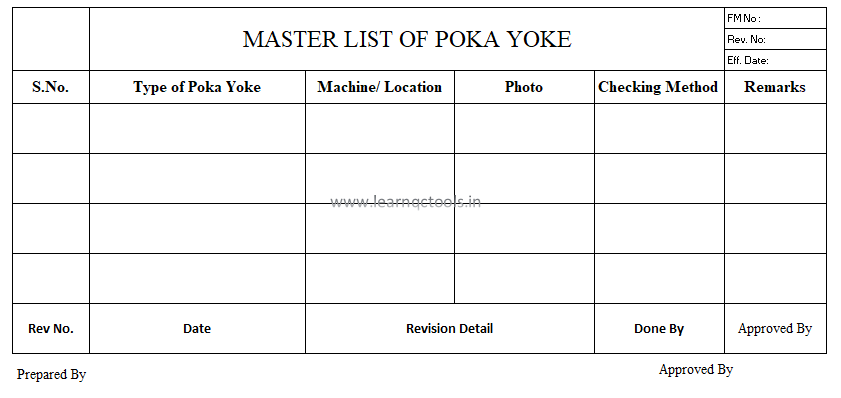
So input for the error proofing list is PFMEA, Internal & Customer complaint handling.
Daily Poka Yoke Check Sheet:
The Error Proofing is verified for effective implementation through the Daily Poka Yoke Checksheet & Record of the same is maintained.
Whatever products are produced during the error-proofing device failure are considered to be suspected products & they are handled as per the Procedure for Control of Non-Conforming Products.
Once the Error Proofing Device is reinstated after rectification they have been verified for correctness before handing over it to regular production.
Poka Yoke Check Sheet

Daily Poka Yoke Checklist free download
Replacement of checking devices/ challenge part:-
All the checking devices or master/challenge parts that are used for verifying the error-proofing devices are replaced at the frequency defined & record of the same is maintained. The due date for replacement is also specified on the device or master/challenging part.
Calibration of Error proofing devices:-
All the Error proofing devices which require calibration are calibrated & record of the same is maintained as per Procedure for Control of Measuring & Monitoring Equipment & Gauges (Calibration Procedure)
Breakdown analysis of the Error Proofing device:
When there is any breakdown in the error-proofing device, then analysis of the breakdown should be done by the incharge with CFT.
Note: These Error Proofing details can be added in other procedures like the Maintenace procedure or Production procedure.
Conclusion
Error proofing (Poka Yoke) is not just a quality tool—it is a mindset that focuses on prevention rather than detection. By implementing proper poka yoke techniques, organizations can eliminate defects, improve efficiency, and achieve consistent product quality.
According to ASQ, mistake proofing (poka-yoke) is a technique used to prevent errors before they occur in a process.
A well-designed error proofing system includes:
- Proper risk identification
- Correct type selection
- Practical implementation
- Regular monitoring
If applied correctly, poka yoke can transform your manufacturing process into a zero-defect system.
Greetings! Very useful advice within this article! Its the little changes that make the most important changes. Thanks for sharing!
As I web site possessor I believe the content material here is rattling wonderful , appreciate it for your hard work. You should keep it up forever! Good Luck.