
A Quality Management System (QMS) works effectively when all business activities are managed as processes. Every organization, whether manufacturing or service-based, uses multiple processes to achieve customer satisfaction, improve quality, and meet business goals. To manage these activities better, companies divide them into different process categories in QMS.
Understanding process categories helps organizations assign responsibilities, monitor performance, reduce waste, and improve efficiency. It also supports compliance with ISO 9001:2015, which promotes the process approach for managing operations.
In this article, you will learn the meaning of process categories in QMS, their types, practical examples, SIPOC diagrams, and how they help improve business performance.
- What is a Process in QMS?
- What are Process Categories in QMS?
- 1. Management Processes
- 2. Core Processes (Customer-Oriented Processes)
- 3. Support Processes
- Process Categories in QMS Table
- Process interaction in QMS
- ISO 9001:2015 and Process Categories
- How to Identify Process Categories in your company
- SIPOC Diagram for QMS Processes
- SIPOC Example: Order to Dispatch Process
- Manufacturing Example of Process Categories
- Service Industry Example of Process Categories
- Benefits of categorizing processes in QMS
- Common mistakes to avoid
- Best KPI Examples for Each Category
- How often should Process Categories be reviewed?
- Frequently Asked Questions
- QMS Process Interaction Chart:
- Final Conclusion
What is a Process in QMS?
A process is a set of related activities that uses inputs to create outputs. Every process has resources, responsibilities, controls, and measurable results.
Examples of business processes:
- Receiving customer inquiry
- Purchasing raw material
- Production planning
- Manufacturing
- Quality inspection
- Delivery to customer
- Handling customer complaints
In a QMS, these processes interact with each other and must be controlled systematically.
What are Process Categories in QMS?
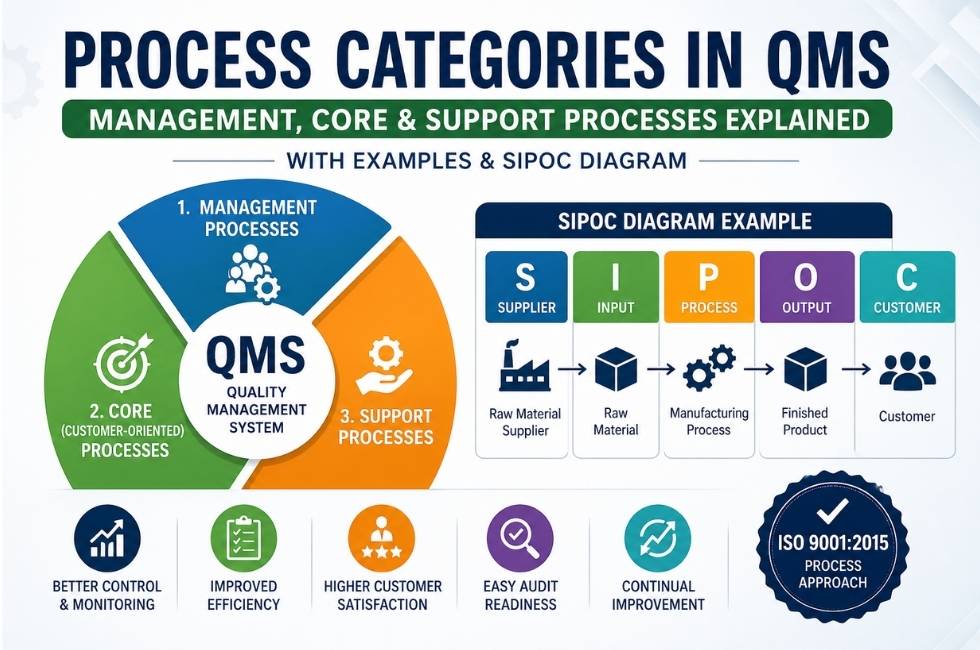
Process categories in QMS are groups of processes based on their purpose and contribution to the organization. Most organizations classify processes into three major categories:
- Management Processes
- Core (Customer-Oriented) Processes
- Support Processes
This structure makes the QMS easier to understand and manage.
Input→Process→Output
1. Management Processes
Management processes are used to direct, control, and improve the organization. These processes are led by top management and focus on strategy, planning, objectives, risks, and performance review.
Examples of Management Processes
- Business planning
- Quality policy deployment
- Setting quality objectives
- Management review meetings
- Internal audits
- Risk and opportunity management
- KPI monitoring
- Resource planning
Why Management Processes are Important
- Provide direction to the business
- Align departments with company goals
- Ensure compliance with ISO 9001
- Support continual improvement
- Improve decision-making
Example
Top management reviews monthly rejection rates, delivery performance, and customer complaints, then takes improvement actions.
2. Core Processes (Customer-Oriented Processes)
Core processes directly create value for the customer. These are the main operational processes that produce goods or services.
They are also called operational processes, realization processes, or customer-oriented processes.
Examples of Core Processes in Manufacturing
- Marketing and sales
- Contract review
- Product design and development (APQP)
- Production planning
- Purchasing
- Manufacturing / machining
- Assembly
- Inspection and testing
- Packaging
- Dispatch
Examples of Core Processes in Service Industry
- Customer registration
- Product or Service delivery
- Complaint resolution
- Billing
- Technical support
Why Core Processes are important?
- Directly impact customer satisfaction
- Generate revenue
- Affect product quality
- Influence on-time delivery
- Determine market reputation
The key requirement of Customer-oriented processes:
- Process add value
- Customer requirement identified
- The process team has understood the requirement
- Customer requirements are fulfilled in a consistent and effective way
- Continual improvement
- Process performance result status
Example
A customer places an order. The company reviews requirements, plans production, manufactures the product, inspects it, and dispatches on time.
3. Support Processes
Support processes do not directly create customer value, but they help core and management processes run smoothly.
Examples of Support Processes
- Human resources
- Recruitment
- Training and competency development
- Maintenance
- Calibration process
- IT support
- Document control
- Finance and accounts
- Security
- Stores management
Why Support Processes are important?
- Maintain operational continuity
- Improve employee capability
- Prevent machine breakdowns
- Ensure measuring equipment accuracy
- Support compliance and documentation
Example
The maintenance team services machines regularly to prevent production downtime.
Process Categories in QMS Table
| Process Category | Purpose | Examples |
|---|---|---|
| Management Processes | Direct and control business | Strategy, audits, reviews |
| Core Processes | Deliver value to customers | Production, sales, dispatch |
| Support Processes | Help other processes run | HR, maintenance, calibration |
Process interaction in QMS
All process categories are linked. No process works alone.
Example:
- Management decides production targets
- Core team manufactures products
- Support team maintains machines and trains operators
This interaction is called the process approach in ISO 9001.
Management→Core Processes←Support Processes
ISO 9001:2015 and Process Categories
ISO 9001 does not force a fixed list of process categories, but it requires organizations to:
- Determine required processes
- Define sequence and interaction
- Assign responsibilities
- Monitor performance
- Control risks
- Improve processes continuously
This means categorizing processes is a practical way to meet ISO 9001 requirements.
How to Identify Process Categories in your company
Follow these simple steps:
Step 1: List all activities
Write all activities performed in your organization.
Examples:
- Sales
- Purchase
- Production
- Inspection
- HR
- Maintenance
- Accounts
Step 2: Ask purpose of each activity
- Does it control the business? → Management
- Does it create product/service? → Core
- Does it support others? → Support
Step 3: Prepare Process Map
Create a process map showing interactions.
Step 4: Define KPIs
Examples:
- On-time delivery
- Rejection rate
- Customer complaints
- Machine uptime
- Training completion
SIPOC Diagram for QMS Processes
A SIPOC diagram helps visualize any process.
SIPOC means:
- Supplier
- Input
- Process
- Output
- Customer
SIPOC Example: Order to Dispatch Process
| Supplier | Input | Process | Output | Customer |
|---|---|---|---|---|
| Customer | Purchase Order | Order Review | Confirmed Order | Customer |
| Vendor | Raw Material | Production | Finished Goods | End User |
| QA Team | Inspection Standard | Final Inspection | Approved Product | Dispatch Dept |
SIPOC helps understand process boundaries and responsibilities.
Manufacturing Example of Process Categories
For an auto parts company:
Management
- Annual business targets
- Customer score review
- Supplier performance review
Core
- RFQ review
- Tool development
- Forging / machining
- Heat treatment
- Inspection
- Dispatch
Support
- Calibration lab
- Maintenance team
- Tool room
- Training department
- IT support
Service Industry Example of Process Categories
For a consultancy company:
Management
- Business strategy
- Client satisfaction review
Core
- Client onboarding
- Audits
- Documentation support
- Training delivery
Support
- Accounts
- HR
- CRM software support
Benefits of categorizing processes in QMS
1. Better Responsibility : Each department knows its role.
2. Easier Monitoring : KPIs can be tracked by category.
3. Improved Efficiency : Redundant steps are removed.
4. Better Audit Readiness : Internal and external audits become easier.
5. Higher Customer Satisfaction : Core processes improve quality and delivery.
6. Stronger Continual Improvement : Weak areas become visible faster.
Common mistakes to avoid
Mixing Core and Support Processes
Example: Purchase may be core or support depending on business type.
No KPI Measurement
Processes without metrics cannot improve.
Ignoring Interaction
Departments working in silos create delays.
Poor Documentation
Undefined responsibilities create confusion.
Best KPI Examples for Each Category
| Category | KPI Examples |
|---|---|
| Management | Audit closure rate, objective achievement |
| Core | Rejection %, OTD, productivity |
| Support | Breakdown hours, training %, calibration status |
How often should Process Categories be reviewed?
Review at least annually or when:
- New product launched
- New customer added
- Major organizational changes
- Audit findings increase
- Performance declines
Frequently Asked Questions
What are the three categories of processes in QMS?
Management processes, core/customer-oriented processes, and support processes.
Is purchasing a core or support process?
It depends on business type. In manufacturing it often supports production. In trading companies it may be core.
Does ISO 9001 require process categories?
ISO 9001 requires identifying and managing processes, but categories are organization-defined.
What is the difference between core and support processes?
Core processes directly deliver value to customers. Support processes help core processes function efficiently.
Why use SIPOC in QMS?
SIPOC gives clear visibility of suppliers, inputs, outputs, and customers for any process.
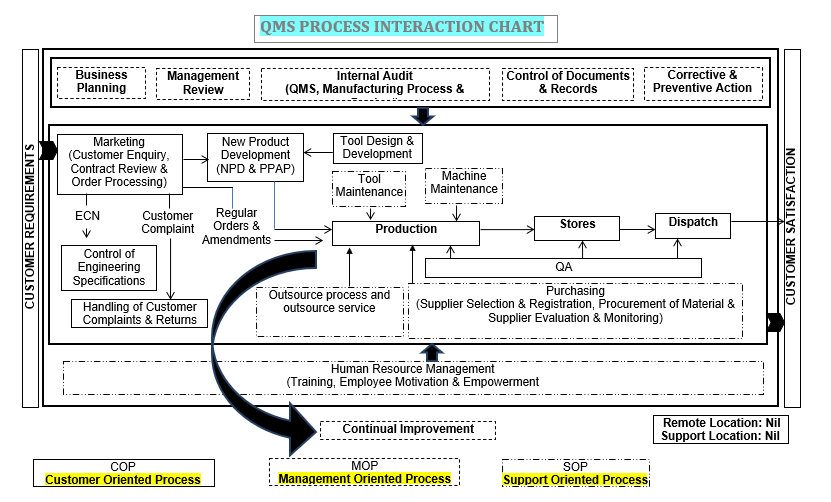
QMS Process Interaction Chart:
Final Conclusion
Understanding process categories in QMS is essential for building an effective Quality Management System. By dividing activities into Management Processes, Core Processes, and Support Processes, organizations can improve accountability, efficiency, compliance, and customer satisfaction.
Whether you run a manufacturing unit, service company, or consultancy business, proper process categorization makes your system stronger and easier to manage.
If you are implementing ISO 9001:2015, start by identifying all processes, mapping interactions, assigning KPIs, and reviewing performance regularly.
Note: This classification is not mentioned in the IATF 16949: 2016 standard but is used by most organizations. But for easy understanding of the organization processes, this categorization is done.