
Introduction
Quality Engineers play a vital role in ensuring that products meet customer expectations, industry standards, and regulatory requirements. They are responsible for maintaining product quality, improving manufacturing processes, reducing defects, and implementing continuous improvement initiatives.
Whether you are a fresher preparing for your first Quality Engineer interview or an experienced professional looking for a better opportunity, interviewers often assess both your technical knowledge and practical problem-solving abilities.
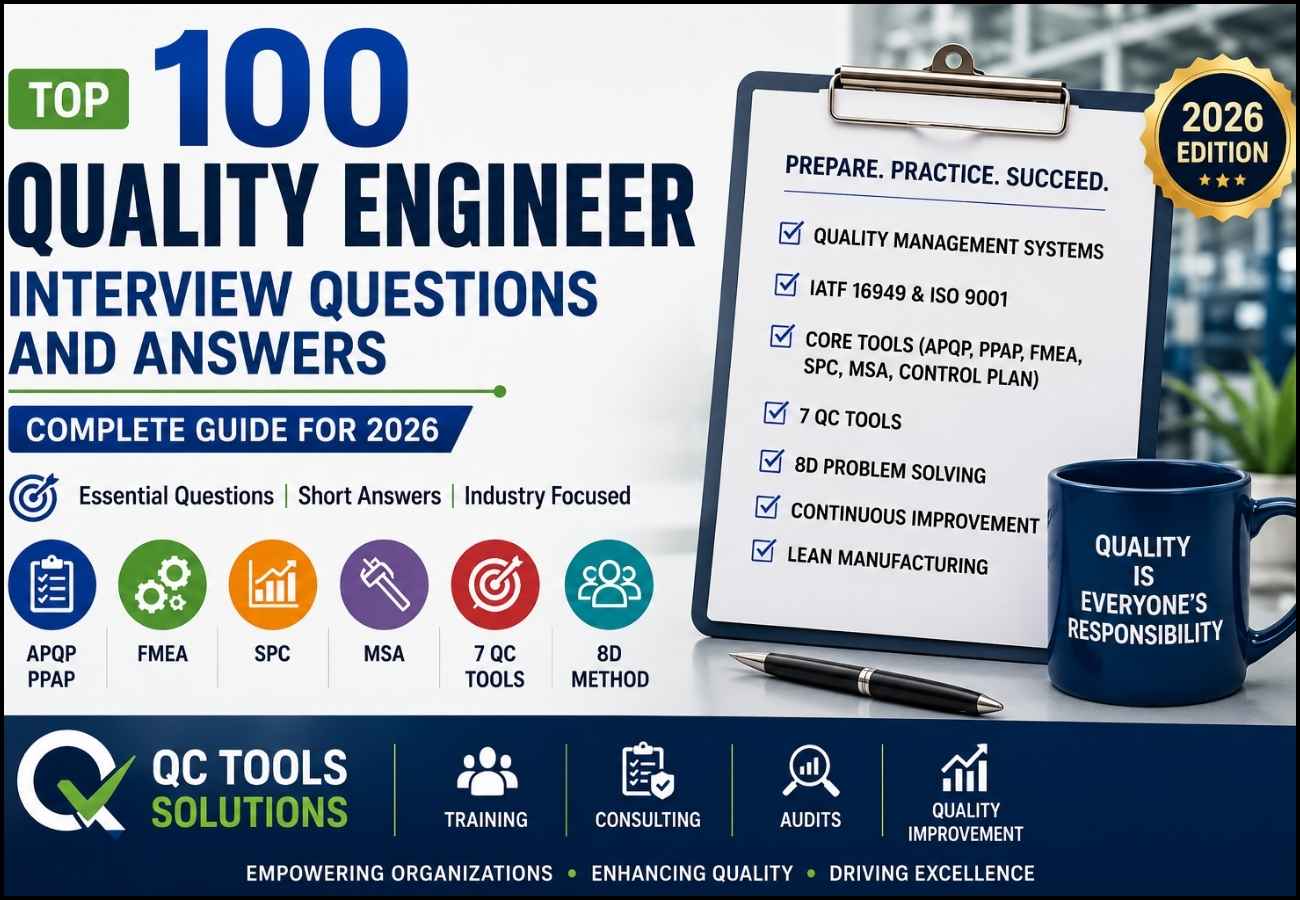
This comprehensive guide covers the Top 100 Quality Engineer Interview Questions and Answers commonly asked in automotive, manufacturing, aerospace, electronics, and engineering industries. The questions are designed to help candidates preparing for companies certified with IATF 16949, ISO 9001, ISO 14001, and other Quality Management Systems.
Who is a Quality Engineer?
A Quality Engineer (QE) is a professional responsible for ensuring that products and manufacturing processes meet defined quality standards, customer requirements, and regulatory specifications.
Quality Engineers work closely with:
- Production Team
- Design Engineers
- Process Engineers
- Suppliers
- Customers
- Maintenance Team
- Top Management
Their primary objective is to prevent defects instead of detecting them after production by implementing robust quality systems, process controls, and continuous improvement initiatives.
Industries Hiring Quality Engineers
Quality Engineers are in demand across various industries, including:
- Automotive
- Aerospace
- Electronics
- Medical Devices
- Plastic Injection Molding
- Sheet Metal Manufacturing
- Forging
- Casting
- Food Industry
- Pharmaceutical Industry
- Consumer Goods
Roles and Responsibilities of a Quality Engineer
A Quality Engineer performs several critical functions to maintain and improve product quality.
1. Ensure Product Quality
Verify that products meet customer specifications, drawings, and standards.
2. Conduct Process Audits
Perform internal audits, layered process audits, and supplier audits to ensure process compliance.
3. Implement Core Tools
Apply automotive Core Tools such as:
- APQP
- PPAP
- FMEA
- SPC
- MSA
4. Root Cause Analysis
Investigate customer complaints, process defects, and supplier issues using:
- 8D Methodology
- 5 Why Analysis
- Fishbone Diagram
- Pareto Analysis
5. Monitor Quality KPIs
Track and improve:
- PPM
- Rejection Rate
- Customer Complaints
- OEE
- COPQ
- Scrap Percentage
- First Pass Yield
6. Customer Interaction
Coordinate with customers during:
- New Product Development
- PPAP Submission
- Customer Audits
- Complaint Resolution
7. Supplier Quality Management
- Supplier Evaluation
- Supplier Audits
- Incoming Quality Control
- Supplier Development
8. Continuous Improvement
Lead Kaizen projects to improve productivity, reduce waste, and enhance process capability.
Skills Required for a Quality Engineer
Recruiters look for candidates with both technical and soft skills.
Technical Skills
- ISO 9001
- IATF 16949
- APQP
- PPAP
- FMEA
- SPC
- MSA
- Control Plan
- GD&T Basics
- Engineering Drawing Reading
- Statistical Analysis
- Process Capability (Cp, Cpk)
- Root Cause Analysis
- Lean Manufacturing
- Six Sigma
- 7 QC Tools
Software Skills
- Microsoft Excel
- Power BI
- Minitab
- SAP QM
- ERP Software
- MS Office
Soft Skills
- Communication
- Problem Solving
- Leadership
- Analytical Thinking
- Teamwork
- Presentation Skills
- Time Management
Top 100 Quality Engineer Interview Questions and Answers
Question 1. Tell me about yourself.
Answer
This is usually the first question in any interview.
Start with your education, mention your work experience, highlight your expertise in quality management, and conclude with your career goals.
Sample Answer
“I have completed my Diploma/B. Tech in Mechanical Engineering and have over three years of experience in Quality Assurance within the automotive industry. My experience includes process inspection, customer complaint handling, PPAP documentation, SPC, MSA, FMEA, and internal audits. I enjoy solving quality problems and continuously improving manufacturing processes. I am looking for an opportunity where I can contribute my quality knowledge while enhancing my professional skills.”
Question 2. What is the difference between Quality Assurance (QA) and Quality Control (QC)?
Answer
| Quality Assurance | Quality Control |
|---|---|
| Process-oriented | Product-oriented |
| Prevents defects | Detects defects |
| Proactive approach | Reactive approach |
| Focuses on systems | Focuses on inspection |
| Example: Process Audit | Example: Final Inspection |
Interview Tip: Explain that QA builds quality into the process, while QC verifies the quality of the finished product.
Question 3. What is the role of a Quality Engineer in a manufacturing company?
Answer
A Quality Engineer is responsible for:
- Ensuring customer requirements are met.
- Monitoring production quality.
- Conducting process audits.
- Handling customer complaints.
- Performing root cause analysis.
- Reducing rejection and scrap.
- Supporting new product development.
- Maintaining quality documentation.
- Coordinating supplier quality activities.
- Driving continuous improvement.
Question 4. What is IATF 16949?
Answer
IATF 16949 is an international Quality Management System standard specifically developed for the automotive industry.
It integrates ISO 9001 requirements with additional automotive-specific requirements such as:
- Risk-based thinking
- Product safety
- Traceability
- Supplier management
- Process approach
- Customer-specific requirements
- Continuous improvement
- Defect prevention
Interview Tip: Mention that IATF 16949 emphasizes prevention of defects and reduction of variation and waste throughout the supply chain.
Question 5. What are the seven Quality Control (QC) Tools?
Answer
The seven basic QC tools are:
- Check Sheet
- Pareto Chart
- Cause and Effect Diagram (Fishbone)
- Histogram
- Scatter Diagram
- Control Chart
- Stratification
These tools are widely used to collect data, analyze problems, identify root causes, and support continuous improvement.
Question 6. What is the difference between a defect, a defective item, and a nonconformity?
Answer
- Defect: A specific flaw or imperfection in a product (e.g., scratch, crack, burr).
- Defective: A product containing one or more defects that fails to meet requirements.
- Nonconformity: Any failure to meet a specified requirement in a product, process, or system.
Example: A missing dimension in a drawing, an incomplete inspection record, or an out-of-specification part can all be considered nonconformities.
Question 7. What are the Automotive Core Tools?
Answer
The five Automotive Core Tools are:
- APQP (Advanced Product Quality Planning)
- PPAP (Production Part Approval Process)
- FMEA (Failure Mode and Effects Analysis)
- SPC (Statistical Process Control)
- MSA (Measurement System Analysis)
These tools help ensure robust product development, process control, and customer satisfaction throughout the product lifecycle.
Question 8. What is Root Cause Analysis (RCA)?
Answer
Root Cause Analysis is a structured problem-solving approach used to identify the underlying cause of a problem instead of only treating its symptoms.
Common RCA techniques include:
- 5 Why Analysis
- Fishbone Diagram (Ishikawa)
- 8D Methodology
- Fault Tree Analysis
- Pareto Analysis
A good Quality Engineer always validates the root cause before implementing corrective actions.
Question 9. What is CAPA?
Answer
CAPA stands for Corrective Action and Preventive Action.
- Corrective Action: Eliminates the root cause of an existing problem to prevent recurrence.
- Preventive Action: Identifies and eliminates potential causes of future problems before they occur.
A typical CAPA process includes:
- Problem identification
- Root cause analysis
- Action plan
- Implementation
- Effectiveness verification
- Documentation and closure
Question 10. What do you do if a customer complaint is received?
Answer
When handling a customer complaint, a Quality Engineer should follow a systematic process:
- Acknowledge the complaint promptly.
- Contain the affected products (sorting, quarantine, or shipment hold).
- Collect relevant data and evidence.
- Analyze the root cause using tools such as 5 Whys or Fishbone.
- Implement corrective and preventive actions.
- Verify the effectiveness of the actions.
- Update relevant documents such as FMEA, Control Plan, SOPs, and inspection standards if necessary.
- Submit an 8D report or customer-required response within the agreed timeline.
- Monitor the process to ensure the issue does not recur.
Interview Tip: Emphasize customer communication, timely containment, and permanent corrective action, as these are critical expectations in automotive and manufacturing environments.
11. What is APQP?
Answer: APQP (Advanced Product Quality Planning) is a structured process used to ensure a product meets customer requirements from concept to production. It consists of five phases: Planning, Product Design, Process Design, Product & Process Validation, and Feedback & Improvement.
12. What is PPAP?
Answer: PPAP (Production Part Approval Process) is used to demonstrate that the supplier understands all customer requirements and can consistently manufacture conforming products. It includes documents such as PSW, DFMEA, PFMEA, Control Plan, MSA, SPC, and Dimensional Reports.
13. What is FMEA?
Answer: FMEA (Failure Mode and Effects Analysis) is a risk assessment tool used to identify potential failures, evaluate their effects, and implement actions to reduce risks before production.
14. What is the difference between DFMEA and PFMEA?
Answer: DFMEA focuses on potential failures in product design, while PFMEA focuses on potential failures in the manufacturing process.
15. What is a Control Plan?
Answer: A Control Plan is a document that defines the process controls, inspection methods, measurement frequency, reaction plans, and responsibilities to ensure product quality during production.
16. What is SPC?
Answer: SPC (Statistical Process Control) is a quality control technique that uses statistical methods and control charts to monitor and control manufacturing processes.
17. What is MSA?
Answer: MSA (Measurement System Analysis) evaluates the accuracy and reliability of measuring equipment. Common MSA studies include Gauge R&R, Bias, Linearity, and Stability.
18. What is Gauge R&R?
Answer: Gauge Repeatability and Reproducibility (Gauge R&R) measures variation caused by the measuring instrument and the operator. It determines whether a measurement system is suitable for use.
19. What are Cp and Cpk?
Answer: Cp measures the potential capability of a process, while Cpk measures the actual process capability by considering process centering. A Cpk value of 1.33 or higher is generally considered acceptable in many industries.
20. What is the 8D Problem Solving Method?
Answer: The 8D Method is a structured approach for solving recurring problems. It includes team formation, problem description, containment, root cause analysis, corrective actions, validation, recurrence prevention, and team recognition.
21. What is a Non-Conformance Report (NCR)?
Answer: An NCR is a document used to record products or processes that do not meet specified requirements. It helps ensure proper corrective actions, documentation, and traceability.
22. What is Poka-Yoke?
Answer: Poka-Yoke is a mistake-proofing technique used to prevent human errors in manufacturing by designing processes that make mistakes impossible or immediately detectable.
23. What is Kaizen?
Answer: Kaizen is a Japanese philosophy of continuous improvement that encourages small, ongoing improvements involving all employees to enhance quality, productivity, and efficiency.
24. What is 5S?
Answer: 5S is a workplace organization methodology consisting of Sort, Set in Order, Shine, Standardize, and Sustain. It improves workplace organization, safety, efficiency, and productivity.
25. Why do you want to work as a Quality Engineer?
Answer: “I enjoy solving quality-related problems, improving manufacturing processes, and ensuring customer satisfaction. My knowledge of quality tools and continuous improvement motivates me to build a successful career as a Quality Engineer while contributing to the organization’s growth and product excellence.”
26. What is ISO 9001?
Answer: ISO 9001 is an international Quality Management System (QMS) standard that helps organizations consistently provide products and services meeting customer and regulatory requirements.
27. What is the objective of ISO 9001?
Answer: The main objective of ISO 9001 is to improve customer satisfaction through effective quality management, continual improvement, and consistent process performance.
28. What is a Quality Management System (QMS)?
Answer: A Quality Management System (QMS) is a structured framework of policies, processes, procedures, and records used to ensure consistent product and service quality.
29. What is an Internal Audit?
Answer: An Internal Audit is a systematic and independent evaluation conducted within an organization to verify compliance with quality management system requirements.
30. What is the purpose of an Internal Audit?
Answer: The purpose of an Internal Audit is to identify nonconformities, verify process effectiveness, ensure compliance, and identify opportunities for improvement.
31. What is a Process Audit?
Answer: A Process Audit evaluates whether a manufacturing process is operating according to defined standards and is capable of producing conforming products.
32. What is a Product Audit?
Answer: A Product Audit verifies whether the finished product meets customer specifications, drawings, and quality requirements.
33. What is a Layered Process Audit (LPA)?
Answer: A Layered Process Audit is a short, frequent audit performed by different management levels to ensure critical process controls are consistently followed.
34. What is Traceability?
Answer: Traceability is the ability to identify and track a product, material, or component throughout the manufacturing process using records or unique identification.
35. What is Calibration?
Answer: Calibration is the process of comparing a measuring instrument with a certified standard to ensure accurate and reliable measurements.
36. Why is Calibration important?
Answer: Calibration ensures measurement accuracy, reduces inspection errors, and helps maintain compliance with quality standards and customer requirements.
37. What is a Master Sample?
Answer: A Master Sample is an approved reference sample used to compare production parts and verify product quality during manufacturing.
38. What is a Work Instruction?
Answer: A Work Instruction is a detailed document that explains how to perform a specific task or operation correctly and consistently.
39. What is a Standard Operating Procedure (SOP)?
Answer: An SOP is a documented procedure that provides step-by-step instructions for performing a process consistently and in compliance with quality requirements.
40. What is First Pass Yield (FPY)?
Answer: First Pass Yield is the percentage of products that pass through a process without requiring rework or repair on the first attempt.
41. What is Rework?
Answer: Rework is the process of correcting a defective product so that it meets specified quality requirements.
42. What is Scrap?
Answer: Scrap is material or products that cannot be repaired or reworked and must be discarded due to quality defects.
43. What is Cost of Poor Quality (COPQ)?
Answer: Cost of Poor Quality (COPQ) is the total cost incurred due to defects, rework, scrap, warranty claims, customer complaints, and process failures.
44. What is Customer Satisfaction?
Answer: Customer Satisfaction is the degree to which a product or service meets or exceeds customer expectations.
45. What is Continuous Improvement?
Answer: Continuous Improvement is the ongoing effort to improve products, processes, and systems using methods such as Kaizen, PDCA, and Lean Manufacturing.
46. What is the PDCA Cycle?
Answer: PDCA stands for Plan, Do, Check, Act. It is a continuous improvement methodology used to solve problems and improve process performance.
47. What is Lean Manufacturing?
Answer: Lean Manufacturing is a management approach focused on eliminating waste, improving efficiency, and maximizing customer value.
48. What are the 8 Wastes of Lean Manufacturing?
Answer: The eight wastes are Transportation, Inventory, Motion, Waiting, Overproduction, Overprocessing, Defects, and Unused Human Talent (TIMWOODS).
49. What is OEE?
Answer: Overall Equipment Effectiveness (OEE) is a performance metric used to measure manufacturing productivity based on Availability, Performance, and Quality.
50. What is Six Sigma?
Answer: Six Sigma is a data-driven methodology used to reduce process variation, eliminate defects, and improve quality through the DMAIC (Define, Measure, Analyze, Improve, Control) approach.
51. What is DMAIC?
Answer: DMAIC stands for Define, Measure, Analyze, Improve, and Control. It is a structured problem-solving methodology used in Six Sigma projects.
52. What is the difference between Correction and Corrective Action?
Answer: A Correction fixes the immediate problem, while a Corrective Action eliminates the root cause to prevent recurrence.
53. What is Preventive Action?
Answer: Preventive Action is taken to eliminate the cause of a potential problem before it occurs.
54. What is Risk-Based Thinking?
Answer: Risk-Based Thinking is identifying, evaluating, and controlling risks and opportunities to improve process performance and prevent failures.
55. What is a Quality Policy?
Answer: A Quality Policy is a formal statement from top management expressing the organization’s commitment to quality and customer satisfaction.
56. What are Quality Objectives?
Answer: Quality Objectives are measurable goals established to improve product quality, process performance, and customer satisfaction.
57. What is Customer-Specific Requirement (CSR)?
Answer: CSR refers to additional quality requirements specified by a customer beyond standard industry or QMS requirements.
58. What is Product Safety?
Answer: Product Safety ensures that a product does not pose any risk to customers during its intended use.
59. What is Process Capability?
Answer: Process Capability measures a process’s ability to consistently produce products within specification limits.
60. What are Specification Limits?
Answer: Specification Limits are the upper and lower acceptable values defined by customer or design requirements.
61. What is a Control Chart?
Answer: A Control Chart is a statistical tool used to monitor process stability and identify variations over time.
62. What is Common Cause Variation?
Answer: Common Cause Variation is the natural variation inherent in a stable manufacturing process.
63. What is Special Cause Variation?
Answer: Special Cause Variation is unexpected variation caused by specific issues such as machine failure, operator error, or material defects.
64. What is Process Validation?
Answer: Process Validation confirms that a manufacturing process consistently produces products meeting predetermined quality requirements.
65. What is Product Validation?
Answer: Product Validation verifies that the finished product meets customer requirements and intended performance criteria.
66. What is Incoming Quality Control (IQC)?
Answer: IQC is the inspection and verification of incoming raw materials and components before they enter production.
67. What is In-Process Quality Control (IPQC)?
Answer: IPQC involves monitoring and inspecting products during manufacturing to ensure process quality.
68. What is Final Quality Control (FQC)?
Answer: FQC is the inspection of finished products before packaging and delivery to customers.
69. What is Outgoing Quality Control (OQC)?
Answer: OQC is the final verification of products before shipment to ensure they meet customer specifications.
70. What is Acceptance Sampling?
Answer: Acceptance Sampling is a statistical method of inspecting a sample from a lot to determine whether the entire lot should be accepted or rejected.
71. What is AQL?
Answer: AQL (Acceptable Quality Level) is the maximum number of defective items allowed in a sampling inspection for a lot to be accepted.
72. What is Supplier Quality Management?
Answer: Supplier Quality Management involves evaluating, monitoring, and improving supplier performance to ensure consistent product quality.
73. What is an 8D Report?
Answer: An 8D Report is a structured document used to record problem-solving activities, root cause analysis, corrective actions, and preventive actions.
74. What is a Quality Manual?
Answer: A Quality Manual is a document that describes an organization’s Quality Management System, policies, scope, and key processes.
75. Why should we hire you as a Quality Engineer?
Answer: “I have strong knowledge of quality tools, quality management systems, problem-solving techniques, and continuous improvement. I am committed to improving product quality, reducing defects, and contributing to customer satisfaction while working effectively as part of a team.”
76. What is the difference between Verification and Validation?
Answer: Verification ensures the product is built according to specifications, while Validation ensures the product meets customer needs and intended use.
77. What is Quality Inspection?
Answer: Quality Inspection is the process of examining products or materials to verify they meet specified quality requirements.
78. What is Visual Inspection?
Answer: Visual Inspection is checking a product for visible defects such as scratches, dents, cracks, burrs, or incorrect assembly without using measuring instruments.
79. What is the purpose of a Check Sheet?
Answer: A Check Sheet is used to collect and record quality-related data in a simple and organized manner for analysis.
80. What is a Pareto Chart?
Answer: A Pareto Chart is a bar graph that helps identify the most significant problems based on the 80/20 principle.
81. What is a Fishbone Diagram?
Answer: A Fishbone Diagram (Cause-and-Effect Diagram) is used to identify and analyze the possible root causes of a problem.
82. What is a Histogram?
Answer: A Histogram is a graphical representation of data distribution used to analyze process variation and frequency.
83. What is a Scatter Diagram?
Answer: A Scatter Diagram shows the relationship between two variables and helps determine whether they are correlated.
84. What is a Flow Chart?
Answer: A Flow Chart is a graphical representation of the sequence of steps in a process.
85. What is a Check Fixture?
Answer: A Check Fixture is a special inspection tool used to verify the dimensional accuracy of manufactured components.
86. What is an Error-Proofing Device?
Answer: An Error-Proofing Device (Poka-Yoke) prevents mistakes or immediately detects errors before defective products are produced.
87. What is Supplier PPAP?
Answer: Supplier PPAP is the approval process used to verify that a supplier can consistently produce parts meeting customer specifications.
88. What is a Run @ Rate?
Answer: Run @ Rate is a production trial conducted to verify that the manufacturing process can achieve the required production volume while maintaining quality.
89. What is Safe Launch?
Answer: Safe Launch is a temporary enhanced inspection process implemented during new product launches to ensure product quality and customer satisfaction.
90. What is an Engineering Change (ECN/ECR)?
Answer: An Engineering Change Notice (ECN) or Engineering Change Request (ECR) is a formal process used to document and control changes in product design or manufacturing processes.
91. What is Document Control?
Answer: Document Control ensures that only the latest approved documents are available for use and obsolete documents are removed.
92. What is Change Management?
Answer: Change Management is the systematic process of planning, reviewing, approving, implementing, and monitoring changes to products or processes.
93. What is a Quality Alert?
Answer: A Quality Alert is a communication issued to inform employees about quality issues, defects, or preventive actions to avoid recurrence.
94. What is Warranty Analysis?
Answer: Warranty Analysis involves investigating returned products and warranty claims to identify recurring failures and improve product quality.
95. What is Customer Complaint Analysis?
Answer: Customer Complaint Analysis is the process of investigating customer complaints, identifying root causes, and implementing corrective actions.
96. What is the role of a Quality Engineer during a Customer Audit?
Answer: A Quality Engineer supports customer audits by presenting quality records, explaining processes, demonstrating compliance, and addressing audit findings.
97. What is the role of a Quality Engineer in New Product Development (NPD)?
Answer: A Quality Engineer ensures quality planning, risk assessment, APQP implementation, PPAP preparation, and process validation during new product development.
98. How do you handle pressure and tight deadlines?
Answer: I prioritize tasks, communicate effectively, focus on critical issues, work systematically, and maintain quality standards while meeting deadlines.
99. What are your strengths as a Quality Engineer?
Answer: My strengths include analytical thinking, problem-solving, knowledge of quality tools, attention to detail, teamwork, communication, and a commitment to continuous improvement.
100. Do you have any questions for us?
Answer: Yes. I would like to know about the company’s quality systems, opportunities for learning and career growth, major quality challenges, training programs, and expectations for this role. Asking thoughtful questions demonstrates genuine interest and professionalism.
Conclusion
Preparing for a Quality Engineer interview requires more than memorizing definitions. Employers look for candidates who understand quality concepts, can apply problem-solving tools, and have practical knowledge of Quality Management Systems, Core Tools, Lean Manufacturing, and continuous improvement techniques.
We hope these Top 100 Quality Engineer Interview Questions and Answers help you build confidence and perform well in your next interview. Review these questions regularly, understand the concepts behind each answer, and relate them to your practical experience. With the right preparation, you can increase your chances of securing a Quality Engineer position in the automotive, manufacturing, aerospace, or other engineering industries.
Looking to build a successful career in Quality Engineering?
Explore more expert resources on Learn QC Tools, including in-depth guides on IATF 16949, ISO 9001, APQP, PPAP, FMEA, SPC, MSA, 8D Problem Solving, Lean Manufacturing, and the 7 QC Tools. Whether you’re preparing for interviews, improving your technical skills, or implementing quality systems in your organization, our practical articles are designed to support your learning.
Need professional support? QC Tools Solutions provides Quality Management System (QMS) consulting, IATF 16949 implementation, Internal Auditor training, Core Tools training, process audits, and quality improvement solutions for manufacturing organizations.
Bookmark this guide, share it with your colleagues, and keep visiting QC Tools Solutions for the latest quality management insights and interview preparation resources.