
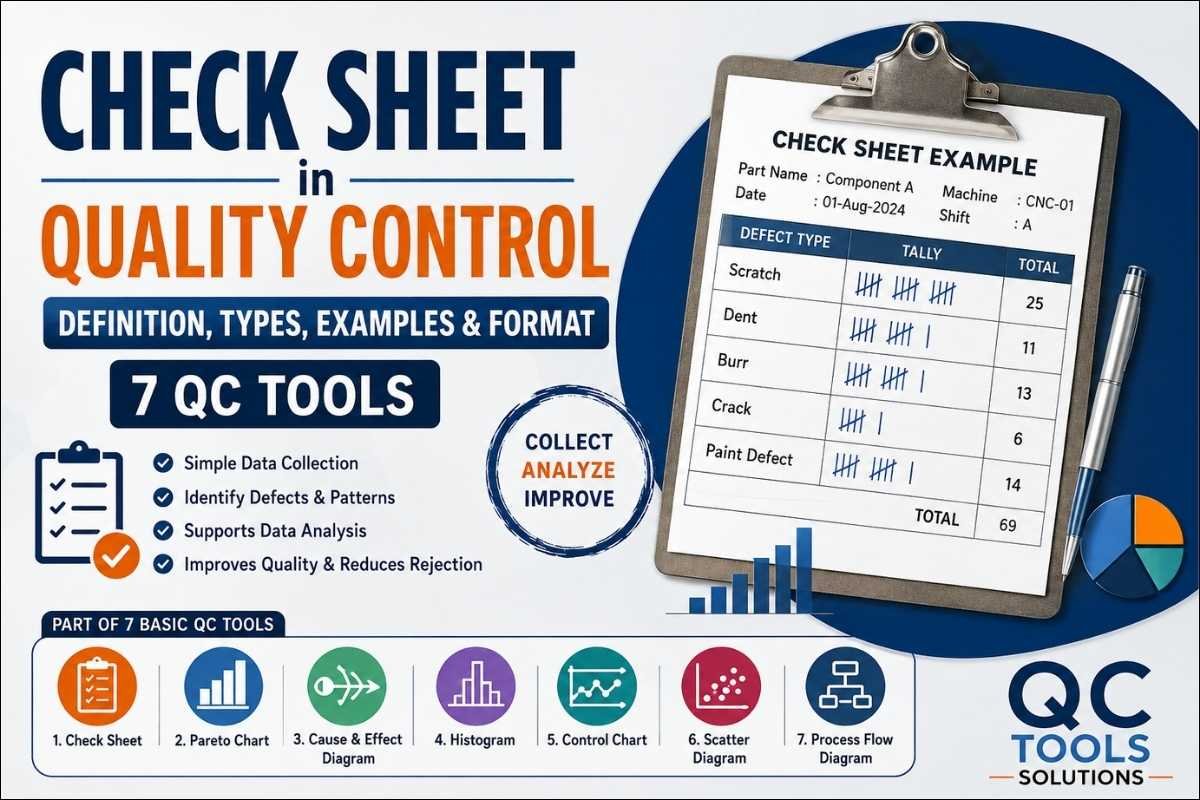
A Check Sheet is one of the seven basic quality control tools used to collect and organize data in a simple and systematic manner. It helps quality professionals, production teams and inspectors record defects, occurrences, measurements or other process information at the place where the data is generated.
A check sheet is also commonly called a Tally Sheet. The collected data can later be analyzed using other quality tools such as the Pareto Chart, Histogram and Bar Graph.
In manufacturing and quality control, a properly designed check sheet makes data collection simple, consistent and easy to analyze.
What is a Check Sheet in Quality Control?
A check sheet in quality control is a structured form used to collect and record data about a process, product, defect or event.
Instead of collecting information randomly in notebooks or different files, a check sheet provides a standard format where the required information can be recorded using tally marks, numbers, symbols or check marks.
For example, if a production department wants to know which defects occur most frequently during final inspection, the inspector can record each defect on a check sheet.
After collecting the data, the total number of occurrences can be calculated and analyzed using a Pareto Chart.
In simple words:
Check Sheet = A simple method for collecting data in a structured format.
Check Sheet in 7 QC Tools
The Check Sheet is one of the 7 Basic QC Tools.
The commonly used seven QC tools are:
- Check Sheet
- Pareto Chart
- Cause and Effect Diagram
- Histogram
- Control Chart
- Scatter Diagram
- Process Flow Diagram
The Check Sheet is generally used at the data collection stage of quality improvement.
For example:
Problem → Collect Data using Check Sheet → Analyze using Pareto Chart → Identify Possible Causes using Fishbone Diagram → Verify Causes → Take Corrective Action
Therefore, the Check Sheet is often the starting point for data-based problem solving.
Why is a Check Sheet used in Quality Control?
The main purpose of a check sheet is to collect reliable and organized data.
It can be used to:
- Record the frequency of defects
- Record the type of defects
- Record defect locations
- Record defect causes
- Record inspection results
- Record machine conditions
- Record production information
- Record rejections and rework
- Record downtime or abnormalities
- Record measurement results
- Identify patterns and trends
- Provide data for further analysis
The data collected through a check sheet can become input for other quality tools.
For example, defect data collected through a check sheet can be summarized in a Pareto Chart to identify the major defect categories.
When should a check sheet be used?
A check sheet is useful when the same type of information needs to be collected repeatedly and consistently.
You can use a check sheet when:
- Data needs to be collected repeatedly.
- Data is generated at a specific location.
- Different people need to collect the same type of information.
- You need to identify the frequency of defects.
- You need to identify patterns in a process.
- You need to collect inspection results.
- You need to record machine conditions.
- You need to collect production or rejection data.
- You need reliable data for further quality analysis.
For example, if a company wants to know how many scratches, dents and paint defects occur every day, a defect check sheet can be used at the inspection area.
Types of Check Sheets
Different types of check sheets can be designed depending on the purpose of data collection.
1. Defect Classification Check Sheet
This check sheet is used to record different types of defects found during inspection.
For example:
| Defect Type | Tally | Total |
|---|---|---|
| Scratch | IIII | 4 |
| Dent | II | 2 |
| Burr | III | 3 |
| Crack | I | 1 |
This type of check sheet helps identify which defects occur most frequently.
2. Defect Location Check Sheet
A defect location check sheet is used when the location of the defect is important.
For example, in an automotive component, defects may be recorded according to the location on the part.
This can help determine whether defects are concentrated in a particular area.
3. Frequency Check Sheet
A frequency check sheet records how frequently an event occurs.
For example, machine stoppages can be recorded during each shift.
| Reason for Stoppage | Shift A | Shift B | Shift C | Total |
|---|---|---|---|---|
| Tool Change | 4 | 3 | 5 | 12 |
| Material Shortage | 2 | 4 | 3 | 9 |
| Machine Problem | 3 | 2 | 4 | 9 |
The data can later be analyzed to identify the major causes of downtime.
4. Inspection Check Sheet
An inspection check sheet is used to record inspection results.
It may contain information such as:
- Part name
- Part number
- Customer
- Operation
- Machine number
- Date
- Shift
- Operator
- Inspection parameter
- Specification
- Inspection method
- Actual result
- OK/NG status
In manufacturing, inspection check sheets should be aligned with applicable product specifications and the organization’s control plan.
5. Process or Verification Check Sheet
This type of check sheet is used to verify whether required process activities or conditions have been completed.
For example:
- Correct material available
- Correct tool installed
- Machine setting verified
- First-piece approval completed
- Required parameter checked
- Safety condition verified
6. Measurement Check Sheet
A measurement check sheet is used to record numerical values such as:
- Diameter
- Length
- Thickness
- Weight
- Temperature
- Pressure
- Torque
The collected measurement data can subsequently be analyzed using tools such as a Histogram or Control Chart.
7. Machine Check Sheet
A machine check sheet is used to verify the condition of equipment before or during operation.
Typical checkpoints may include:
- Lubrication condition
- Oil level
- Abnormal noise
- Leakage
- Safety guard
- Pressure
- Temperature
- Electrical condition
- Cleaning condition
A daily machine startup check sheet is a common example.
Check Sheet Format
There is no single standard check sheet format. The format should be designed according to the purpose of data collection.
A basic quality control check sheet may contain:
| Date | Shift | Defect | Machine | Operator | Tally | Total |
|---|---|---|---|---|---|---|
| 01-Aug | A | Scratch | M1 | Operator 1 | ||
| 01-Aug | A | Dent | M1 | Operator 1 | ||
| 01-Aug | B | Scratch | M2 | Operator 2 |
A good check sheet should be:
- Simple to understand
- Easy to fill in
- Easy to verify
- Clearly labeled
- Suitable for the required data
- Designed to minimize duplicate data entry
- Useful for subsequent analysis
How to make a check sheet?
Follow these steps to prepare an effective check sheet.
Step 1: Define the Purpose
First determine why you need to collect the data.
For example:
To identify the most frequent defects occurring during final inspection.
Step 2: Define what data is required
Decide exactly what information needs to be recorded.
For example:
- Defect type
- Date
- Shift
- Machine
- Part number
- Quantity
- Location
Step 3: Define the Categories
Create clear categories for the information to be collected.
For example:
- Scratch
- Dent
- Crack
- Burr
- Wrong dimension
Categories should be clear enough that different people interpret them in the same way.
Step 4: Decide Who, When and Where
Define:
- Who will collect the data?
- When will the data be collected?
- Where will it be collected?
- For how long will it be collected?
Step 5: Design the Check Sheet
Create a simple format that allows the operator or inspector to record information quickly using tally marks, numbers or check marks.
Step 6: Trial the Format
Use the check sheet for a short trial period.
Check whether:
- All required information can be recorded.
- Any important category is missing.
- The format is easy to understand.
- Data collection takes excessive time.
Step 7: Start Data Collection
Once the format is confirmed, start collecting the data consistently.
The person collecting the data should follow the defined method throughout the data-collection period.
Check Sheet Example in Quality Control
Consider a manufacturing company that wants to identify the major defects found during final inspection.
The quality inspector records the defects every day.
| Defect | Monday | Tuesday | Wednesday | Thursday | Friday | Total |
|---|---|---|---|---|---|---|
| Scratch | 5 | 4 | 6 | 3 | 7 | 25 |
| Dent | 2 | 3 | 2 | 1 | 3 | 11 |
| Burr | 3 | 2 | 4 | 2 | 2 | 13 |
| Crack | 1 | 1 | 2 | 1 | 1 | 6 |
| Paint Defect | 4 | 3 | 2 | 3 | 2 | 14 |
From this check sheet, the organization can identify the total occurrence of each defect.
The data can then be converted into a Pareto Chart to determine which defects contribute most to the total rejection.
This is one of the major advantages of using a check sheet as part of the 7 QC Tools.
Monthly Rejection Check Sheet
A monthly rejection check sheet can be used in manufacturing to collect and summarize rejection information.
Typical information may include:
- Part number
- Part name
- Defect type
- Quantity produced
- Rejection quantity
- Rejection percentage
- Rejection PPM
- Machine
- Process
- Shift
Daily rejection data can be collected and then summarized at the end of the month.
This information can be used for:
- Pareto analysis
- Rejection trend analysis
- Process improvement
- Management review
- Corrective action
Daily Production Check Sheet
A production check sheet can be used to collect daily production information.
Typical information includes:
- Date
- Shift
- Machine
- Operator
- Part number
- Operation
- Production quantity
- Rejection quantity
- Rework quantity
- Downtime
- Time loss
This information can also support calculations related to production performance and Overall Equipment Effectiveness (OEE).
Daily Machine Check Sheet
A daily machine check sheet is generally used to verify machine condition before starting production.
Typical checkpoints may include:
- Oil level
- Lubrication
- Hydraulic pressure
- Air pressure
- Abnormal noise
- Leakage
- Safety guards
- Emergency stop
- Cleaning
- Electrical condition
The operator can complete the check sheet before starting the machine, and the supervisor or responsible person can verify it according to the organization’s procedure.
Inspection Check Sheet Example
An inspection check sheet may be used for setup approval, first-piece inspection or in-process inspection.
A typical format may include:
| Field | Information |
|---|---|
| Part Name | Component A |
| Part Number | ABC-001 |
| Customer | Customer A |
| Operation | Turning |
| Machine | CNC-01 |
| Date | 01-Aug |
| Shift | A |
| Parameter | Diameter |
| Specification | 20.00 ± 0.05 mm |
| Actual | 20.02 mm |
| Status | OK |
The inspection parameters, specifications and inspection method should be based on the applicable product and process requirements, such as the control plan and approved specifications.
Check Sheet and Pareto Chart
The Check Sheet and Pareto Chart are closely connected.
A typical sequence is:
Check Sheet → Data Collection → Summarization → Pareto Chart → Major Problem Identification
For example, suppose the check sheet shows:
- Scratch = 25
- Paint defect = 14
- Burr = 13
- Dent = 11
- Crack = 6
This data can be converted into a Pareto Chart.
The Pareto Chart helps the team focus on the most significant problems rather than trying to solve every problem simultaneously.
Check Sheet and Histogram
A check sheet can also be used to collect measurement data.
For example, suppose the diameter of a component is measured repeatedly.
The collected measurements can then be analyzed using a Histogram to understand:
- Data distribution
- Variation
- Spread
- Central tendency
- Possible abnormal patterns
Therefore:
Check Sheet = Collect Data
Histogram = Analyze Distribution
Check Sheet and Cause and Effect Diagram
The Check Sheet provides factual data, while the Cause and Effect Diagram helps the team explore possible causes of a problem.
For example:
Check Sheet: Shows that scratches are the most frequent defect.
↓
Pareto Chart: Confirms that scratches are the major defect.
↓
Cause and Effect Diagram: Helps identify possible causes related to Man, Machine, Method, Material, Measurement and Environment.
↓
Root Cause Verification: Data and process investigation are used to verify the actual cause.
This combination supports systematic problem solving.
Check Sheet vs Checklist
A check sheet and a checklist are related but they are not the same.
| Check Sheet | Checklist |
|---|---|
| Mainly used for data collection | Mainly used for task or requirement verification |
| Records frequency, measurements or occurrences | Confirms whether something has been completed |
| Can use tally marks and numerical data | Usually uses Yes/No, OK/NG or Done/Not Done |
| Data can be analyzed statistically | Mainly provides verification evidence |
| Example: Defect frequency sheet | Example: Audit checklist |
For example:
Check Sheet: How many scratches were found?
Checklist: Was the surface inspection completed?
This distinction is important in quality control.
Benefits of a Check Sheet
The major benefits of using a check sheet include:
- Simple and easy to use
- Provides a structured method of data collection
- Reduces dependence on memory
- Helps standardize data collection
- Makes data easier to organize
- Helps identify patterns
- Helps identify frequent defects
- Supports Pareto analysis
- Supports Histogram analysis
- Provides factual information for problem solving
- Helps teams make data-based decisions
- Can be customized for different processes
Limitations of a Check Sheet
Although a check sheet is simple and useful, it also has some limitations.
- Poorly defined categories can produce unreliable data.
- Incorrect data collection can lead to incorrect conclusions.
- A check sheet only collects information; it does not automatically identify the root cause.
- An overly complicated format can make data collection difficult.
- Data should be collected under defined and representative process conditions.
- The collected information should be reviewed and analyzed appropriately.
Therefore, the quality of the check sheet itself is important.
What makes a Good Check Sheet?
A good check sheet should follow these principles:
Keep it Simple
The person collecting data should understand the form without extensive explanation.
Define Each Category Clearly
Different people should classify the same event in the same way.
Collect Only Necessary Data
Avoid adding unnecessary columns that increase workload without providing useful information.
Make Data Collection Easy
Use tally marks, check marks, numbers or simple entries wherever possible.
Include Traceability Where Required
Depending on the application, include information such as:
- Date
- Shift
- Machine
- Part number
- Operator
- Inspector
- Lot or batch number
Make the Data useful for analysis
Design the format so that the collected information can easily be summarized and analyzed.
Check Sheet in Manufacturing
Check sheets are widely useful in manufacturing environments.
Common applications include:
- Incoming inspection
- In-process inspection
- Final inspection
- Defect collection
- Rejection monitoring
- Rework monitoring
- Machine startup verification
- Production monitoring
- Downtime collection
- Process parameter recording
- Maintenance checks
- Customer complaint data collection
For example, in an automotive manufacturing process, a defect check sheet can be used to collect data from final inspection and then use that data for Pareto analysis and corrective action.
Check Sheet in Quality Improvement
The real value of a check sheet is not simply recording data.
Its value comes from converting observations into usable information.
A typical quality improvement cycle can be:
Observe → Collect Data → Analyze → Identify Problem → Find Causes → Verify Causes → Take Action → Monitor Results
The check sheet supports the data-collection stage of this cycle.
Without reliable data, quality improvement decisions can become based on assumptions rather than facts.
Check Sheet PDF and Template
A useful check sheet should be designed according to the specific purpose of data collection.
For example, you may need separate templates for:
- Defect collection
- Inspection
- Machine startup
- Production
- Rejection
- Rework
- Downtime
- Measurement
- Process verification
A downloadable Check Sheet PDF or Excel template can be particularly useful for quality engineers, production engineers, inspectors and students learning the 7 QC Tools.
Frequently Asked Questions About Check Sheets
What is a check sheet in quality control?
A check sheet is a structured form used to collect and organize data about defects, events, measurements, inspections or process conditions. It is one of the seven basic QC tools.
What is a check sheet in 7 QC Tools?
A check sheet is one of the seven basic QC tools. It is mainly used for systematic data collection before the data is analyzed using other quality tools.
What are the types of check sheets?
Common types include defect classification check sheets, defect location check sheets, frequency check sheets, measurement check sheets, inspection check sheets, process verification check sheets and machine check sheets.
What is a QC checklist?
A QC checklist is a list of requirements, activities or checkpoints used to verify whether specified tasks or conditions have been completed. It is different from a check sheet, which is primarily designed for collecting data.
What is the difference between a check sheet and a checklist?
A check sheet generally collects data such as defect frequency, measurements or occurrences. A checklist generally verifies whether required activities or conditions have been completed.
What is a check sheet format?
A check sheet format is a structured table designed for a specific data-collection purpose. It may include fields such as date, shift, machine, part number, defect type, tally, quantity and inspection status.
How do you prepare a check sheet?
First define the purpose, determine what data is required, define categories, decide who and when the data will be collected, design the form, conduct a trial and then begin standardized data collection.
What is an example of a check sheet?
A defect check sheet used during final inspection is a common example. The inspector records defects such as scratches, dents, cracks and burrs using tally marks and summarizes the total at the end of the inspection period.
Why is a check sheet important?
A check sheet makes data collection systematic, consistent and easier to analyze. It provides factual information that can support quality improvement and problem solving.
How is a check sheet used with a Pareto Chart?
Defect data is first collected using a check sheet. The totals are then summarized and arranged in descending order to prepare a Pareto Chart. This helps identify the most significant defect categories.
Is a check sheet the same as a checklist?
No. Although the terms are sometimes used interchangeably, their purposes are different. A check sheet generally collects data, while a checklist generally verifies completion or compliance.
What are the 7 QC Tools?
The seven basic QC tools are Check Sheet, Pareto Chart, Cause and Effect Diagram, Histogram, Control Chart, Scatter Diagram and Process Flow Diagram.
Practical Example of the 7 QC Tools, starting with a Check Sheet
Suppose a manufacturing company has a high rejection rate.
The team first collects defect data using a Check Sheet.
The data is summarized in a Pareto Chart.
The major defect is identified.
The team then uses a Cause and Effect Diagram to identify possible causes.
The causes are investigated and verified using actual process data.
After corrective action, a Control Chart or other suitable monitoring method can be used to determine whether the process remains stable.
This shows how the Check Sheet can become the starting point for systematic quality improvement.
Key Takeaways
A Check Sheet is a simple but powerful quality control tool.
The most important points are:
- Check Sheet is one of the 7 Basic QC Tools.
- It is primarily used for systematic data collection.
- It can record defects, measurements, occurrences and inspection results.
- It should be simple and easy to use.
- Categories should be clearly defined.
- Data should be collected consistently.
- Check Sheet data can be analyzed using Pareto Charts, Histograms and other tools.
- A check sheet is different from a checklist.
- Manufacturing organizations can use check sheets for inspection, production, rejection, machine checks and process monitoring.
- Reliable data collection is an important foundation for fact-based problem solving.
Check Sheet example:
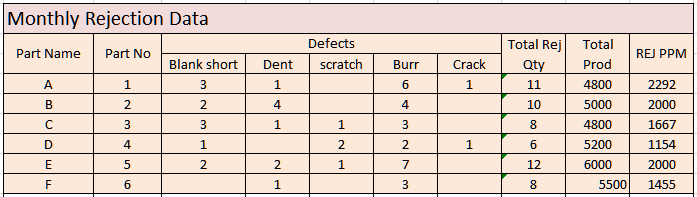
Monthly Rejection Sheet:
This is a format for collecting monthly rejection data in the automotive industry. We can collect rejection data through red bin meetings daily. At the end of the month, summarize all rejections in this format to do a Pareto analysis. Also we can get total rejections part-wise, defect-wise and rejection PPM of the month.
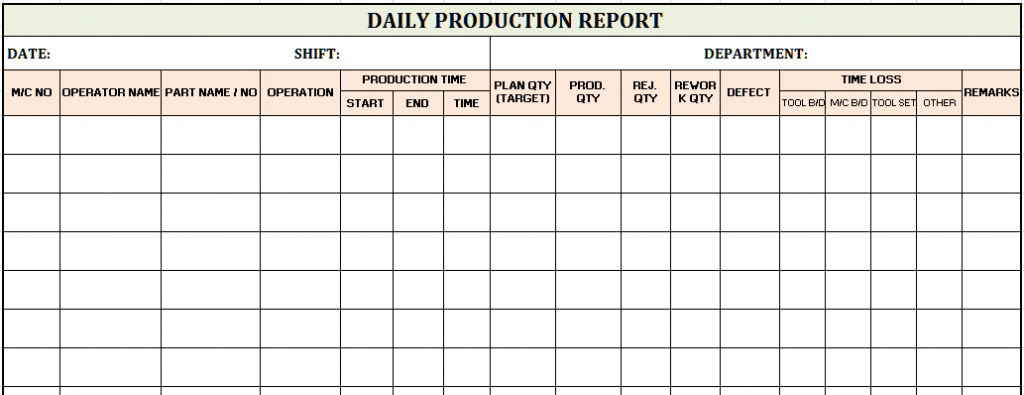
Daily Production Report:
In the production sheet, we can collect daily production data of Machines, Operators, Part Names, Operations, Production quantity, Rejection quantity, Rework quantity and time loss etc. So there is a lot of data captured in one sheet. It is used for calculating performance, Overall equipment effectiveness (OEE) etc.
Daily Machine Check Sheet:
The daily machine check sheet is used to check the condition of the machine before starting. There are some checkpoints in the daily machine check sheet. The operator fills the check sheet daily and the supervisor verifies the daily machine check sheet. This is also called a startup check sheet.
For more details about the daily machine check sheet. Check the machine maintenance procedure.
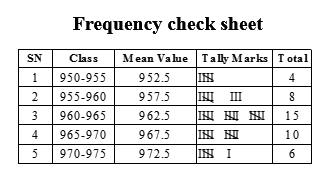
Frequency Check Sheet :
It is a sheet for collecting data on a frequency basis.
Inspection Check Sheet :
This is the format to be used for part inspection for set-up approval and in-process inspection. There should be a judgment row for part quality status in this format. The check sheet contains Part name, Part number, Customer name, operation name, machine number, operator name and date. So this check sheet contains all the data for traceability purposes. The parameters, specifications and inspection method are as per the control plan.

Conclusion
The Check Sheet in Quality Control is one of the simplest and most useful tools for collecting process data. It provides a structured way to record defects, measurements, inspection results, production information and other events directly where they occur.
Its importance becomes even greater when it is used together with the other 7 QC Tools. Data collected through a Check Sheet can be summarized in a Pareto Chart, analyzed using a Histogram, investigated using a Cause and Effect Diagram and monitored using a Control Chart.
For quality professionals, production engineers, inspectors and students, learning how to design and use an effective check sheet is an important step toward data-based quality improvement and systematic problem solving.
You may like to read about other 7 QC Tools:
I enjoy your writing style truly enjoying this site.