
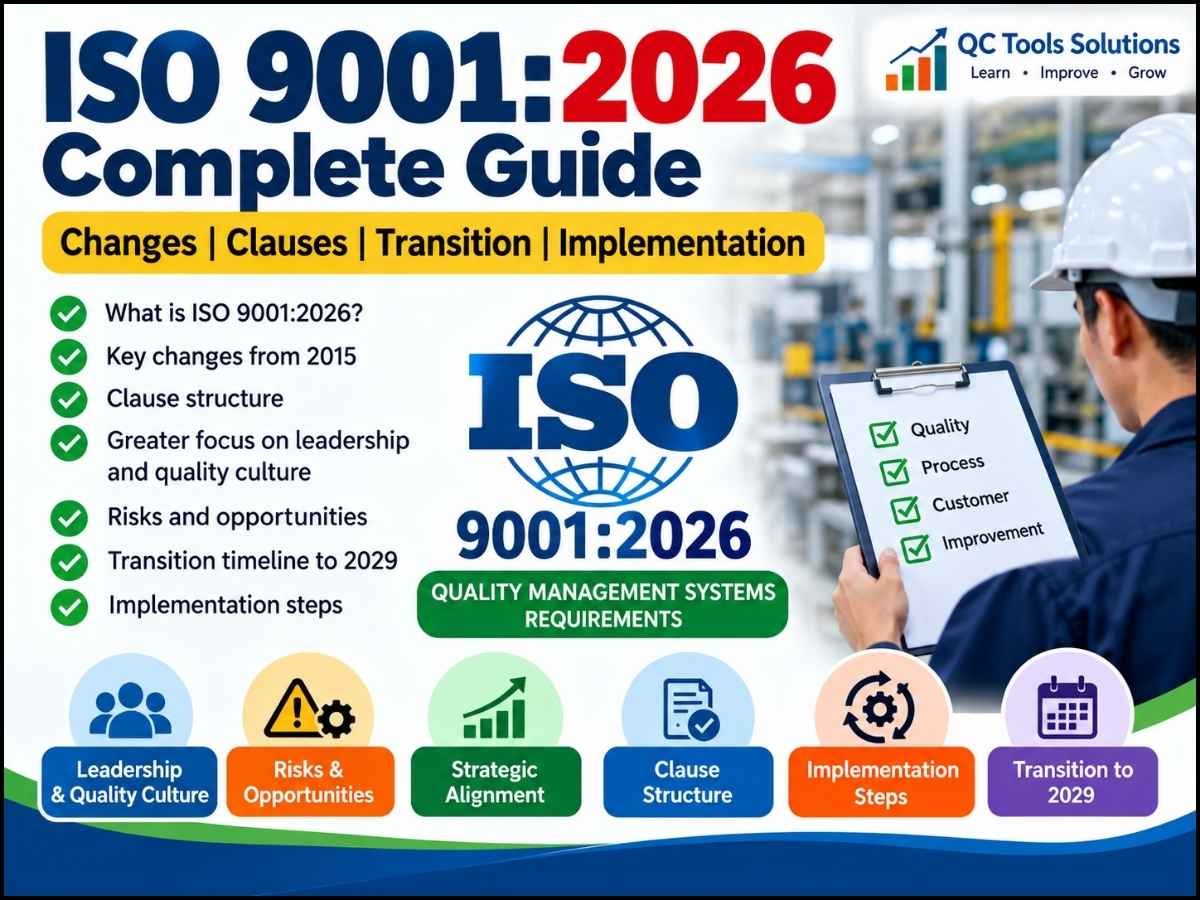
ISO 9001:2026 is the latest edition of the internationally recognized standard for Quality Management Systems (QMS). It was officially published on 16 September 2026 and replaces ISO 9001:2015.
The new edition builds on the familiar ISO 9001 framework rather than completely changing the way organizations manage quality. The revision focuses on clearer requirements, stronger leadership, quality culture, accountability, better consideration of risks and opportunities, and improved alignment with other ISO management system standards.
For organizations already certified to ISO 9001:2015, ISO 9001:2026 does not mean starting the Quality Management System from zero. Organizations should review their existing QMS, understand the new requirements, identify gaps and make the necessary changes.
This article explains what ISO 9001:2026 is, what has changed, what has remained the same, the transition timeline, and how organizations can prepare for the new edition.
- What is ISO 9001:2026?
- When was ISO 9001:2026 published?
- Why was ISO 9001 revised?
- What are the major changes in ISO 9001:2026?
- 1. Stronger emphasis on leadership
- Simple example
- 2. Greater focus on quality culture
- 3. Clearer distinction between risks and opportunities
- Example
- 4. Stronger connection between quality and business strategy
- 5. Greater emphasis on people and awareness
- 6. New Annex A
- 7. Continued alignment with other ISO management standards
- What has NOT changed in ISO 9001:2026?
- ISO 9001:2015 vs ISO 9001:2026
- ISO 9001:2026 Clauses
- What does ISO 9001:2026 mean for existing ISO 9001:2015 certified companies?
- ISO 9001:2026 Transition Timeline
- How to Prepare for ISO 9001:2026 Transition
- Step 1: Obtain and understand the new standard
- Step 2: Conduct a gap analysis
- Step 3: Review the Quality Policy
- Step 4: Review quality culture
- Step 5: Review risks and opportunities
- Step 6: Update training and awareness
- Step 7: Conduct an internal audit
- Step 8: Review with top management
- Step 9: Coordinate with your certification body
- Do you need to rewrite all ISO 9001 documents?
- Benefits of ISO 9001:2026
- ISO 9001:2026 Frequently Asked Questions
- Is ISO 9001:2026 released?
- Does ISO 9001:2026 replace ISO 9001:2015?
- Is ISO 9001:2026 mandatory?
- Do ISO 9001:2015 certified companies need to start again?
- What is the ISO 9001:2026 transition deadline?
- When will new ISO 9001 certifications be issued to ISO 9001:2026?
- Has the ISO 9001 clause structure changed?
- What is the biggest focus of ISO 9001:2026?
- Is ISO 9001:2026 completely different from ISO 9001:2015?
- Conclusion
What is ISO 9001:2026?
ISO 9001:2026 is the sixth edition of ISO 9001, titled Quality management systems — Requirements.
It provides requirements for establishing, implementing, maintaining and continually improving a Quality Management System (QMS).
ISO 9001 can be used by organizations of different sizes and from different sectors. It is applicable to manufacturing, automotive, engineering, construction, healthcare, education, IT, consulting, logistics and service organizations.
The standard is designed to help organizations:
- Consistently meet customer requirements
- Improve products and services
- Control and improve processes
- Manage risks and opportunities
- Improve customer satisfaction
- Strengthen leadership involvement
- Promote continual improvement
- Build confidence among customers and other interested parties
ISO states that more than one million certificates have been issued to organizations in 189 countries, making ISO 9001 the world’s most widely used quality management standard.
When was ISO 9001:2026 published?
ISO 9001:2026 was officially published on 16 September 2026.
It is now the current edition of ISO 9001, replacing ISO 9001:2015. ISO’s official standard page identifies ISO 9001:2026 as Edition 6, published in September 2026.
ISO 9001 revision timeline
| Edition | Year | Status |
|---|---|---|
| ISO 9001:1987 | 1987 | Superseded |
| ISO 9001:1994 | 1994 | Superseded |
| ISO 9001:2000 | 2000 | Superseded |
| ISO 9001:2008 | 2008 | Superseded |
| ISO 9001:2015 | 2015 | Previous edition |
| ISO 9001:2026 | 2026 | Current edition |
The 2026 edition is therefore not simply a draft or proposed revision. It is the published international standard.
Why was ISO 9001 revised?
Organizations today operate in an environment that is different from the environment in which ISO 9001:2015 was developed.
Organizations face changing customer expectations, increasingly interconnected supply chains, digital technologies, changing business conditions and new risks and opportunities.
ISO explains that the 2026 revision is intended to improve the clarity, usability and relevance of the standard while maintaining the established ISO 9001 framework.
The objective is therefore not to replace the fundamental principles of quality management.
Instead, ISO 9001:2026 strengthens and clarifies important areas of the existing QMS approach.
What are the major changes in ISO 9001:2026?
The most important changes and areas of emphasis include:
- Stronger emphasis on leadership
- Greater focus on quality culture
- Greater clarity regarding risks and opportunities
- Stronger connection between quality and strategic direction
- Greater emphasis on people, awareness and accountability
- A new Annex A to clarify concepts and requirements
- Continued alignment with the Harmonized Structure used by ISO management system standards
These changes are intended to make ISO 9001 easier to understand and apply effectively.
1. Stronger emphasis on leadership
Leadership has always been an important part of ISO 9001, but the 2026 edition gives greater visibility to the role of leadership in establishing an effective quality culture.
Quality should not be treated as the responsibility of only the Quality Manager or Quality Department.
Top management should demonstrate leadership and support the effectiveness of the QMS.
For example, management should actively consider:
- Customer complaints
- Quality objectives
- Process performance
- Risks and opportunities
- Nonconformities
- Improvement activities
- Customer satisfaction
- Resources and competence
Simple example
A weak approach would be:
“Quality is the responsibility of the Quality Department.”
A stronger QMS approach is:
“Quality is a responsibility shared throughout the organization, with leadership providing direction and support.”
This helps make quality part of normal business management.
2. Greater focus on quality culture
One of the notable areas of emphasis in ISO 9001:2026 is quality culture.
Quality culture refers to the behaviours, attitudes and practices that influence how people approach quality in an organization.
A documented procedure alone does not guarantee good quality.
For example, an organization may have a procedure requiring operators to stop production when a serious defect is detected. But if employees are discouraged from stopping production because of production targets, the procedure may not be effective in practice.
A positive quality culture encourages people to:
- Follow defined processes
- Report problems
- Prevent defects
- Escalate important issues
- Learn from mistakes
- Understand customer requirements
- Participate in improvement activities
ISO’s explanation of the 2026 revision specifically highlights leadership, quality culture, accountability and ethical behavior.
3. Clearer distinction between risks and opportunities
ISO 9001:2026 provides greater clarity around the consideration of risks and opportunities.
The organization should not look only at what might go wrong.
It should also identify opportunities that could produce beneficial results.
Example
Risk:
A critical supplier may experience a long-term capacity problem.
Possible action:
Develop an alternative source or contingency arrangement.
Opportunity:
Automation could improve inspection effectiveness and reduce inspection time.
Possible action:
Evaluate an automated inspection system and implement it if the evaluation demonstrates suitable benefits.
This approach encourages organizations to manage uncertainty while also looking for opportunities to improve performance.
ISO describes this as a clearer distinction between risks and opportunities, supporting more proactive decision-making.
4. Stronger connection between quality and business strategy
A Quality Management System should not operate separately from the organization’s business strategy.
For example, suppose an automotive component manufacturer has a strategic objective to become a preferred supplier to global automotive customers.
Its QMS should support that objective through areas such as:
- Customer satisfaction
- On-time delivery
- Reduction in customer complaints
- Process capability
- Supplier performance
- Employee competence
- Reduction in rejection
- Continual improvement
This means the QMS becomes a business management tool, rather than simply a system maintained for certification.
ISO identifies closer alignment with organizational strategy and strategic direction as an important aspect of the 2026 revision.
5. Greater emphasis on people and awareness
An effective QMS depends on people.
ISO 9001:2026 places greater emphasis on awareness related to quality culture and ethical behavior.
Employees should understand:
- The quality policy
- Relevant quality objectives
- Their contribution to the QMS
- The importance of conforming processes
- The consequences of nonconforming output
- Their responsibilities within the QMS
Training alone is not enough.
Organizations should also ensure that employees understand why quality requirements are important and how their work affects customers and organizational performance.
6. New Annex A
ISO 9001:2026 introduces a new Annex A intended to provide additional clarification about key concepts, terminology and the intent behind requirements.
This is important because one challenge when implementing a management system standard is interpreting requirements consistently.
The new Annex A is intended to support better understanding and application of the standard.
Organizations should remember that Annex A is intended to help users understand the requirements; it should not be treated as a separate set of additional requirements.
7. Continued alignment with other ISO management standards
ISO 9001:2026 retains the Harmonized Structure used by ISO management system standards.
This supports organizations that operate integrated management systems.
For example, an organization may have:
- ISO 9001 – Quality Management
- ISO 14001 – Environmental Management
- ISO 45001 – Occupational Health and Safety
Using a common structure can make integration easier and help organizations avoid unnecessary duplication between management systems.
What has NOT changed in ISO 9001:2026?
It is important not to assume that ISO 9001:2026 completely changes the existing QMS approach.
The new edition continues to build on the established ISO 9001 framework.
Important concepts that remain central include:
- Customer focus
- Leadership
- Process approach
- Risk-based thinking
- Continual improvement
- Evidence-based decision-making
- Relationship management
ISO specifically describes the revision as building on the established framework rather than replacing it.
The 2026 edition also carries forward the consideration of climate change that was introduced into ISO 9001 through the 2024 amendment.
ISO 9001:2015 vs ISO 9001:2026
The following table provides a high-level comparison.
| Area | ISO 9001:2015 | ISO 9001:2026 |
|---|---|---|
| QMS framework | Established QMS framework | Builds on the same framework |
| Customer focus | Important | Remains important |
| Process approach | Required | Remains central |
| Risk-based thinking | Required | Greater clarity around risks and opportunities |
| Leadership | Required | Stronger emphasis on leadership and accountability |
| Quality culture | Present through leadership/people requirements | Greater visibility and emphasis |
| Strategic alignment | Addressed through context and planning | Stronger emphasis |
| People awareness | Required | Greater emphasis on quality culture and ethical behaviour |
| Annex A | Previous guidance structure | New Annex A for clarification |
| Integration with other ISO standards | Harmonized Structure | Continued alignment with Harmonized Structure |
| Climate change | Added through 2024 amendment | Carried forward |
This is a high-level comparison, not a clause-by-clause interpretation of the copyrighted standard. Organizations should consult the official ISO 9001:2026 standard and their certification body when determining specific compliance requirements.
ISO 9001:2026 Clauses
ISO 9001:2026 retains the familiar 10-clause Harmonized Structure used by ISO management system standards.
The main structure remains:
- Scope
- Normative references
- Terms and definitions
- Context of the organization
- Leadership
- Planning
- Support
- Operation
- Performance evaluation
- Improvement
For organizations already working with ISO 9001:2015, this continuity is important because the overall structure remains familiar. ISO/TC 176 confirms that the 2026 edition retains the Harmonized Structure.
What does ISO 9001:2026 mean for existing ISO 9001:2015 certified companies?
Organizations certified to ISO 9001:2015 do not need to completely rebuild their QMS.
The practical approach is to:
- Understand the ISO 9001:2026 requirements.
- Compare them with the existing QMS.
- Identify gaps.
- Update processes and documented information where required.
- Communicate changes to employees.
- Implement the revised requirements.
- Verify effectiveness.
- Coordinate the transition with the certification body.
The transition should therefore be treated as a QMS improvement project, not simply a documentation exercise.
ISO 9001:2026 Transition Timeline
Organizations certified to ISO 9001:2015 have a transition period.
According to ISO/TC 176 transition guidance:
- Certification bodies are to be ready to assess ISO 9001:2026 no later than 31 March 2027.
- Accreditation body transition decisions are scheduled to be completed by 30 September 2027.
- From 31 March 2028, new and initial accredited certifications may only be issued to ISO 9001:2026.
- Organizations already certified to ISO 9001:2015 have until 30 September 2029 to complete their transition to ISO 9001:2026.
The transition may be carried out during a scheduled surveillance audit, re-certification audit or through a separate transition audit, depending on the certification arrangements and applicable requirements.
Important
Do not wait until 2029 to start reviewing your QMS.
Starting early gives the organization time to:
- Understand the changes
- Train employees
- Review quality culture
- Review risks and opportunities
- Align quality objectives with strategy
- Update documented information
- Conduct an internal audit
- Complete corrective actions
- Discuss the transition plan with the certification body
How to Prepare for ISO 9001:2026 Transition
Here is a practical step-by-step approach.
Step 1: Obtain and understand the new standard
Start with the official ISO 9001:2026 standard.
Do not rely only on articles, social media posts or unofficial checklists when making compliance decisions.
Step 2: Conduct a gap analysis
Compare your existing ISO 9001:2015 QMS with ISO 9001:2026.
Create a simple table:
| Requirement/Area | Existing Practice | Gap | Required Action | Responsibility | Target Date |
|---|---|---|---|---|---|
| Leadership | Existing | Review required | Update approach | Top Management | |
| Quality culture | Existing | Improvement required | Define actions | HR/QMS | |
| Risks & opportunities | Existing | Review | Update process | QMS | |
| Awareness | Existing | Review | Update training | HR | |
| Annex A | New clarification | Review | Evaluate applicability | QMS |
Step 3: Review the Quality Policy
Check whether the Quality Policy is properly connected to:
- Organizational context
- Strategic direction
- Customer requirements
- Quality objectives
- Continual improvement
The policy should not simply exist as a framed document on the wall.
Step 4: Review quality culture
Ask practical questions:
- Do employees report problems?
- Can employees stop a process when serious quality issues occur?
- Does management act on quality issues?
- Are lessons learned shared?
- Are quality objectives understood?
- Does production pressure override quality requirements?
These questions can provide useful evidence about the organization’s quality culture.
Step 5: Review risks and opportunities
Check whether the organization identifies both:
Risks that need to be managed
and
Opportunities that could produce beneficial results.
Review risks related to:
- Suppliers
- Customers
- Processes
- People
- Equipment
- Technology
- Business continuity
- Changes in requirements
Step 6: Update training and awareness
Train relevant employees about the changes.
Training should be practical.
For example, explain:
“What does ISO 9001:2026 change in my job?”
rather than simply giving employees a copy of the new standard.
Step 7: Conduct an internal audit
After implementing the changes, conduct an internal audit.
The audit should check whether the revised QMS is:
- Implemented
- Effective
- Consistent with the new requirements
- Supporting business objectives
Step 8: Review with top management
Discuss the transition during the Management Review or another appropriate management forum.
Review:
- Transition status
- Gap analysis
- Resources
- Training
- Risks and opportunities
- Quality objectives
- Customer feedback
- Audit results
- Improvement actions
Step 9: Coordinate with your certification body
Finally, discuss the transition plan with your certification body.
The certification body can explain:
- Applicable transition arrangements
- Audit timing
- Required audit duration
- Documentation requirements
- Transition audit arrangements
Do you need to rewrite all ISO 9001 documents?
No.
ISO 9001:2026 does not mean that every existing procedure, format and record must be rewritten.
Instead, review your existing documented information and determine whether changes are actually necessary.
For example, you may need to review:
- Quality Manual, if maintained
- Quality Policy
- Quality Objectives
- Risk and opportunity process
- Organizational context
- Awareness and training processes
- Internal audit process
- Management Review process
- Corrective action process
- Operational procedures
The principle should be:
Change what needs to change; keep what already works.
This approach can prevent unnecessary documentation.
Benefits of ISO 9001:2026
When effectively implemented, ISO 9001 can help organizations:
- Improve customer satisfaction
A structured QMS helps organizations consistently understand and meet customer requirements.
- Improve process performance
Process monitoring and continual improvement can help identify inefficiencies and opportunities for improvement.
- Strengthen risk management
A clearer approach to risks and opportunities can support better decision-making.
- Improve employee involvement
Greater attention to awareness and quality culture can help employees understand their role in achieving quality results.
- Strengthen leadership involvement
The revised emphasis on leadership encourages quality to become part of business management rather than remaining the responsibility of one department.
- Support continual improvement
The QMS provides a structured framework for identifying problems, analyzing causes, implementing actions and evaluating results.
ISO 9001:2026 Frequently Asked Questions
Is ISO 9001:2026 released?
Yes. ISO 9001:2026 was officially published on 16 September 2026 and is the current edition of the standard.
Does ISO 9001:2026 replace ISO 9001:2015?
Yes. ISO 9001:2026 replaces ISO 9001:2015 as the current edition.
Is ISO 9001:2026 mandatory?
ISO 9001 certification itself is generally voluntary. However, a customer, regulator, contract or other interested party may require an organization to demonstrate conformity or certification.
Do ISO 9001:2015 certified companies need to start again?
No. Existing organizations should build on their current QMS and make the changes necessary to meet ISO 9001:2026 requirements. ISO itself states that organizations do not need to completely change their QMS.
What is the ISO 9001:2026 transition deadline?
Organizations already certified to ISO 9001:2015 have until 30 September 2029 to complete their transition to ISO 9001:2026 under the published ISO/TC 176 transition guidance.
When will new ISO 9001 certifications be issued to ISO 9001:2026?
From 31 March 2028, new and initial accredited certifications may only be issued to ISO 9001:2026 under the transition guidance.
Has the ISO 9001 clause structure changed?
The 2026 edition retains the Harmonized Structure used by ISO management system standards.
What is the biggest focus of ISO 9001:2026?
The revision gives greater emphasis to leadership, quality culture, accountability, strategic alignment, risks and opportunities, people awareness and clearer application of requirements.
Is ISO 9001:2026 completely different from ISO 9001:2015?
No. The 2026 edition builds on the established ISO 9001 framework. Core concepts such as customer focus, process approach, risk-based thinking and continual improvement remain important.
Conclusion
ISO 9001:2026 is an evolution of the ISO 9001 Quality Management System rather than a complete replacement of the established QMS approach.
The new edition was published on 16 September 2026 and places greater emphasis on leadership, quality culture, accountability, strategic alignment, risks and opportunities, people awareness and clearer interpretation of requirements.
For organizations already certified to ISO 9001:2015, the transition should not be viewed simply as an exercise in changing documents. It is an opportunity to review whether the QMS is actually helping the organization achieve its business objectives, satisfy customers, manage risks, improve processes and develop a strong culture of quality.
The best approach is to understand the new requirements, conduct a gap analysis, strengthen the existing QMS, involve employees, verify effectiveness and plan the transition with the certification body.
Organizations certified to ISO 9001:2015 have until 30 September 2029 to complete the transition, but beginning the preparation early can make the process more controlled and manageable.
Important: This article provides an educational overview of ISO 9001:2026. It does not reproduce the ISO standard or provide a substitute for purchasing and reviewing the official standard. For certification or compliance decisions, organizations should refer to the official ISO 9001:2026 standard and applicable certification-body guidance.