
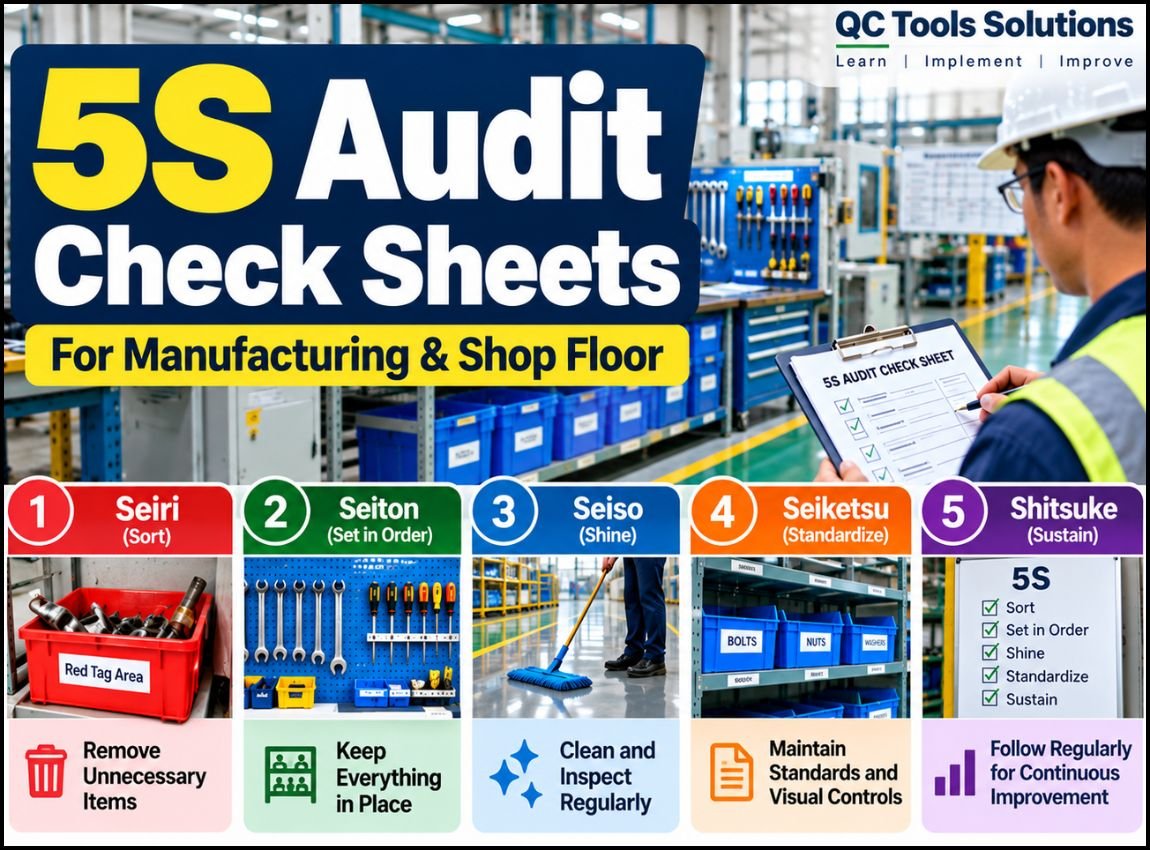
5S Audit Check Sheet for Manufacturing: Shop Floor Checklist
A 5S audit check sheet is a practical tool for evaluating workplace organization, cleanliness, standardization, and discipline in manufacturing and other work areas.
This 5S check sheet for the shop floor helps auditors systematically evaluate the five 5S principles:
- Seiri – Sort
- Seiton – Set in Order
- Seiso – Shine
- Seiketsu – Standardize
- Shitsuke – Sustain
A well-designed 5S audit checklist should not only identify housekeeping problems. It should also help the organization identify abnormalities, assign corrective actions and maintain improvements over time.
In this article, you will find practical 5S checkpoints for manufacturing, a sample 5S check sheet format, scoring criteria and guidance for conducting a 5S audit on the shop floor.
Free 5S Audit Check Sheet for Manufacturing
Use this practical 5S audit check sheet to audit production areas, machine shops, assembly lines, warehouses, stores, offices, and other workplace areas.
Available Formats
5S Check Sheet – Excel: Editable format for regular audits and customization.
5S Audit Checklist – PDF: Printable format for shop-floor audits.
Download the 5S check sheet and customize the checkpoints according to your process, workplace and company requirements.
What Is a 5S Audit Check Sheet?
A 5S audit check sheet is a structured checklist used to verify whether 5S standards are being followed in a workplace.
It provides specific 5S checkpoints for each of the five S principles and allows the auditor to record:
- Audit observations
- Score
- Non-conformities
- Improvement opportunities
- Corrective actions
- Responsible person
- Target completion date
- Closure status
For manufacturing organizations, the checklist can be customized according to production machines, tools, jigs, dies, raw materials, WIP, finished goods, maintenance areas, inspection areas and warehouses.
5S Check Sheet for Shop Floor
A shop-floor 5S audit should focus on conditions that directly affect workplace organization, safety, productivity and visual management.
| 5S | Principle | Main Shop-Floor Check |
|---|---|---|
| 1S | Sort – Seiri | Remove unnecessary materials, tools and equipment |
| 2S | Set in Order – Seiton | Provide defined locations for everything |
| 3S | Shine – Seiso | Keep machines, floors and workplace clean |
| 4S | Standardize – Seiketsu | Maintain visual and documented standards |
| 5S | Sustain – Shitsuke | Maintain discipline and continuously improve |
The purpose of a 5S audit is not simply to make the workplace look clean. The audit should help make abnormalities and deviations from the standard visible.
1S – Sort (Seiri)
Sort means separating necessary items from unnecessary items and removing items that are not required for the work area.
5S Check Points for Sort
Check whether:
- Unnecessary raw material is lying in the workplace.
- Unnecessary WIP is present.
- Old or unused machines are occupying the workplace.
- Unused jigs, fixtures, tools or dies are available.
- Unnecessary containers are stored in the area.
- Obsolete documents and standards are present.
- Red-tagged items are properly identified.
- Unnecessary items are moved to a designated area.
- Criteria for identifying unnecessary items are clearly defined.
Sample Sort (Seiri) Audit Check Sheet
| S.No. | Check Point | Score 0–5 | Observation | Action |
|---|---|---|---|---|
| 1 | No unnecessary RM/WIP in the area | |||
| 2 | No unused machine/equipment | |||
| 3 | Unused jigs, tools and dies identified | |||
| 4 | Unnecessary items are properly marked | |||
| 5 | Old/obsolete documents removed |
2S – Set in Order (Seiton)
Set in Order means arranging necessary items so that they can be easily located, used and returned to their designated locations.
The basic principle is:
A place for everything and everything in its place.
Checkpoints for Set in Order
Check whether:
- Storage locations are clearly identified.
- Shelves have location indicators.
- Materials have defined storage locations.
- Tools have designated locations.
- Jigs and fixtures have defined locations.
- Minimum and maximum quantities are displayed where applicable.
- Gangways are clearly marked.
- Material storage areas are identified.
- FIFO arrangements are followed where required.
- Tool boards or shadow boards are used where appropriate.
- Items can be easily located and returned after use.
- 30-second rule to search for every item
Sample Set in Order Audit Check Sheet
| S.No. | Check Point | Score 0–5 | Observation | Action |
|---|---|---|---|---|
| 1 | Storage locations are identified | |||
| 2 | Tools have designated locations | |||
| 3 | Material locations are marked | |||
| 4 | Min./Max. quantities are displayed | |||
| 5 | Gangways and storage areas are marked |
3S – Shine (Seiso)
Shine means cleaning the workplace, machines, equipment and surrounding areas while using cleaning activities to identify abnormalities.
Cleaning should not be treated only as housekeeping. It can also help identify problems such as:
- Oil leakage
- Coolant leakage
- Loose components
- Abnormal noise
- Damaged equipment
- Accumulated chips
- Dust
- Water leakage
- Unsafe conditions
5S Check Points for Shine
Check whether:
- Floors are clean.
- Machines are free from chips and dirt.
- Oil and water spills are removed.
- Equipment is cleaned regularly.
- Cleaning responsibilities are clearly assigned.
- Cleaning standards are displayed.
- Cleaning activities are combined with inspection where appropriate.
- Abnormal conditions identified during cleaning are reported.
- Operators maintain workplace cleanliness.
Sample Shine Audit Check Sheet
| S.No. | Check Point | Score 0–5 | Observation | Action |
|---|---|---|---|---|
| 1 | Floor is clean and free from waste | |||
| 2 | Machines are clean | |||
| 3 | No oil/water leakage remains unattended | |||
| 4 | Cleaning responsibility is defined | |||
| 5 | Cleaning is used to identify abnormalities |
4S – Standardize (Seiketsu)
Standardize means establishing standards so that the first three S principles are maintained consistently.
Without standardization, a workplace may become organized for a short period and gradually return to its previous condition.
5S Checkpoints for Standardize
Check whether:
- SOPs are available and current.
- Workplace standards are displayed.
- Cleaning standards are defined.
- Visual controls are available.
- Floor markings are maintained.
- Labels and identification boards are maintained.
- Standard locations are clearly defined.
- Improvement suggestions are recorded.
- Improvement actions are implemented.
- Employees understand the applicable standards.
Sample Standardize Audit Check Sheet
| S.No. | Check Point | Score 0–5 | Observation | Action |
|---|---|---|---|---|
| 1 | SOPs are available and current | |||
| 2 | Visual standards are displayed | |||
| 3 | Floor markings are maintained | |||
| 4 | Workplace standards are followed | |||
| 5 | Improvement actions are implemented |
5S – Sustain (Shitsuke)
Sustain means developing the discipline and management system required to maintain 5S continuously.
The objective is to make 5S part of the organization’s normal working culture rather than a one-time cleaning activity.
5S Checkpoints for Sustain
Check whether:
- Employees are trained in 5S.
- Regular 5S audits are conducted.
- Previous audit findings are closed.
- Responsibilities are clearly assigned.
- Employees understand their workplace standards.
- Training records are maintained.
- 5S performance is reviewed.
- Improvement actions are tracked.
- Management supports 5S activities.
- Employees follow established standards without continuous supervision.
Sample Sustain Audit Check Sheet
| S.No. | Check Point | Score 0–5 | Observation | Action |
|---|---|---|---|---|
| 1 | Employees are trained in 5S | |||
| 2 | 5S audits are conducted regularly | |||
| 3 | Previous findings are closed | |||
| 4 | Responsibilities are clearly defined | |||
| 5 | Employees follow workplace standards |
5S Check Sheet Format
A practical 5S check sheet format should contain enough information to identify the audited area, evaluate each checkpoint and follow up corrective actions.
Recommended Audit Information
- Company name
- Department
- Area/Zone
- Audit date
- Shift
- Auditor name
- Zone leader
- Audit number
- Previous audit score
Recommended Checklist Columns
| Column | Purpose |
|---|---|
| S.No. | Identification of checkpoint |
| 5S Category | Sort, Set in Order, Shine, Standardize or Sustain |
| Check Point | Requirement being evaluated |
| Score | 0–5 or company-defined rating |
| Observation | Evidence found during audit |
| Corrective Action | Required improvement |
| Responsibility | Person responsible |
| Target Date | Planned completion date |
| Status | Open/In Progress/Closed |
| Remarks | Additional information |
This makes the sheet more useful than a simple Yes/No checklist because it connects the audit finding with corrective action and follow-up.
5S Audit Scoring Criteria
A company can define its own scoring system. A practical 0–5 scoring method can be used as follows:
| Score | Rating | Meaning |
|---|---|---|
| 0 | Unacceptable | No evidence of the requirement |
| 1 | Initial | Activity has started but evidence is limited |
| 2 | Needs Improvement | Activity is present but several opportunities exist |
| 3 | Acceptable | Minimum required level is maintained |
| 4 | Very Good | Good results are consistently maintained |
| 5 | Excellent | Strong and sustained 5S practices are demonstrated |
The scoring criteria should be standardized within the organization so different auditors interpret the scores consistently.
How to Calculate 5S Audit Score
If every applicable checkpoint has a maximum score of 5:
5S Audit Score (%) = Actual Score ÷ Maximum Possible Score × 100
Example
Suppose:
- Number of applicable checkpoints = 25
- Maximum score per checkpoint = 5
- Maximum possible score = 25 × 5 = 125
- Actual score = 103
Therefore:
5S Audit Score = 103 ÷ 125 × 100 = 82.4%
The organization can establish its own acceptance criteria.
| Score | Suggested Status |
|---|---|
| 90–100% | Excellent |
| 80–89% | Very Good |
| 70–79% | Acceptable |
| Below 70% | Improvement Required |
These ranges are examples only. Your organization should define the thresholds appropriate to its own 5S system.
5S Checklist for Manufacturing
A manufacturing 5S checklist should be more specific than a generic housekeeping checklist.
For example, a production area can include the following checkpoints.
Machine Area
- Machine surfaces are clean.
- No oil or coolant leakage is left unattended.
- Tools are stored at designated locations.
- Unused fixtures are removed.
- Machine cleaning standards are displayed.
- Chips and waste are removed.
- Abnormalities are identified and reported.
Material Store Area
- Raw material locations are identified.
- WIP locations are identified.
- Finished-goods locations are identified.
- Material identification is visible.
- FIFO is followed where applicable.
- Minimum/maximum quantities are defined where required.
- No material is kept in gangways.
Tool Area
- Tools have designated locations.
- Tool identification is visible.
- Damaged tools are segregated.
- Tool boards or shadow boards are maintained.
- Measuring instruments are stored properly.
- Unused tools are removed.
Workplace and Safety
- Gangways are clearly marked.
- Emergency exits are accessible.
- Fire extinguishers are accessible.
- PPE is stored properly.
- Electrical panels are accessible.
- Waste bins are identified.
- Workplace signs are visible.
5S Audit Check Sheet Example
The following is a simple example that can be adapted for a production shop floor.
| 5S | Check Point | Score | Observation | Corrective Action |
|---|---|---|---|---|
| Sort | Unnecessary material removed | |||
| Sort | Unused tools/fixtures removed | |||
| Set in Order | Tools have defined locations | |||
| Set in Order | Material locations identified | |||
| Set in Order | Gangways clearly marked | |||
| Shine | Machine is clean | |||
| Shine | Floor is clean and dry | |||
| Standardize | SOP available at workstation | |||
| Standardize | Visual controls maintained | |||
| Sustain | Regular 5S audit conducted | |||
| Sustain | Previous actions closed |
How to conduct a 5S Audit on the Shop Floor
Step 1: Select the Audit Area
Define the area to be audited.
Examples include:
- CNC machining area
- Assembly line
- Tool room
- Maintenance area
- Warehouse
- Inspection area
- Raw-material store
Step 2: Prepare the 5S Check Sheet
Use the standard checklist and add process-specific checkpoints.
Step 3: Conduct the Shop-Floor Walk
Walk through the area and observe actual conditions.
Do not rely only on discussions with employees.
Step 4: Record Objective Evidence
Write specific observations.
Instead of:
“Area not clean.”
Write:
“Metal chips found below CNC machine; cleaning standard requires removal at the end of each shift.”
Specific observations make corrective action easier.
Step 5: Assign the Score
Evaluate each applicable checkpoint according to the organization’s scoring criteria.
Step 6: Identify Corrective Actions
For each significant gap, define:
- What needs to be corrected?
- Who is responsible?
- Target date
- Current status
Step 7: Verify Closure
During the next audit, verify whether the previous action was actually implemented.
Step 8: Monitor the Trend
Track the score over time.
For example:
July: 68% → August: 75% → September: 82% → October: 86%
The trend can help management understand whether 5S improvements are being sustained.
5S Audit Corrective Action Format
A good 5S audit should not stop after assigning a score.
Use an action tracker such as:
| Finding | Root Cause | Corrective Action | Responsibility | Target Date | Status |
|---|---|---|---|---|---|
| Unused fixtures stored near machine | No defined storage area | Create fixture storage location | Production | 10-Oct | Open |
| Material outside marked area | Storage capacity inadequate | Review storage layout | Stores | 12-Oct | In Progress |
| Machine has oil leakage | Leakage not reported | Repair leakage and update inspection point | Maintenance | 08-Oct | Closed |
For repeated problems, consider using 5 Why analysis or 8D problem solving rather than repeatedly correcting the symptom.
Benefits of using a 5S Audit Check Sheet
A structured 5S checklist can help an organization:
- Improve workplace organization
- Reduce unnecessary items
- Improve material and tool accessibility
- Improve visual management
- Identify abnormalities earlier
- Improve workplace cleanliness
- Establish standard practices
- Improve employee awareness
- Track corrective actions
- Monitor 5S performance
- Sustain improvements
The main value of the checklist is consistency. Different auditors can evaluate the same area against defined checkpoints rather than relying entirely on subjective observations.
5S Audit Checklist – Excel and PDF Download
A 5S checklist in Excel is particularly useful when you want to:
- Customize checkpoints
- Add company-specific requirements
- Maintain audit records
- Track corrective actions
- Calculate scores
- Analyze audit trends
- Maintain historical records
A 5S checklist PDF is useful when you want to:
- Print the checklist
- Conduct manual shop-floor audits
- Carry the checklist during Gemba walks
- Record observations manually
- Maintain signed audit records
Download 5S Audit Check Sheet
Download 5S Audit Check Sheet in Excel
Download 5S Audit Checklist in PDF
Difference Between 5S Checklist and 5S Audit Check Sheet
These terms are often used interchangeably, but there is a practical difference.
| 5S Checklist | 5S Audit Check Sheet |
|---|---|
| Lists requirements/check points | Lists requirements plus audit recording fields |
| Can be used as a simple verification tool | Used for formal/periodic auditing |
| May use Yes/No | Usually includes score and observations |
| May not require action tracking | Can include corrective actions and target dates |
| Useful for daily checks | Useful for periodic audits |
For manufacturing organizations, a combined checklist and audit sheet is often more practical.
How often should a 5S Audit be conducted?
The frequency depends on the maturity of the workplace.
A company may consider:
- Daily: Operator/self-check
- Weekly: Zone-level 5S check
- Monthly: Formal 5S audit
- Quarterly: Management review or cross-functional audit
Newly implemented 5S areas may require more frequent audits until standards become established.
The important point is to maintain a consistent audit frequency and close identified actions.
Common Mistakes in 5S Audits
1. Treating 5S as Only Cleaning
5S includes organization, standardization and sustainment—not just cleanliness.
2. Using Vague Checkpoints
Instead of:
“Area is good.”
Use:
“All tools are stored in their designated locations and tool identification is visible.”
3. Giving Everybody the Same Score
Scores should be based on actual evidence.
4. Ignoring Previous Findings
Repeated findings indicate that corrective actions may not be effective.
5. Not Assigning Responsibility
Every significant finding should have an owner and target date.
6. Conducting Audits Only Before Customer Visits
5S should be maintained as a routine management system rather than a preparation activity.
7. Using the Same Checklist Everywhere
A basic checklist can be common, but manufacturing areas should have additional process-specific checkpoints.
5S Audit Checklist Frequently Asked Questions
What is a 5S audit check sheet?
A 5S audit check sheet is a structured document used to evaluate the implementation and maintenance of Sort, Set in Order, Shine, Standardize and Sustain in a workplace.
What are the 5S checkpoints?
Typical 5S checkpoints include unnecessary items, storage locations, tool arrangement, cleanliness, visual controls, SOPs, employee training, audit frequency and corrective-action closure.
What should a 5S checklist for manufacturing contain?
A manufacturing checklist should include checkpoints for raw materials, WIP, machines, tools, jigs, fixtures, storage areas, floor markings, cleaning, visual controls, SOPs and employee practices.
Can I use a 5S check sheet on the shop floor?
Yes. A 5S check sheet can be used for production lines, machining areas, assembly areas, warehouses, stores, maintenance areas and other workplace zones.
Can a 5S check sheet be prepared in Excel?
Yes. Excel is useful when the checklist needs to be customized, scored and used repeatedly. It can also be used to maintain audit history and corrective-action records.
Is a 5S checklist available in PDF format?
Yes. A PDF version is useful when the checklist needs to be printed and used for manual shop-floor audits.
How is a 5S audit scored?
A company can use a defined rating system such as 0–5. The score can then be converted into a percentage based on the maximum applicable score.
How frequently should a 5S audit be conducted?
The frequency depends on the organization’s requirements. Daily checks, weekly zone checks and monthly formal audits are common approaches.
What is the difference between 5S and a 5S audit?
5S is a workplace organization methodology. A 5S audit is the systematic evaluation used to verify whether the 5S standards are being followed and sustained.
What should be done when a 5S audit finding is identified?
Record the evidence, define the corrective action, assign responsibility and a target date, and verify the effectiveness and closure during follow-up.
Other 5S check Sheets for reference:
5S Audit Check Sheets:
| S.No | Check Items | Description | Score | 0 | 1 | 2 | 3 | 4 | 5 |
|---|---|---|---|---|---|---|---|---|---|
| 1 | Materials and Parts | Does the RM or WIP include unneeded material? | |||||||
| 2 | Machine or Equipment | Is there any unused equipment (old machine) around? | |||||||
| 3 | Jigs, Tools and Dies | Are there any unused jigs, tools, dies or similar items around? | |||||||
| 4 | Unnecessary items | Is it obvious which items have been marked as unnecessary? | |||||||
| 5 | Old documents and standards | Are there any old and useless documents around? |
| S.No | Check Items | Description | Score | 0 | 1 | 2 | 3 | 4 | 5 |
|---|---|---|---|---|---|---|---|---|---|
| 1 | Location indicators | Have shelves and other storage areas been marked with location indicators and addresses? | |||||||
| 2 | Item indicators | Do the shelves have indicators showing which items go where? | |||||||
| 3 | Quantity indicators | Are the maximum and minimum allowable quantities indicated? | |||||||
| 4 | Marking of gangways and in-process inventory area | Are white lines or other markers used to indicate gangways and storage areas? | |||||||
| 5 | Jigs and Tools | Are jigs and tools arranged rationally to facilitate picking them up and returning them? |
| S.No | Check Items | Description | Score | 0 | 1 | 2 | 3 | 4 | 5 |
|---|---|---|---|---|---|---|---|---|---|
| 1 | Floors | Are floors kept shiny, clean and free of waste, water and oil? | |||||||
| 2 | Machines | Are the machines wiped clean often and kept free of shavings, chips and oil? | |||||||
| 3 | Cleaning and Checking | Is equipment inspection combined with equipment maintenance? | |||||||
| 4 | Cleaning Responsibilities | Is there a person responsible for overseeing the cleaning operation? | |||||||
| 5 | Habitual cleanliness | Do operators habitually sweep floors and wipe equipment without being told? |
| S.No | Check Items | Description | Score | 0 | 1 | 2 | 3 | 4 | 5 |
|---|---|---|---|---|---|---|---|---|---|
| 1 | Improved memos | Are improvement suggestions regularly being generated? | |||||||
| 2 | Improvement suggestions | Are improvement ideas being acted on? | |||||||
| 3 | Key procedures | Are SOPs clear, documented and actively used? | |||||||
| 4 | Visual controls | Are visual controls effective and sensible? Can these be seen from a distance? | |||||||
| 5 | Guide arrows and other signs | Are these easy to understand and helpful? Does the plant look like an open book? Can anyone easily find toilets, canteen, reception etc? |
| S.No | Check Items | Description | Score | 0 | 1 | 2 | 3 | 4 | 5 |
|---|---|---|---|---|---|---|---|---|---|
| 1 | Training | Is everyone adequately trained in the SOP? | |||||||
| 2 | General Discipline | Do people report for their work on time? Are their uniforms clean? | |||||||
| 3 | Dojo | Does the company have its dojo? Are the facilities adequate? Are the trainers competent? | |||||||
| 4 | TNI | Does the company have a culture of Training needs identification? Are training plans adhered to? Are training records kept? | |||||||
| 5 | Targets and responsibilities | Are people clear about their targets and responsibilities? Can they narrate these when asked for? |
5S Rating Criteria:
0 = Unacceptable, No evidence of this item.
1 = Activity started, slight evidence of this item.
2 = Widespread activity, many opportunities for improvement have been found.
3 = Minimum acceptable level sustained for at least one month.
4 = Very good results, sustained for at least 3 months.
5 = World-class examples, sustained for at least 6 months.
Conclusion
A 5S audit check sheet provides a simple and systematic way to evaluate workplace organization, cleanliness, standardization and discipline. For manufacturing organizations, the checklist should be customized with practical 5S checkpoints covering machines, tools, materials, WIP, storage areas, visual controls, SOPs and employee practices.
I was looking at some of your blog posts on this
site and I believe this web site is really informative!
Thanks for your valuable feedback.
IATF requirements clearly explained. Informative website
Thanks for your feedback