
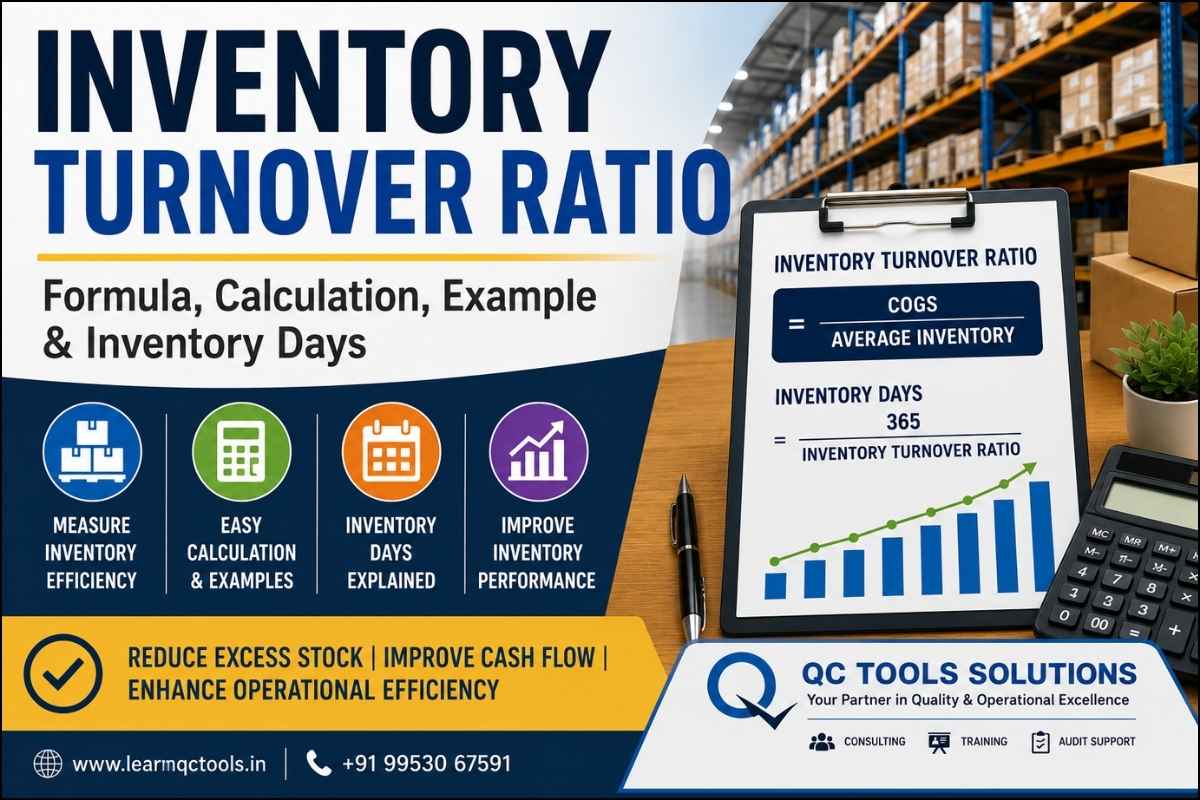
Inventory turnover ratio is an important inventory management KPI that measures how efficiently a company uses and replaces its inventory during a specific period. It helps businesses understand how quickly inventory is moving, whether excess stock is being maintained, and how effectively working capital is being utilized.
For manufacturing companies, inventory turnover is particularly important because inventory may include raw materials, work-in-process (WIP), finished goods, components and consumables. Monitoring inventory turnover regularly can help reduce excess inventory, control inventory carrying costs and improve overall operational efficiency.
In this article, we will explain the inventory turnover ratio formula, how to calculate inventory turnover ratio, average inventory, inventory days, monthly inventory turnover, and how to interpret a high or low inventory turnover ratio. We will also discuss what is considered a good inventory turnover ratio and how manufacturing companies can improve inventory performance.
- What is Inventory Turnover Ratio?
- Inventory Turnover Ratio Formula
- What is Cost of Goods Sold (COGS)?
- How to Calculate Average Inventory?
- Inventory Turnover Ratio Calculation Example
- How to Calculate Monthly Inventory Turnover Ratio?
- What are Inventory Days?
- Inventory Turnover Ratio vs Inventory Days
- Is a Higher or Lower Inventory Turnover Ratio Better for a Company?
- What is a Good Inventory Turnover Ratio?
- What Does a High Inventory Turnover Ratio Mean?
- What Does a Low Inventory Turnover Ratio Mean?
- Inventory Turnover Ratio in Manufacturing
- How to Improve Inventory Turnover Ratio
- Inventory Turnover Ratio Formula in Excel
- Frequently Asked Questions (FAQ):
- Is a higher or lower inventory turnover ratio better for a company?
- What is a good inventory turnover ratio?
- What does an inventory turnover ratio of 5 mean?
- What is the formula for inventory turnover ratio?
- What is inventory turnover days?
- Can inventory turnover ratio be calculated monthly?
- How can a manufacturing company improve inventory turnover?
- Conclusion
What is Inventory Turnover Ratio?
Inventory turnover ratio measures how many times a company sells or uses its average inventory during a particular period.
In simple words, it tells us how quickly a company converts its inventory into sales through its normal business operations.
A higher inventory turnover generally indicates that inventory is moving quickly. A lower turnover ratio may indicate excess inventory, slow-moving materials, weak demand or inefficient inventory management.
However, a higher inventory turnover ratio is not automatically better. If inventory turnover becomes excessively high, the company may not have sufficient stock to meet customer demand or production requirements.
Therefore, inventory turnover should always be evaluated together with demand, lead time, safety stock, customer service levels and industry conditions.
Inventory Turnover Ratio Formula
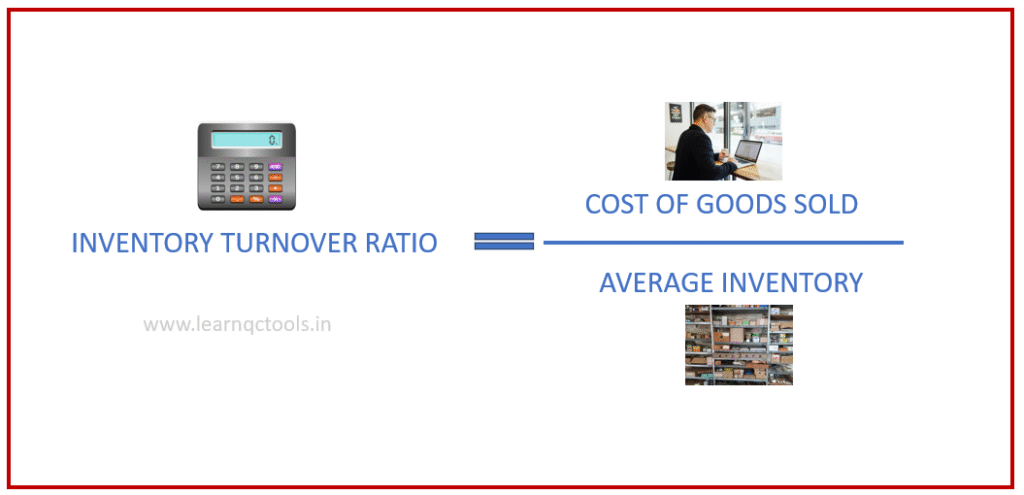
The standard inventory turnover ratio formula is:
Inventory Turnover Ratio = Cost of Goods Sold (COGS) ÷ Average Inventory
Where:
Average Inventory = (Beginning Inventory + Ending Inventory) ÷ 2
For example, if a company has:
Beginning inventory = ₹20 lakh
Ending inventory = ₹30 lakh
Cost of Goods Sold = ₹150 lakh
First calculate average inventory:
Average Inventory = (₹20 lakh + ₹30 lakh) ÷ 2
Average Inventory = ₹25 lakh
Now calculate inventory turnover:
Inventory Turnover Ratio = ₹150 lakh ÷ ₹25 lakh
Inventory Turnover Ratio = 6 times
This means the company’s average inventory was turned over approximately six times during the period.
What is Cost of Goods Sold (COGS)?
Cost of Goods Sold, commonly called COGS, represents the direct cost associated with producing or purchasing the goods sold by a company.
For a manufacturing company, COGS may include direct material, direct labour and other manufacturing costs associated with producing the finished products, depending on the company’s accounting method.
It is important to use COGS rather than sales revenue when calculating inventory turnover ratio because inventory is recorded at cost rather than selling price.
Therefore:
Inventory Turnover Ratio = COGS ÷ Average Inventory
Using sales instead of COGS can produce a misleading result.
How to Calculate Average Inventory?
Average inventory is generally calculated using beginning and ending inventory values.
Average Inventory = (Beginning Inventory + Ending Inventory) ÷ 2
For example:
Beginning inventory = ₹40 lakh
Ending inventory = ₹60 lakh
Average Inventory = (₹40 lakh + ₹60 lakh) ÷ 2
Average Inventory = ₹50 lakh
Average inventory provides a better representation of the inventory held during the period than using only the ending inventory figure.
For companies with significant monthly inventory fluctuations, it may be more useful to calculate average inventory using monthly inventory values rather than only beginning and ending inventory.
Inventory Turnover Ratio Calculation Example
Consider a manufacturing company with the following annual figures:
Beginning inventory = ₹2 crore
Ending inventory = ₹4 crore
Annual COGS = ₹60 crore
First calculate average inventory:
Average Inventory = (₹2 crore + ₹4 crore) ÷ 2
Average Inventory = ₹3 crore
Now calculate the inventory turnover ratio:
Inventory Turnover Ratio = ₹60 crore ÷ ₹3 crore
Inventory Turnover Ratio = 20 times
This means that the company turned over its average inventory approximately 20 times during the year.
A turnover ratio should not be judged in isolation. The company should compare it with its previous performance, management targets, product characteristics and industry benchmarks.
How to Calculate Monthly Inventory Turnover Ratio?
Companies can calculate inventory turnover monthly to monitor inventory performance more frequently.
The monthly formula is:
Monthly Inventory Turnover Ratio = Monthly COGS ÷ Average Monthly Inventory
For example:
Monthly COGS = ₹50 lakh
Beginning-of-month inventory = ₹12 lakh
End-of-month inventory = ₹18 lakh
Average monthly inventory:
(₹12 lakh + ₹18 lakh) ÷ 2 = ₹15 lakh
Monthly inventory turnover:
₹50 lakh ÷ ₹15 lakh = 3.33 times
Companies may also annualize the monthly turnover ratio for comparison purposes:
Annualized Inventory Turnover = Monthly Turnover × 12
However, monthly turnover and annualized turnover should be clearly identified so that the figures are not misunderstood.
What are Inventory Days?
Inventory days, also called days inventory or days inventory on hand, indicate approximately how many days a company holds inventory before it is consumed or sold.
The formula is:
Inventory Days = 365 ÷ Inventory Turnover Ratio
For example, if the inventory turnover ratio is 10:
Inventory Days = 365 ÷ 10
Inventory Days = 36.5 days
This means the company’s average inventory is held for approximately 36.5 days.
Some organizations use 360 days instead of 365 days for internal calculations. The important point is to use a consistent method when comparing performance.
Another way to calculate inventory days is:
Inventory Days = (Average Inventory ÷ COGS) × 365
A higher inventory turnover generally results in fewer inventory days, while a lower turnover generally results in more inventory days.
Inventory Turnover Ratio vs Inventory Days
Inventory turnover ratio and inventory days are closely related but express inventory performance differently.
| Metric | Formula | Meaning |
|---|---|---|
| Inventory Turnover Ratio | COGS ÷ Average Inventory | Number of times inventory turns over |
| Inventory Days | 365 ÷ Inventory Turnover Ratio | Approximate days inventory is held |
For example, if a company has an inventory turnover ratio of 12:
Inventory Days = 365 ÷ 12
Inventory Days = approximately 30.4 days.
Therefore, the company holds approximately one month’s average inventory.
Is a Higher or Lower Inventory Turnover Ratio Better for a Company?
A higher inventory turnover ratio is generally considered positive because it indicates that inventory is moving quickly and the company may require less working capital to maintain inventory.
However, a higher ratio is not always better.
An excessively high inventory turnover ratio may indicate that inventory levels are too low. This can result in material shortages, production stoppages, emergency purchasing, delayed deliveries or loss of customers.
A very low inventory turnover ratio may indicate excess stock, slow-moving inventory, obsolete materials, weak demand or poor inventory planning.
Therefore, the objective should not simply be to maximize inventory turnover.
The objective should be to maintain an appropriate inventory turnover level that supports customer demand, production requirements and business profitability.
For a manufacturing company, the ideal balance is enough inventory to maintain uninterrupted production without maintaining unnecessary stock.
What is a Good Inventory Turnover Ratio?
There is no single inventory turnover ratio that is considered good for every company.
The appropriate inventory turnover ratio depends on:
- Industry
- Product type
- Customer demand
- Supplier lead time
- Production cycle
- Safety stock requirements
- Purchasing policy
- Batch size
- Seasonality
- Supply chain conditions
For example, a company producing fast-moving consumer products may have a very different inventory turnover target from a company manufacturing specialized automobile components.
Instead of asking whether a particular number is universally good, companies should compare their inventory turnover against:
- Previous-year performance
- Monthly trends
- Internal targets
- Industry benchmarks
- Similar products or product groups
- Customer service requirements
A consistent improvement in inventory turnover, without negatively affecting production or customer delivery, can be a positive sign.
What Does a High Inventory Turnover Ratio Mean?
A high inventory turnover ratio generally means that inventory is moving quickly.
Possible benefits include:
- Lower inventory carrying cost
- Lower working capital requirement
- Less risk of obsolete inventory
- Faster movement of materials
- Better utilization of warehouse space
- Improved cash flow
However, an unusually high turnover ratio should be investigated.
It could also indicate that the company is maintaining insufficient safety stock or purchasing materials only after shortages occur.
Therefore, management should analyze inventory turnover together with stock-outs, production stoppages, customer complaints and delivery performance.
What Does a Low Inventory Turnover Ratio Mean?
A low inventory turnover ratio means that inventory is moving relatively slowly.
Possible reasons include:
- Excess inventory
- Slow-moving products
- Obsolete materials
- Poor demand forecasting
- Large purchasing quantities
- Long production cycles
- Low customer demand
- Excessive safety stock
- Poor production planning
A low turnover ratio increases the possibility of inventory becoming obsolete or damaged and may tie up significant working capital.
Manufacturing companies should therefore perform regular inventory ageing analysis and identify slow-moving and non-moving inventory.
Inventory Turnover Ratio in Manufacturing
Inventory turnover ratio is especially useful in manufacturing because inventory exists at several stages of the production process.
Raw Material Inventory
Raw materials should be available when required for production, but excessive raw material stock increases working capital and storage costs.
Companies can improve raw material turnover by optimizing purchasing quantities, reducing supplier lead time and improving material planning.
Work-in-Process Inventory
WIP inventory is generated while materials move through different manufacturing processes.
High WIP may indicate:
- Production bottlenecks
- Long cycle times
- Large batch sizes
- Poor line balancing
- Quality problems
- Waiting time between processes
Reducing WIP can improve material flow and reduce working capital.
Finished Goods Inventory
Finished goods inventory should be aligned with customer demand and delivery requirements.
Excess finished goods may indicate overproduction, inaccurate forecasting or weak sales.
Lean manufacturing techniques such as Kanban, pull production, smaller batch sizes and improved production planning can help control inventory.
How to Improve Inventory Turnover Ratio
Companies can improve inventory turnover by focusing on the causes of excessive or slow-moving inventory.
1. Reduce Excess Inventory
Identify materials and products that are above required levels and establish reduction plans.
2. Control Slow-Moving and Non-Moving Inventory
Prepare an inventory ageing report and review slow-moving and non-moving items regularly.
3. Improve Demand Forecasting
Better forecasting helps organizations purchase and produce according to actual customer requirements.
4. Reduce Supplier Lead Time
Shorter and more reliable supplier lead times can reduce the need for excessive safety stock.
5. Use Kanban
Kanban can help control inventory levels and replenish materials based on actual consumption.
6. Reduce Batch Size
Large production batches can create unnecessary WIP and finished goods inventory. Smaller batches can improve material flow when operationally practical.
7. Improve Production Planning
Production should be aligned with customer demand, available capacity and material availability.
8. Reduce Obsolete Inventory
Regularly identify obsolete materials and products and take appropriate action before their value deteriorates further. Excess and obsolete inventory can also contribute to the cost of poor quality (COPQ) and operational losses.
9. Improve Quality
Quality problems can create additional inventory through rework, replacement production and rejected materials. Improving process quality can therefore support better inventory utilization. Inventory turnover can be monitored as a measurable quality or operational objective.
Inventory Turnover Ratio Formula in Excel
The inventory turnover ratio can be easily calculated in Excel.
For example, suppose:
Beginning Inventory = ₹20 lakh
Ending Inventory = ₹30 lakh
COGS = ₹150 lakh
Average inventory can be calculated using:
=(Beginning Inventory + Ending Inventory)/2
Then inventory turnover can be calculated using:
=COGS/Average Inventory
The result is:
6 times
Companies can create a monthly inventory dashboard in Excel to track:
- Inventory value
- COGS
- Average inventory
- Inventory turnover
- Inventory days
- Slow-moving inventory
- Non-moving inventory
- Excess inventory
This makes inventory turnover a practical management KPI rather than just an accounting calculation.
Frequently Asked Questions (FAQ):
Is a higher or lower inventory turnover ratio better for a company?
Generally, a higher inventory turnover ratio indicates faster inventory movement and efficient use of working capital. However, an excessively high ratio can indicate insufficient inventory and may create stock-outs or production interruptions. Therefore, the best inventory turnover ratio is the level that balances inventory cost with customer and production requirements.
What is a good inventory turnover ratio?
There is no universal good inventory turnover ratio. It varies according to industry, product type, demand, lead time, production cycle and inventory policy. Companies should compare their ratio with historical performance, internal targets and relevant industry benchmarks.
What does an inventory turnover ratio of 5 mean?
An inventory turnover ratio of 5 means that the company’s average inventory was turned over approximately five times during the measurement period.
If calculated annually, the corresponding inventory days would be:
365 ÷ 5 = 73 days
What is the formula for inventory turnover ratio?
The standard formula is:
Inventory Turnover Ratio = COGS ÷ Average Inventory
Average inventory is normally calculated as:
(Beginning Inventory + Ending Inventory) ÷ 2
What is inventory turnover days?
Inventory turnover days represent the approximate number of days inventory is held before being sold or consumed.
The formula is:
Inventory Days = 365 ÷ Inventory Turnover Ratio
Can inventory turnover ratio be calculated monthly?
Yes. Companies can calculate monthly inventory turnover using monthly COGS divided by average monthly inventory. Monthly monitoring can help identify changes in inventory performance more quickly than annual calculations.
How can a manufacturing company improve inventory turnover?
A manufacturing company can improve inventory turnover by reducing excess inventory, controlling slow-moving materials, improving demand forecasting, reducing supplier lead time, optimizing batch sizes, improving production planning, implementing Kanban and reducing obsolete inventory.
Conclusion
Inventory turnover ratio is a useful KPI for measuring how efficiently a company manages its inventory. The standard calculation uses Cost of Goods Sold divided by Average Inventory.
A high inventory turnover generally indicates faster inventory movement, while a low turnover may indicate excess or slow-moving inventory. However, companies should not try to maximize inventory turnover without considering production requirements, customer demand, safety stock and supply chain risks.
For manufacturing organizations, inventory turnover should be monitored together with inventory days, raw material stock, WIP, finished goods, slow-moving inventory and non-moving inventory.
The most effective approach is to establish an appropriate inventory target, monitor the KPI regularly and continuously improve the processes that affect inventory movement.
By combining inventory turnover analysis with Lean manufacturing practices such as Kanban, improved production planning, smaller batch sizes, better supplier management and waste reduction, organizations can reduce excess inventory while maintaining reliable production and customer delivery.
This version is structured to target “inventory turnover ratio,” “inventory turnover ratio formula,” “inventory turnover ratio calculation,” “inventory days,” “good inventory turnover ratio,” “inventory turnover in manufacturing,” and related People Also Ask searches.