
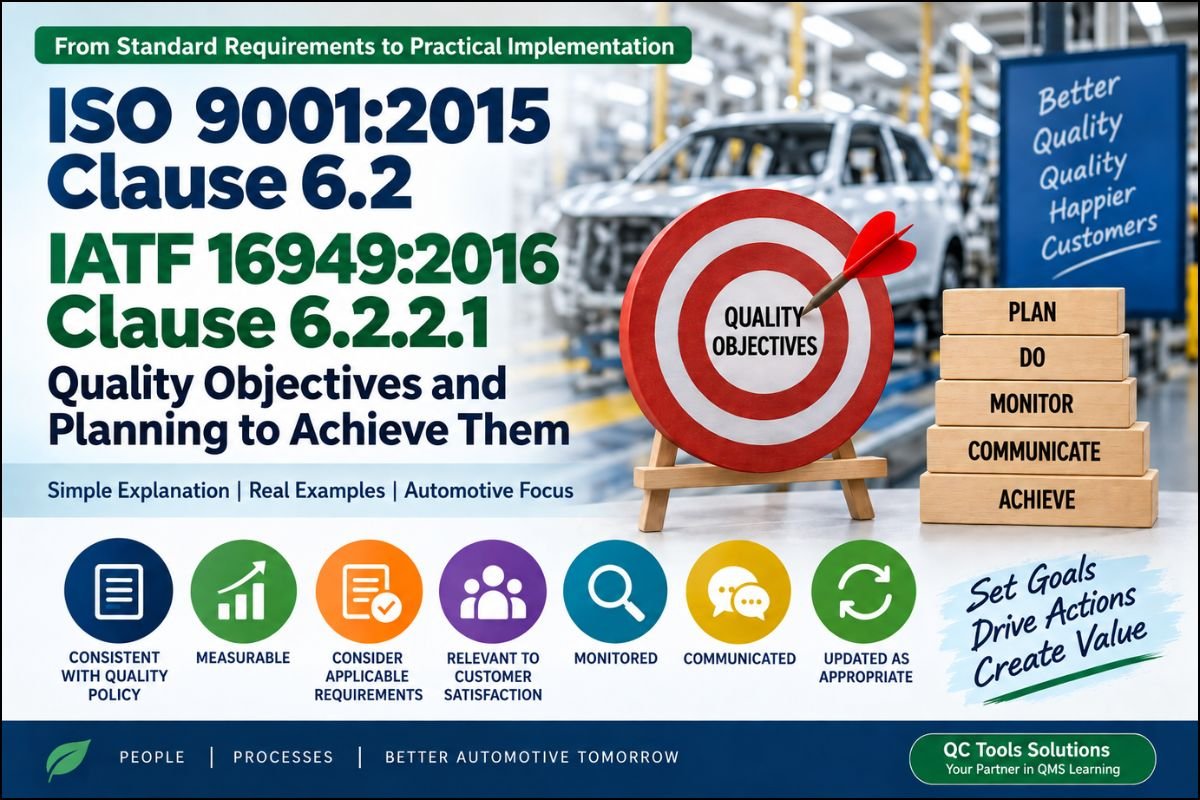
Quality objectives are an important part of a Quality Management System (QMS). They help organizations improve product quality, meet customer requirements, monitor process performance, and achieve continual improvement.
ISO 9001:2015 Clause 6.2 defines requirements for establishing quality objectives and planning how to achieve them. IATF 16949:2016 Clause 6.2.2.1 adds specific requirements for automotive organizations, including customer-focused objectives, top management responsibility, and annual quality objectives.
This article explains these requirements in simple language with practical examples for automotive manufacturing companies, Quality Engineers, and QMS professionals.
What Are Quality Objectives?
A quality objective is a specific result an organization wants to achieve related to product quality, process performance, customer satisfaction, or the Quality Management System.
For example, an automotive component manufacturer wants to reduce customer rejection.
Quality Objective: Reduce customer rejection from 2,000 PPM to below 1,000 PPM by December 2026.
This objective identifies the current performance, target, and deadline. It is more useful than a general statement such as “Improve quality.”
Quality objectives should support the quality policy and address relevant customer and organizational requirements.
ISO 9001:2015 Clause 6.2.1 – Quality Objectives
ISO 9001:2015 requires the organization to establish quality objectives at relevant functions, levels, and processes needed for the QMS.
The quality objectives shall be consistent with the quality policy, measurable, take into account applicable requirements, relevant to product and service conformity and enhancement of customer satisfaction, monitored, communicated, and updated as appropriate.
The organization shall maintain documented information on the quality objectives.
1. Objectives Must Be Consistent with the Quality Policy
Quality objectives should support the commitments in the quality policy.
For example, if the quality policy includes customer satisfaction, product conformity, and continual improvement, the organization may establish objectives such as:
- Reduce customer complaints.
- Improve first-pass yield.
- Reduce internal rejection.
- Improve on-time delivery.
- Improve corrective action effectiveness.
Example: If the quality policy focuses on supplying conforming products, reducing customer rejection is a relevant quality objective.
Audit Question: How do the quality objectives support the organization’s quality policy?
2. Objectives Must Be Measurable
Quality objectives should have a suitable measurement method so the organization can evaluate performance.
Non-measurable objective: Improve product quality.
Measurable objective: Reduce internal rejection from 2.5% to 1.5% by December 2026.
Other examples include:
- Maintain customer rejection below 800 PPM.
- Achieve 98% on-time delivery.
- Reduce rework from 4% to 2%.
- Improve first-pass yield to 98%.
These are illustrative targets. Actual targets should be based on organizational performance, customer requirements, and relevant data.
The organization should define how the KPI will be calculated, monitored, and evaluated.
3. Objectives must consider Applicable Requirements
Quality objectives should consider applicable requirements, including:
- Customer specifications.
- Product drawings.
- Customer-specific requirements.
- Statutory and regulatory requirements.
- Contractual requirements.
- Internal QMS requirements.
Example: A customer requires supplier rejection below 500 PPM. The organization should consider this requirement when establishing its customer quality objective.
Quality objectives should not conflict with applicable customer requirements. The organization should identify relevant requirements before setting targets.
4. Objectives must be relevant to Product Conformity and Customer Satisfaction
Quality objectives should contribute to product conformity and customer satisfaction.
For an automotive manufacturer, relevant objectives may include:
- Reduction in customer rejection.
- Reduction in manufacturing defects.
- Improvement in product audit performance.
- Reduction in customer complaints.
- Improvement in delivery performance.
- Reduction in repeat quality problems.
Example: If a customer reports dimensional defects, the organization may establish an objective to reduce dimensional rejection by improving process controls and measurement practices.
5. Objectives must be monitored
The organization must monitor progress toward its quality objectives.
Example: Internal Rejection Target = 1.5%
| Month | Target | Actual |
|---|---|---|
| January | ≤ 1.5% | 1.8% |
| February | ≤ 1.5% | 1.6% |
| March | ≤ 1.5% | 1.3% |
When performance does not meet the target, the organization should investigate the reasons and determine suitable action.
Possible causes of high rejection include tool wear, incorrect machine settings, material variation, inadequate inspection, and operator training gaps.
Monitoring should provide useful information for improvement and management decisions.
6. Objectives must be communicated
Relevant quality objectives should be communicated to employees who contribute to their achievement.
For example, production operators should understand applicable quality targets, defect prevention requirements, and the actions to take when abnormalities occur.
Communication methods may include department meetings, training, visual performance boards, KPI reviews, and management review meetings.
7. Objectives must be updated as appropriate
Quality objectives should be reviewed and updated when changes in requirements, processes, or performance make an update appropriate.
Possible reasons include:
- New customer requirements.
- Changes in manufacturing processes.
- New products.
- Significant performance changes.
- Results of previous objectives.
- Applicable regulatory changes.
Any updates should be based on relevant information and appropriate review.
ISO 9001:2015 Clause 6.2.2 – Planning to Achieve Quality Objectives
Clause 6.2.2 requires the organization to determine how quality objectives will be achieved.
The organization must determine:
- What will be done.
- What resources will be required.
- Who will be responsible.
- When it will be completed.
- How the results will be evaluated.
What will be done?
The organization should identify the activities required to achieve the objective.
Example: To reduce internal rejection from 2.5% to 1.5%, planned actions may include:
- Analyze major rejection defects.
- Conduct root cause analysis.
- Review process parameters.
- Improve inspection controls.
- Implement error-proofing where appropriate.
- Monitor results.
What Resources will be required?
Resources may include employees, technical expertise, training, inspection equipment, tooling, budget, and maintenance support.
Example: If tool wear causes dimensional rejection, resources may include new tooling, tool-life monitoring, maintenance support, and operator training.
Who Will Be Responsible?
The organization should assign responsibility for activities and follow-up.
| Activity | Responsible Function |
|---|---|
| Rejection data analysis | Quality Engineer |
| Process improvement | Production Engineer |
| Tooling improvement | Maintenance / Production |
| Training | Production and Quality |
| Effectiveness verification | Quality Department |
Responsibilities should be clear so that progress can be monitored.
When Will It Be Completed?
The organization should establish appropriate deadlines.
For example:
- Data analysis: 10 October 2026.
- Root cause analysis: 15 October 2026.
- Process improvement trial: 20 October 2026.
- Corrective action implementation: 31 October 2026.
- Effectiveness verification: November 2026.
The dates should be realistic and suitable for the objective.
How Will Results Be Evaluated?
The organization should define how it will determine whether the objective has been achieved.
Evaluation may include:
- Comparing actual results with the target.
- Reviewing performance trends.
- Verifying corrective action effectiveness.
- Confirming that improvements are sustained.
Completing an action does not automatically prove that the quality objective has been achieved.
IATF 16949 Clause 6.2.2.1 – Supplemental Requirements
IATF 16949:2016 Clause 6.2.2.1 provides additional requirements for quality objectives in the automotive industry.
Top management shall ensure that quality objectives to meet customer requirements are defined, established, and maintained for relevant functions, processes, and levels throughout the organization.
The results of the organization’s review regarding interested parties and their relevant requirements shall be considered when establishing annual, at a minimum, quality objectives and related performance targets, both internal and external.
Top Management Responsibility
Top management must ensure that customer-focused quality objectives are established and maintained across relevant organizational functions and processes.
Quality objectives should not be limited to the Quality Department. Production, Purchase, Maintenance, Logistics, and other relevant functions may have objectives supporting customer requirements.
Example:
| Function | Example Quality Objective |
|---|---|
| Quality | Maintain customer rejection below the agreed target |
| Production | Improve first-pass yield |
| Purchase | Improve incoming material quality |
| Maintenance | Reduce quality-related machine downtime |
| Logistics | Improve on-time delivery |
These are examples and not numerical targets prescribed by IATF 16949.
Annual Quality Objectives
IATF 16949 requires annual quality objectives at a minimum. The organization should consider the results of its review of interested parties and relevant requirements when establishing annual objectives and related internal and external performance targets.
Interested parties may include customers, employees, suppliers, owners, management, and regulatory authorities.
Example:
| Interested Party | Relevant Requirement | Possible Objective |
|---|---|---|
| Customer | Product conformity | Reduce customer rejection |
| Customer | Delivery performance | Improve on-time delivery |
| Employees | Competence | Improve training effectiveness |
| Supplier | Material quality | Improve incoming quality |
Not every interested-party expectation must become a quality objective. The organization should determine which requirements are relevant to its QMS.
Internal and External Performance Targets
Internal targets relate to the organization’s own process performance.
Examples include:
- Internal rejection.
- First-pass yield.
- Rework.
- Process audit performance.
- Machine-related quality losses.
External targets relate to customer-facing performance.
Examples include:
- Customer PPM.
- Customer complaints.
- On-time delivery.
- Customer scorecard performance.
Targets should be established based on applicable requirements, historical performance, and improvement priorities.
Quality Objective Planning Example
An automotive supplier establishes the following objective:
Objective: Reduce customer rejection from 1,500 PPM to below 800 PPM by December 2026.
| Requirement | Action Plan |
|---|---|
| What will be done? | Analyze defects and implement corrective actions |
| Resources | Quality and Production Engineers, inspection equipment |
| Responsibility | Quality Manager and Production Manager |
| Completion | December 2026 |
| Evaluation | Monthly PPM review and effectiveness verification |
The organization should monitor customer rejection, review the performance trend, and take appropriate action when the target is not achieved.
Documented Information for Quality Objectives
ISO 9001:2015 requires documented information on quality objectives.
A quality objective register may include:
- Objective and department.
- KPI and baseline.
- Target.
- Applicable customer requirement.
- Action plan.
- Resources.
- Responsibility.
- Completion date.
- Monitoring frequency.
- Evaluation method.
- Actual results.
- Status and follow-up actions.
The format may be adapted to the organization’s QMS.
Common Mistakes in Quality Objective Implementation
1. Objectives are not measurable: General statements such as “Improve quality” lack clear targets.
2. No customer connection: Objectives are established without considering relevant customer requirements.
3. No clear responsibility: No person is assigned to manage the objective.
4. Objectives are not monitored: The register exists, but actual performance is not reviewed.
5. Actions are completed without evaluation: Activities are finished, but results are not checked against the target.
6. Objectives are prepared only for audits: Quality objectives are not used in daily process management.
Organizations should use quality objectives in KPI reviews, management meetings, process improvement, and management review.
Internal Audit Questions for Clause 6.2
Internal auditors can use the following questions:
- Are quality objectives established at relevant functions and processes?
- Are objectives measurable and consistent with the quality policy?
- Do objectives consider applicable customer requirements?
- Are objectives monitored and communicated?
- Is documented information maintained?
- Are resources and responsibilities defined?
- Are completion dates and evaluation methods established?
- Has top management ensured customer-focused objectives?
- Are annual objectives established in accordance with IATF requirements?
- Have interested-party requirements been considered?
These questions are practical audit prompts. Auditors should evaluate objective evidence against the applicable standard and customer-specific requirements.
Conclusion
ISO 9001:2015 Clause 6.2 and IATF 16949 Clause 6.2.2.1 provide a structured approach for establishing and achieving quality objectives.
Quality objectives should be measurable, customer-focused, monitored, communicated, and supported by clear responsibilities and action plans.
For automotive organizations, top management involvement and consideration of customer requirements are essential for maintaining effective quality objectives.
A quality objective is valuable when it leads to measurable improvement in product quality, process performance, and customer satisfaction.