
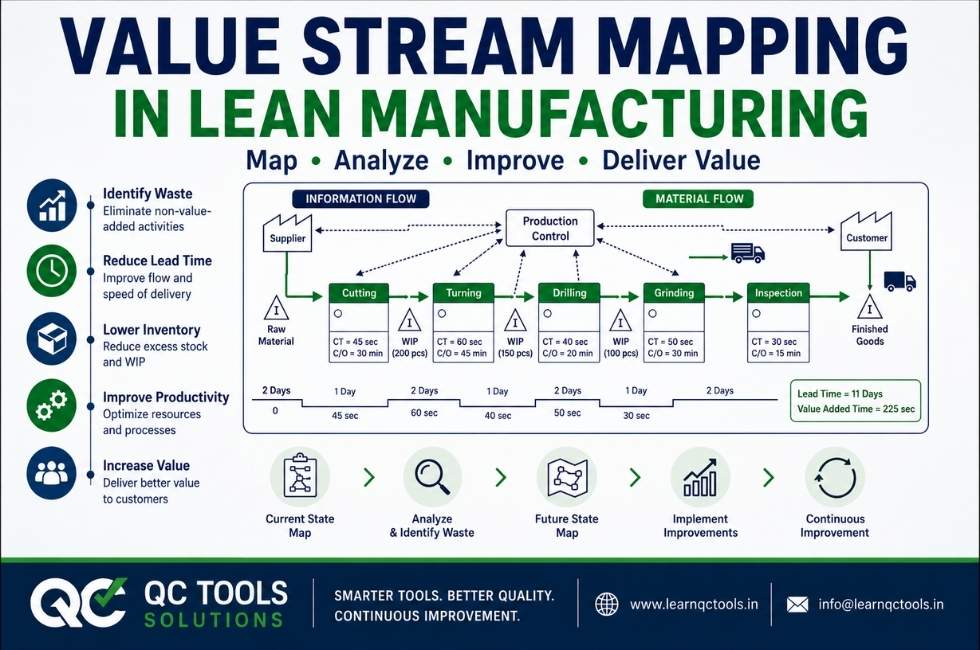
Value Stream Mapping (VSM) is one of the most effective lean manufacturing tools used to analyze, visualize, and improve the flow of materials and information required to deliver a product or service to customers. It helps industries identify waste, reduce lead time, improve productivity, and create efficient manufacturing processes.
In lean manufacturing, value stream mapping is widely used for continuous improvement by identifying non-value-added activities and eliminating waste from the production system. It provides a complete picture of the manufacturing flow from raw material to finished product.
Manufacturing industries use value stream mapping to improve operational efficiency, reduce inventory, optimize manpower, and increase customer satisfaction.
What is Value Stream Mapping?
Value Stream Mapping is a visual lean manufacturing technique used to map the complete process flow of materials and information in a manufacturing or business process. It helps organizations understand the current state of operations and design a future state with improved efficiency.
A value stream map includes all activities involved in the production process, including:
- Material flow
- Information flow
- Process cycle time
- Inventory levels
- Waiting time
- Transportation
- Inspection activities
The main objective of value stream mapping is to identify waste and improve process flow.
Value Stream Mapping in Lean Manufacturing
Value stream mapping is a core lean manufacturing tool used for process improvement and waste reduction. Lean manufacturing focuses on delivering maximum customer value with minimum waste, and VSM supports this goal by identifying activities that do not add value.
Using value stream mapping in lean manufacturing helps organizations:
- Reduce production lead time
- Eliminate bottlenecks
- Improve production flow
- Reduce work-in-process inventory
- Increase manufacturing productivity
- Improve communication between departments
VSM provides a systematic method for implementing lean principles in manufacturing industries.
Why Value Stream Mapping is Important in Manufacturing
Manufacturing industries often face problems such as excessive inventory, production delays, long lead times, unnecessary movement, and poor communication. Value stream mapping helps identify these problems visually and provides opportunities for continuous improvement.
Importance of value stream mapping in manufacturing:
- Identifies non-value-added activities
- Improves material flow
- Reduces manufacturing waste
- Helps in lean implementation
- Improves production planning
- Reduces cycle time
- Enhances customer satisfaction
- Supports continuous improvement initiatives
Benefits of Value Stream Mapping
Value stream mapping offers several benefits to manufacturing industries and business organizations.
1. Waste Reduction
VSM helps identify different types of waste in manufacturing processes such as waiting, transportation, excess inventory, and overproduction.
2. Improved Lead Time
By eliminating unnecessary activities and improving process flow, manufacturing lead time can be significantly reduced.
3. Better Process Visibility
VSM provides a clear understanding of the complete manufacturing process from supplier to customer.
4. Reduced Inventory
It helps reduce excess raw material, WIP inventory, and finished goods inventory.
5. Improved Productivity
Value stream mapping improves machine utilization, manpower efficiency, and overall productivity.
6. Better Communication
Cross-functional teams can better understand process flow and improvement opportunities.
Types of Value Stream Maps
Current State Map
A current state map represents the existing manufacturing process and highlights current problems, delays, inventories, and waste.
It helps organizations understand:
- Current process flow
- Existing cycle time
- Inventory levels
- Information flow
- Process inefficiencies
Future State Map
A future state map represents the improved process after eliminating waste and implementing lean improvements.
It focuses on:
- Reduced lead time
- Better material flow
- Improved productivity
- Lower inventory
- Efficient manufacturing operations
Ideal State Map
An ideal state map represents the perfect manufacturing process with zero waste and maximum efficiency.
Value Stream Mapping Symbols
Different symbols are used in value stream mapping to represent processes, inventory, transportation, and information flow.
Common value stream mapping symbols include:
| Symbol | Purpose |
|---|---|
| Process Box | Represents a manufacturing process |
| Inventory Triangle | Shows inventory or storage |
| Arrow | Represents material flow |
| Information Arrow | Represents information flow |
| Supplier Symbol | Indicates supplier |
| Customer Symbol | Indicates customer |
| Data Box | Displays process data |
| Kaizen Burst | Indicates improvement opportunity |
Understanding value stream mapping symbols is essential for creating accurate VSM diagrams.
Steps of Value Stream Mapping Process
Step 1: Select Product Family
Choose the product or product family for which the value stream map will be prepared.
Step 2: Collect Manufacturing Data
Collect production-related data such as:
- Cycle time
- Changeover time
- Inventory
- Manpower
- Machine uptime
- Lead time
Step 3: Draw Current State Map
Prepare the current state value stream map showing the existing manufacturing process.
Step 4: Identify Waste and Bottlenecks
Analyze the current state map to identify:
- Waiting
- Excess inventory
- Transportation waste
- Production delays
- Bottlenecks
Step 5: Develop Future State Map
Design a future state value stream map with lean improvements.
Step 6: Implement Improvements
Implement lean manufacturing tools such as:
- 5S
- Kaizen
- Kanban
- SMED
- TPM
- Line balancing
Step 7: Monitor Results
Measure process improvements and continuously improve the manufacturing system.
Value Stream Mapping Example in Manufacturing
Consider an automobile component manufacturing company producing machined shafts.
The manufacturing process includes:
- Raw material cutting
- Turning operation
- Drilling operation
- Grinding operation
- Inspection
- Packing
During current state analysis, the company identified:
- Excess inventory between processes
- High waiting time
- Long setup time
- Production bottlenecks
After implementing lean manufacturing improvements through value stream mapping:
- Lead time reduced by 35%
- Inventory reduced by 40%
- Productivity improved by 25%
- Material movement reduced significantly
This example shows how value stream mapping improves manufacturing efficiency.
Current State Map vs Future State Map
| Current State Map | Future State Map |
|---|---|
| Shows existing process | Shows improved process |
| Identifies waste | Eliminates waste |
| Higher inventory | Lower inventory |
| Longer lead time | Reduced lead time |
| Existing bottlenecks | Improved process flow |
Difference Between Process Mapping and Value Stream Mapping
| Process Mapping | Value Stream Mapping |
|---|---|
| Focuses on process steps | Focuses on value flow |
| Detailed operational view | Complete system view |
| Used for local improvement | Used for lean transformation |
| Limited information flow | Includes material and information flow |
Seven Wastes Identified by Value Stream Mapping
Value stream mapping helps identify the seven wastes of lean manufacturing.
1. Transportation
Unnecessary movement of material.
2. Inventory
Excess raw material or WIP inventory.
3. Motion
Unnecessary movement of operators.
4. Waiting
Idle time between processes.
5. Overproduction
Producing more than customer demand.
6. Overprocessing
Performing unnecessary operations.
7. Defects
Production of defective parts requiring rework.
Value Stream Mapping helps organizations identify the 7 Wastes of Lean Manufacturing and improve operational efficiency through continuous improvement initiatives.
Challenges in implementing Value Stream Mapping
Organizations may face some challenges while implementing value stream mapping.
Common challenges include:
- Resistance to change
- Lack of lean manufacturing knowledge
- Inaccurate manufacturing data
- Poor cross-functional coordination
- Lack of management support
Proper training and team involvement are important for successful implementation.
Best Practices for Successful Value Stream Mapping
To achieve maximum benefits from value stream mapping, organizations should follow these best practices:
- Involve cross-functional teams
- Collect accurate process data
- Focus on customer requirements
- Continuously monitor improvements
- Implement lean manufacturing tools effectively
- Update value stream maps regularly
Applications of Value Stream Mapping
Value stream mapping is widely used in:
- Automobile industry
- Aerospace manufacturing
- Electronics industry
- Machining industry
- Assembly operations
- Healthcare sector
- Service industries
Conclusion
Value Stream Mapping is a powerful lean manufacturing tool used to identify waste, improve process flow, and increase productivity in manufacturing industries. It provides a visual representation of material and information flow and helps organizations implement continuous improvement effectively.
By using value stream mapping in lean manufacturing, companies can reduce lead time, minimize inventory, improve operational efficiency, and enhance customer satisfaction. Proper implementation of current state and future state value stream maps can significantly improve manufacturing performance and support long-term business growth.
Organizations aiming for lean transformation and operational excellence should adopt value stream mapping as a key process improvement tool.
For more lean manufacturing tools, quality management resources, and process improvement techniques, visit QC Tools Solutions or contact us at info@learnqctools.in
Frequently Asked Questions (FAQs)
What is value stream mapping in lean manufacturing?
Value stream mapping is a lean manufacturing tool used to analyze and improve the flow of materials and information in a production process.
What are the benefits of value stream mapping?
The main benefits include waste reduction, improved productivity, lower inventory, reduced lead time, and better process flow.
What is the difference between current state and future state map?
A current state map shows the existing manufacturing process, while a future state map shows the improved process after lean implementation.
What are value stream mapping symbols?
Value stream mapping symbols are graphical icons used to represent processes, inventory, transportation, and information flow in a VSM diagram.
How is value stream mapping used in manufacturing?
Manufacturing industries use VSM to identify waste, optimize production flow, reduce lead time, and improve operational efficiency.
What is lead time in value stream mapping?
Lead time is the total time taken for a product to move from raw material stage to finished goods delivery.
What is takt time in lean manufacturing?
Takt time is the rate at which products must be produced to meet customer demand.