

What is the APQP Responsibility Matrix?
The APQP Responsibility Matrix is an essential tool used in the automotive and manufacturing industries. It clearly defines the roles and responsibilities of departments involved in new product development and launch. APQP (Advanced Product Quality Planning) ensures quality, customer satisfaction, and reliability throughout the product lifecycle.
By using a responsibility matrix, organizations avoid confusion, delays, and duplication of work during APQP implementation.
Why is the Responsibility Matrix Important?
- Ensures role clarity across departments
- Improves accountability and communication
- Minimizes delays and errors in product launch
- Supports compliance with IATF 16949 and customer requirements
Key Elements of the Matrix
- Responsible (R): Team executing the activity
- Accountable (A): Department answerable for the success of the activity
- Consulted (C): Teams providing expertise or inputs
- Informed (I): Stakeholders updated on progress
Development Categories in APQP
| Development Category | Code |
|---|---|
| New Part | A |
| Similar Part | B |
| Design Change (ECN) | C |
| Process Change (PCN) | D |
| Material Change | E |
| Machine Change | F |
| Plant Location Change | G |
| Supplier Change | H |
Example of APQP Matrix
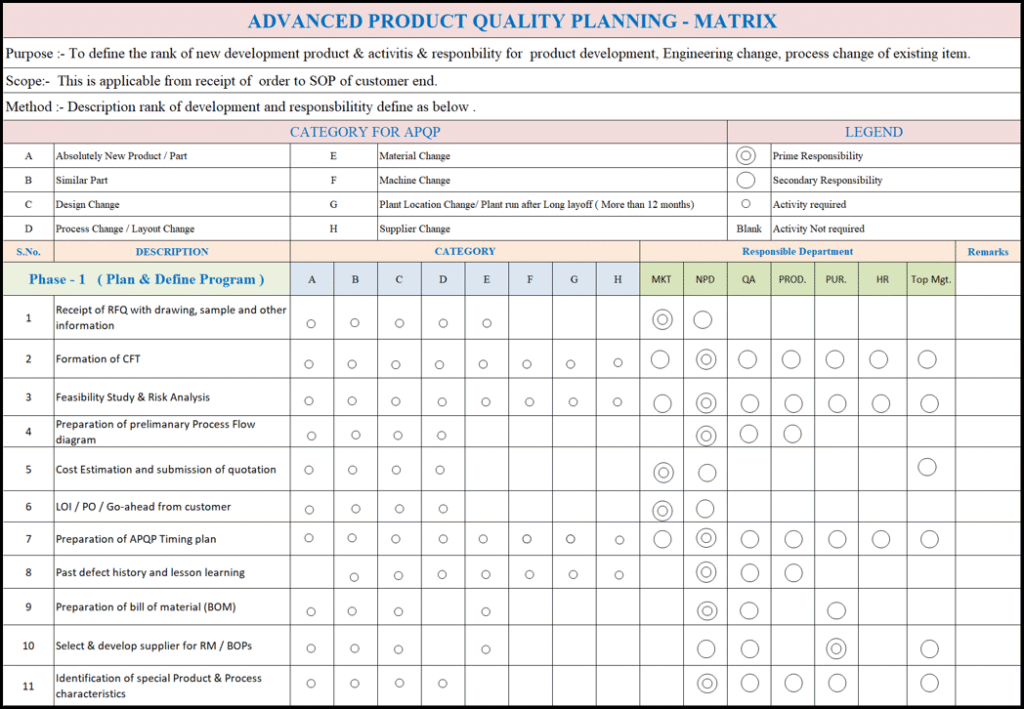
Each APQP Matrix—from RFQ receipt to SOP at customer end—assigns primary and secondary responsibilities:
- Marketing → Prime responsibility for RFQ receipt
- NPD / Engineering → Secondary responsibility for early design support
- Production, QA, Purchase, Supplier Quality → Assigned roles across validation and launch phases
- Categories for APQP are defined by a category code (A to H).
- The matrix categorizes activities according to their application.
- A small circle indicates the applicable activity.
- For each activity, the responsible department is marked with:
- Double circle: Primary responsibility
- Single circle: Secondary responsibility
Example – Activity No. 1: “Receipt of RFQ with drawing”
- Applicable in categories A, B, C, D & E
- Prime responsibility: Marketing department
- Secondary responsibility: NPD department
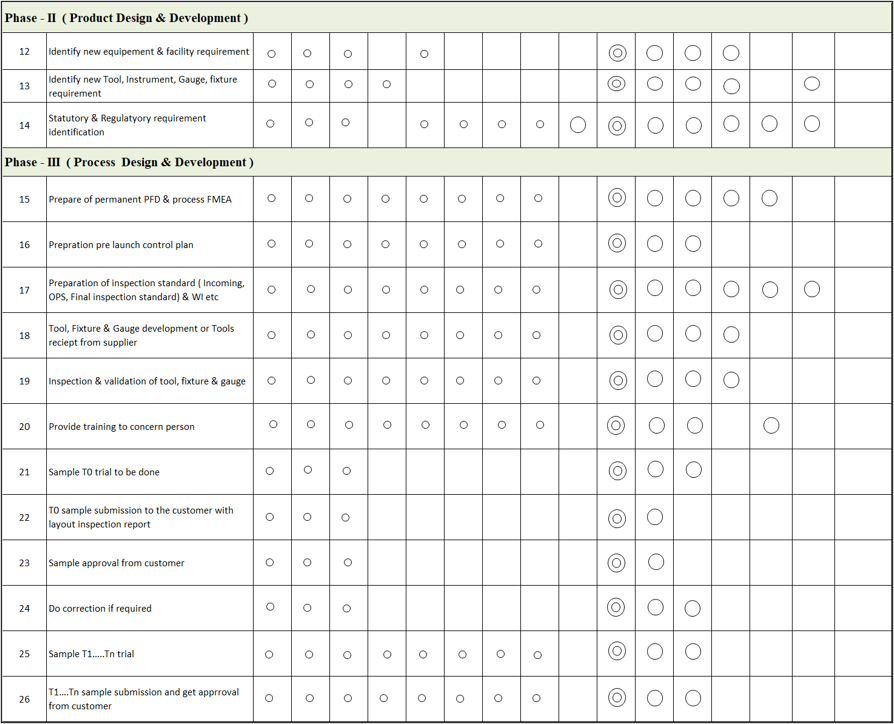
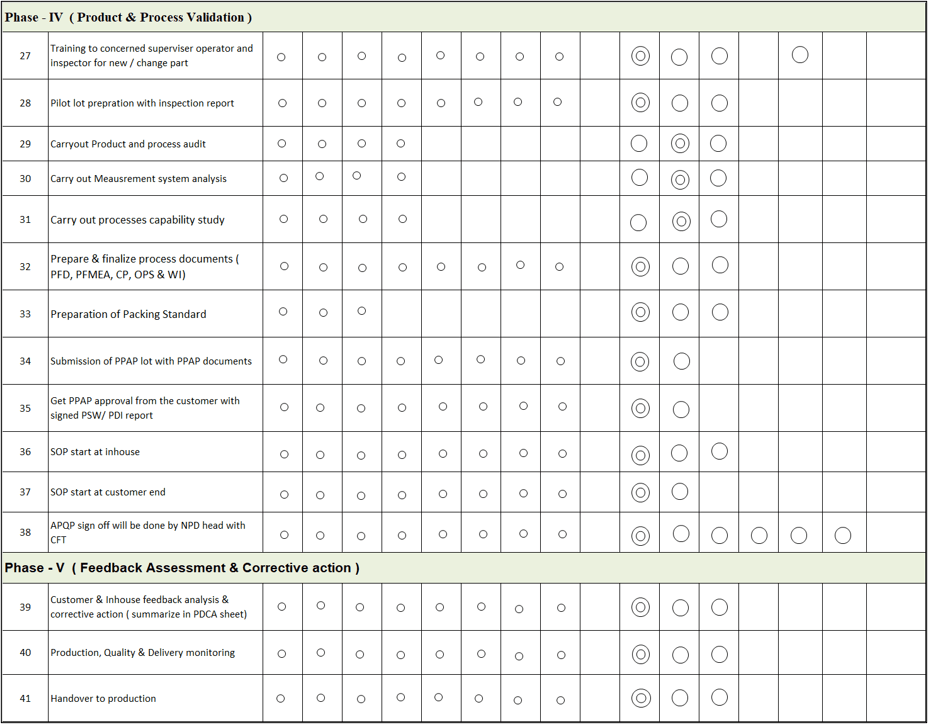
Similarly, all other activities and responsibilities can be easily understood from the APQP matrix.
APQP Responsibility Matrix Format (Chart):
A typical APQP Responsibility Matrix format consists of APQP activities listed in rows and responsible departments listed in columns.
Organizations may customize this format according to their product development process and customer-specific requirements.
Benefits of Using APQP Responsibility Matrix
- Aligns all functions during product development
- Reduces rework and conflicts between teams
- Provides a standard reference during audits
- Helps in supplier–customer communication
Download APQP Matrix Excel Template
APQP Responsibility Matrix Format with Example
An APQP Responsibility Matrix is a structured document that defines the roles and responsibilities of various departments involved in the Advanced Product Quality Planning (APQP) process. It ensures that every APQP activity is assigned to the appropriate function, reducing confusion and improving project execution.
The matrix is typically prepared during the planning stage of a new product development project and serves as a roadmap for cross-functional teams throughout the APQP process.
👉 Download APQP Matrix Excel to customize for your organization.
Purpose of APQP Responsibility Matrix
The primary objectives of an APQP Responsibility Matrix are:
- Define ownership of APQP activities.
- Improve communication among departments.
- Ensure timely completion of deliverables.
- Avoid duplication of work.
- Support compliance with AIAG APQP requirements.
- Facilitate effective project management and monitoring.
APQP Responsibility Matrix Example
Consider an automotive supplier developing a new sheet metal bracket for an OEM customer.
The Marketing department receives the customer RFQ and gathers customer requirements. The Engineering team performs feasibility analysis and develops the product design. The Quality department prepares PFMEA, Control Plan, MSA, and PPAP documents. Production develops manufacturing processes and conducts trial runs, while the Purchase department manages supplier development activities.
By assigning responsibilities through the APQP Matrix, every department understands its role and project milestones can be achieved within the planned timeline.
Benefits of using APQP Responsibility Matrix
Organizations implementing an APQP Responsibility Matrix can achieve several benefits:
- Clear accountability for APQP deliverables.
- Better coordination among cross-functional teams.
- Improved project tracking and monitoring.
- Reduced risk of missed activities.
- Faster product development cycle.
- Enhanced compliance with IATF 16949 requirements.
- Improved customer satisfaction.
APQP Responsibility Matrix and IATF 16949
Although IATF 16949 does not explicitly require an APQP Responsibility Matrix, the standard emphasizes project management, cross-functional planning, risk-based thinking, and product realization. The APQP Responsibility Matrix helps organizations demonstrate effective planning and responsibility assignment during audits.
Many automotive OEMs and Tier-1 suppliers use APQP matrices as part of their new product development and supplier quality planning systems.
Common Mistakes while preparing APQP Matrix
Organizations often make the following mistakes:
- Assigning responsibilities to only one department.
- Not involving cross-functional teams.
- Failing to update the matrix after project changes.
- Missing customer-specific requirements.
- Not linking APQP activities with project timelines.
- Inadequate management review of APQP progress.
Avoiding these mistakes can significantly improve APQP effectiveness and project success.
Frequently Asked Questions (FAQs)
What is an APQP Responsibility Matrix?
It is a structured chart that defines departmental responsibilities in all APQP phases.
Why should companies use it?
It ensures accountability, faster decision-making, and error-free product launches.
Who prepares the APQP Responsibility Matrix?
Usually prepared by the Quality or NPD team, with inputs from all functions.
How many categories are there in the APQP Matrix?
The APQP Matrix uses eight categories (A to H), covering new parts, design changes, process changes, supplier changes, and more.
How does the APQP Matrix support IATF 16949 compliance?
By clearly defining responsibilities and documenting activities, the APQP Matrix ensures that all IATF 16949 requirements are addressed during product development.
What is the purpose of an APQP Matrix?
The purpose is to assign ownership, improve coordination, and ensure completion of APQP deliverables within planned timelines.
Is APQP Responsibility Matrix mandatory in IATF 16949?
While not specifically mandated, it is widely used to demonstrate effective project management and APQP implementation.
Can APQP Responsibility Matrix be maintained in Excel?
Yes. Most organizations maintain APQP Responsibility Matrices in Excel because it is easy to update, review, and share among departments.
What departments are usually included in an APQP Matrix?
Typical departments include Marketing, Design, Quality, Production, Purchase, Tooling, Main tenance, Logistics, and Supplier Quality.
Conclusion
The APQP Responsibility Matrix is a valuable project management tool that clearly defines roles and responsibilities throughout the APQP process. By assigning ownership of activities, organizations can improve communication, ensure timely completion of deliverables, and enhance compliance with automotive quality requirements. A well-maintained APQP Matrix supports successful product launches, reduces project risks, and contributes to customer satisfaction.
The APQP Responsibility Matrix streamlines roles, ensures accountability, and reduces errors in product development. It aligns teams across all APQP phases and supports compliance with standards like IATF 16949. By applying it effectively, companies can achieve smoother launches and higher customer satisfaction.
Sir format have protection
Plz password share to unprotected
By which we can follow this
It can be downloaded easily and no password.
Very well presented. Every quote was awesome and thanks for sharing the content. Keep sharing and keep motivating others.
It can be downloaded easily and no password.
Fantastic blog!