
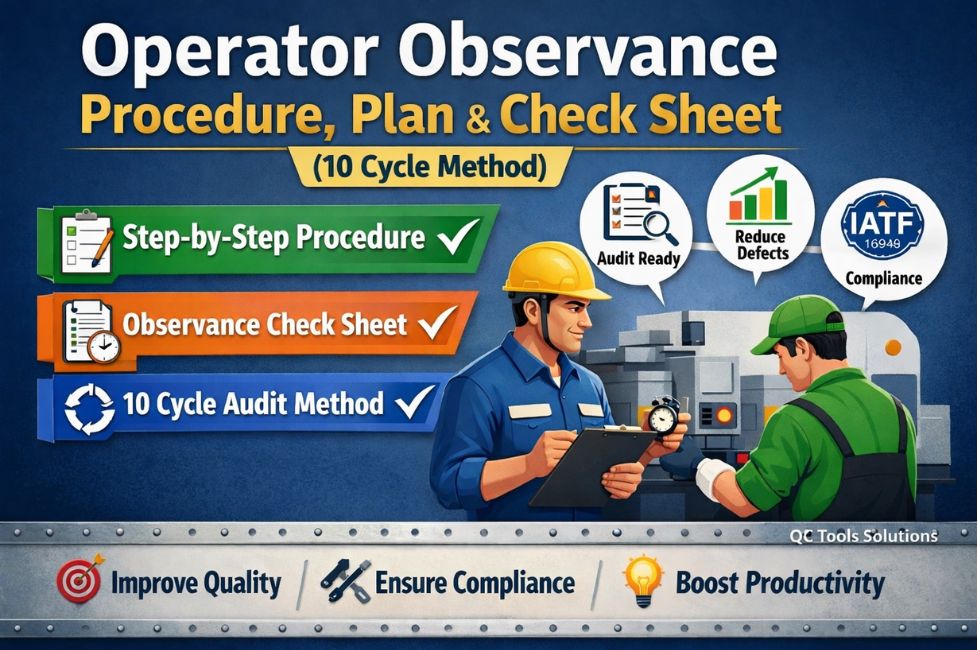
Operator observance is a critical shop-floor activity used in manufacturing industries to verify whether operators are following defined standards, work instructions, and quality requirements. It plays a vital role in ensuring process discipline, reducing defects, and meeting IATF 16949 audit expectations.
This guide explains operator observance procedure, plan, check sheet format, and the 10 cycle operator observance method with practical examples.
What is Operator Observance?
Operator observance is a systematic method of observing an operator while performing a task to ensure compliance with:
• Standard Operating Procedures (SOP)
• Work Instructions
• Quality requirements
• Safety guidelines
It is commonly used in process audits, layered audits, and internal quality checks.
👉 In simple words:
It is “watching the operator and verifying whether the work is being done correctly.”
Operator Observance Procedure (Step-by-Step)
Follow this practical procedure used in manufacturing industries:
Step 1: Select the Process
Choose a critical process or workstation based on:
• Customer complaints
• Internal defects
• New process implementation
Step 2: Inform the Operator
Explain purpose clearly:
• No fear or pressure
• It is for improvement, not fault finding
Step 3: Observe the Operation
Carefully watch:
• Method of working
• Sequence of operations
• Use of tools and gauges
Step 4: Compare with Standard
Check against:
• SOP
• Control Plan
• Work Instructions
Step 5: Record Observations
Use an operator observance check sheet to record:
• Conformity
• Deviations
• Remarks
Step 6: Take Action
• Immediate correction (if required)
• Root cause analysis
• Training or retraining
Operator Observance Plan (Frequency & Coverage)
A proper plan ensures consistency and audit compliance.
Example Plan:
• Daily → Critical processes
• Weekly → Key operations
• Monthly → Full line coverage
Plan can be quarterly if expierenced operators.
Planning Factors:
• Risk level
• Customer requirements
• Past rejection data
👉 Tip: Always document your plan. Auditors frequently ask for this.
Operator Observance Check Sheet Format
A structured check sheet helps standardize observations.

Typical Format Includes:
• Operator Name
• Process Name
• Date & Time
• Operation Steps
• Check Points
• OK / Not OK
• Remarks
• Auditor Name
Key Check Points:
• Correct method followed
• Proper use of tools
• Safety compliance
• Quality checks performed
• No shortcut or deviation
👉 Pro Tip: Use a simple and visual format so it can be used easily on shop floor.
10 Cycle Operator Observance Method
This is a highly effective and commonly used method in audits.
What is 10 Cycle Observance?
Observe the operator for 10 consecutive cycles of the same operation.
What to Check:
• Cycle time consistency
• Repeatability of process
• Adherence to standard method
• Any variation or shortcut
• Quality checks performed each cycle
Why It Matters:
• Detects hidden variation
• Ensures process stability
• Strengthens audit compliance
👉 This method is especially useful in IATF audits and customer inspections
Key Check Points in Operator Observance
While observing, focus on these critical areas:
Quality
• Part inspection done correctly
• Gauges used properly
• No defect passed
Many defects like burrs or scratches can be identified early through operator observance, as explained in Sheet Metal Defects.
• Correct sequence followed
• No deviation from SOP
Process
Safety
• PPE used
• Safe handling of tools
Productivity
• Cycle time maintained
• No unnecessary delays
Benefits of Operator Observance
Implementing operator observance gives strong benefits:
• Improves process discipline
• Reduces defects and rework
• Enhances operator awareness
• Supports audit readiness
• Identifies training needs
• Strengthens quality culture
Operator observance is also useful during Production Part Approval Process validation to ensure operators follow approved processes
Common Mistakes in Operator Observance
Avoid these common mistakes:
• Observing only for formality
• Not recording actual findings
• Ignoring small deviations
• No corrective action taken
• Not covering all shifts
👉 Remember: Observance without action has no value.
Practical Example (Shop Floor)
During operator observance on a drilling machine:
• Operator skipped cleaning before drilling
• Result → Burr formation issue
Action Taken:
• Retraining given
• SOP updated
• Defect reduced significantly
👉 This shows how small observations can prevent major problems. To prevent operator errors, implement Poka-Yoke in critical operations.
Work Instruction for Operator Observance :
- Prepare operator observance plan as per defined frequency (3 or 6 months as per need)
- Cover all the operators and all shifts in operator observance.
- If an operator is absent, then conduct re-observance of that operator when present in the month.
- Keep WI/OPS in the file before conducting operator observance and conduct with an observance check sheet. (Work Instruction / Operation Standard)
- Conduct operator observance without informing the operator.
- Maintain operator observance record and take the sign of the operator.
- If the operator is found not working as per standard or is not able to give an answer, provide training and maintain the record.
- Conduct operator observance again within a week to check the effectiveness of the training.
Operator Observance Check Points:
- Does he report to duty on time?
- Does he properly wear safety items, PPE (Personal protective equipment) & uniform?
- Does he clean the workstation & equipment?
- Does he work as per work instructions/operation standards?
- Does he follow quality checkpoints?
- Does he check the first piece?
- Does he complete the job during breaks?
- Does he update the daily machine check sheet?
- Does he maintain an hourly productivity sheet?
- Does he work as per the production target / Cycle Time?
- Does he behave well with co-operators & supervisors?
- Does he put the rejected items in the red bin with proper identification?
- Does he ask for help in abnormal situations?
- Does he know the current in-house / Customer defects?
- Does he know the critical quality points of his station?
- Does he know the quality policy?
- Does he hand over the work to his reliever?
- Does he leave the station in cleaning condition?
FAQs on Operator Observance
What is operator observance check sheet?
It is a document used to record observations while monitoring an operator’s work against defined standards.
What is 10 cycle operator observance?
It is a method of observing 10 continuous cycles of an operation to verify consistency and adherence to standards.
How often should operator observance be done?
It depends on process criticality but typically daily, weekly, or monthly as per plan.
Is operator observance required in IATF 16949?
Yes, it supports process audit requirements and ensures standard work compliance.
Conclusion
Operator observance is a powerful tool for improving quality, ensuring process compliance, and strengthening audit readiness. When combined with a proper procedure, plan, check sheet, and 10 cycle method, it becomes highly effective in controlling shop-floor variations.
If implemented correctly, it not only improves product quality but also builds a strong culture of discipline and accountability in manufacturing operations. Operator observance supports process audit requirements as per International Automotive Task Force guidelines.
This was a good read. Thanks for the post.