
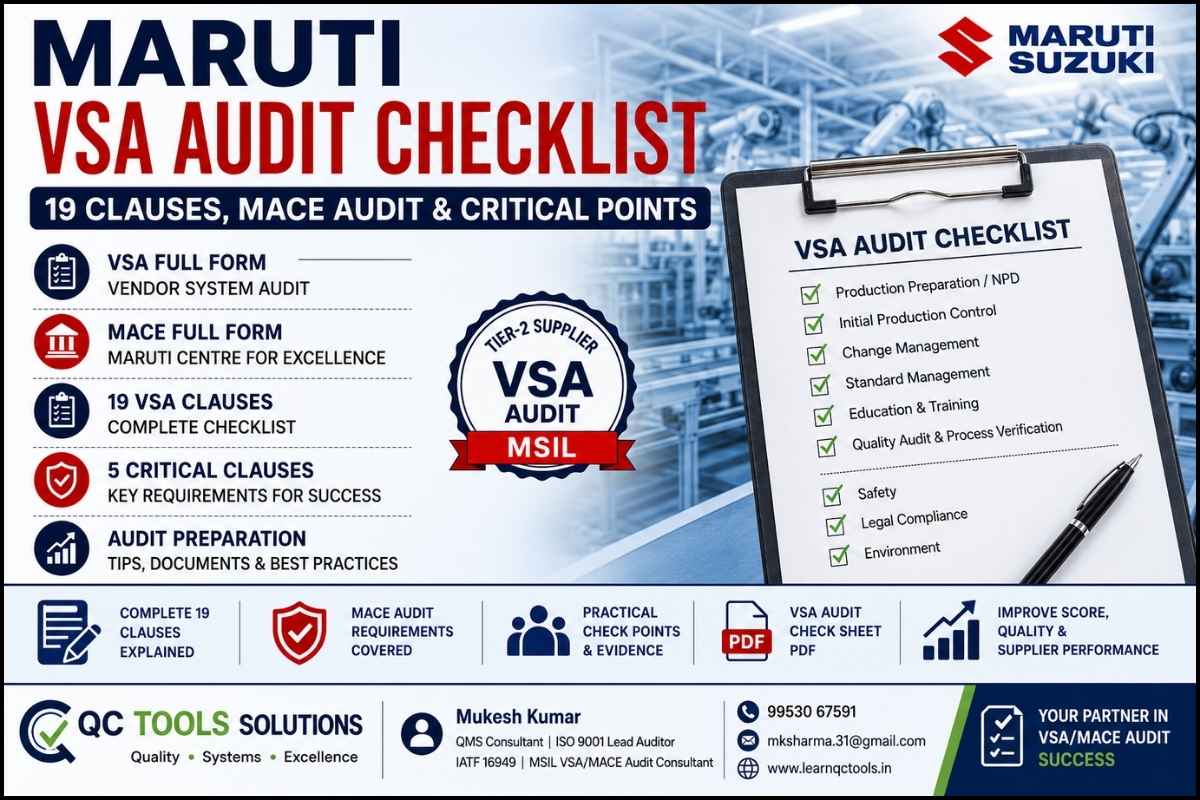
Maruti VSA Audit Checklist: 19 Clauses, MACE Audit, VSA Full Form & Critical Points
VSA full form is Vendor System Audit. A Maruti VSA audit is a customer-specific supplier assessment used to evaluate how effectively a vendor has implemented quality systems, manufacturing controls, safety requirements and other supplier requirements.
For automotive suppliers working with Maruti Suzuki India Limited (MSIL), understanding the VSA audit checklist, VSA clauses, critical requirements and audit preparation is important for maintaining robust processes and improving supplier performance.
This guide explains the Maruti VSA audit checklist, 19 VSA clauses, critical clauses, MACE audit, audit preparation, common observations and practical checkpoints for Tier-2 suppliers.
Important: VSA/MACE requirements and checklist versions may be revised by the customer. Always verify the latest customer-issued checklist or requirements applicable to your supplier category before an audit.
- Maruti VSA Audit Checklist: 19 Clauses, MACE Audit, VSA Full Form & Critical Points
- Maruti VSA Audit Checklist – 19 Clauses
- VSA Audit Checklist – Clause-Wise Check Points
- Clause 1: Production Preparation / New Product Development
- Clause 2: Initial Production Control
- Clause 3: Change Management
- Clause 4: Standard Management
- Clause 5: Education and Training
- Clause 6: Quality Audit and Process Verification
- Clause 7: Supplier Control
- Clause 8: Handling Abnormality in Quality
- Clause 9: 5S Management
- Clause 10: Equipment and Inspection Equipment Management
- Clause 11: Implementation of Standards
- Clause 12: Product Management
- Clause 13: Handling Management
- Clause 14: Critical Parts Management
- Clause 15: Adequate Testing Facility
- Clause 16: Process Audit
- Clauses 17–19: Business, Safety, Legal and EHS Requirements
- Clause 17 – Financial/Business and Management Requirements
- Clause 18 – Safety
- Clause 19 – Legal Compliance, Environment and HR
- Common VSA Audit Non-Conformities
- 1. PFMEA and Control Plan are not linked
- 2. Corrective action has no effective root-cause analysis
- 3. Effectiveness verification is missing
- 4. 4M change records are incomplete
- 5. Training records are incomplete
- 6. Traceability gaps
- 7. Shop-floor standards are not followed
- 8. Poka-Yoke verification is weak
- 9. Calibration is overdue
- 10. Previous audit findings are repeated
- How to Prepare for a Maruti VSA Audit
- Documents to Keep Ready for VSA Audit
- VSA Audit Preparation – Final 1-Day Checklist
- VSA Audit Checklist PDF / MACE Audit Check Sheet
- VSA Audit vs Process Audit
- Frequently Asked Questions About VSA Audit
- What is the full form of VSA audit?
- What is a Maruti VSA audit?
- What is a MACE audit?
- How many clauses are there in the VSA audit?
- What are the 5 critical clauses in a VSA audit?
- Is VSA audit the same as IATF 16949?
- Is IATF 16949 certification enough for a VSA audit?
- What documents are required for a VSA audit?
- How can I prepare for a VSA audit?
- What happens if VSA audit performance is poor?
- Key Takeaways
What is VSA Audit?
VSA stands for Vendor System Audit.
A VSA audit is a structured supplier assessment focused on the implementation and effectiveness of the supplier’s management systems, manufacturing processes, quality controls and customer-specific requirements.
For Maruti Suzuki suppliers, the audit is closely associated with the supplier development ecosystem supported by the Maruti Centre for Excellence (MACE). Maruti Suzuki describes MACE as an initiative to upgrade the capabilities of its vendor base, including Tier-2 suppliers, through training, consultancy, and manufacturing-excellence activities.
Unlike a general ISO 9001 or IATF 16949 certification audit, a VSA audit focuses heavily on the supplier’s practical implementation and customer-specific expectations.
VSA Audit Quick Answer
VSA full form: Vendor System Audit
VSA audit meaning: A supplier system and manufacturing assessment focused on implementation, process control and customer requirements.
MACE full form: Maruti Centre for Excellence
Main VSA focus: Quality systems, process controls, change management, training, abnormality handling, equipment management, product control, safety and other supplier requirements.
Typical VSA checklist structure: The commonly referenced checklist contains 19 major clauses, but suppliers should always use the latest applicable customer-issued checklist.
What Is MACE Audit?
MACE stands for Maruti Centre for Excellence.
MACE was established as an initiative involving Maruti Suzuki and its vendor partners to improve vendor capability in areas such as quality, cost, technology, manufacturing excellence, safety and human-capital development.
Why is the Maruti VSA Audit important?
The VSA audit helps assess whether a supplier has implemented effective systems rather than relying only on documented procedures.
Important areas include:
- New Product Development and production preparation
- Initial production control
- 4M/change management
- Standard management
- Employee education and training
- Quality audit and process verification
- Supplier control
- Abnormality and complaint handling
- 5S
- Machine and inspection equipment management
- Product identification and traceability
- Critical part management
- Adequate Testing facilities
- Process audits
- Safety
- Legal and environmental compliance
- Management involvement and business-related requirements
For suppliers, strong VSA performance can support better process discipline, customer confidence and supplier development.
VSA Audit vs IATF 16949 Audit
VSA and IATF 16949 should not be treated as the same audit.
| Aspect | VSA Audit | IATF 16949 Audit |
|---|---|---|
| Type | Customer-specific supplier audit | Automotive QMS certification audit |
| Main focus | Customer requirements and practical implementation | Conformity to IATF 16949 requirements |
| Evaluation | Checklist/score based | Audit findings and certification rules |
| Customer focus | MSIL/customer-specific expectations | Automotive QMS requirements |
| Scope | Supplier system and manufacturing implementation | Defined QMS scope and processes |
| Result | Supplier performance/assessment | Certification status and audit findings |
A supplier can have IATF 16949 certification and still have gaps against customer-specific VSA requirements.
Maruti VSA Audit Checklist – 19 Clauses
The commonly referenced Maruti VSA/Tier-2 checklist structure contains the following 19 major areas:
- Production Preparation / New Product Development
- Initial Production Control
- Change Management
- Standard Management
- Education and Training
- Quality Audit and Process Verification
- Supplier Control
- Handling Abnormality in Quality
- 5S Management
- Equipment and Inspection Equipment Management
- Implementation of Standards
- Product Management
- Handling Management
- Critical Parts Management
- Adequate Testing Facility
- Process Audit
- Financial/Business and Management-Related Requirements
- Safety
- Legal Compliance, Environment and/or Management/HR Requirements
5 Critical Clauses in VSA Audit
Based on the practical VSA requirements commonly emphasized by suppliers and auditors, five areas deserve particular attention:
- Change Management
- Education and Training
- Handling Abnormality in Quality
- Equipment and Inspection Equipment Management
- Safety
For Tier-1 suppliers, Supplier Control is also an important area because the supplier must demonstrate effective control and development of its supply base.
1. Change Management
Change management is one of the most important areas because uncontrolled changes can directly affect product quality.
Typical audit points include:
- Planned and unplanned changes are clearly defined.
- 4M changes are identified and controlled.
- Change approval requirements are defined.
- Customer approval is obtained wherever required.
- Changes are communicated to relevant departments.
- Initial parts after change are identified and controlled.
- Quality checks after change are recorded.
- Traceability is maintained.
- Effectiveness of the change is verified.
Documents/Evidence to Keep Ready
- 4M change procedure
- 4M change register
- Change approval records
- Customer communication/approval
- Initial part records
- Change-related inspection records
- Revised drawings/specifications
- Updated PFMEA and Control Plan where applicable
2. Education and Training
VSA auditors generally look beyond the existence of a training calendar. They want evidence that employees are competent for their assigned jobs.
Important points include:
- Training needs are identified.
- Annual training plans are prepared.
- Operators receive job-specific training.
- Skill matrices are maintained.
- Skill evaluation is performed.
- Effectiveness of training is evaluated.
- Certified/special-process operators are controlled.
- Refresher training is provided where necessary.
- Training records are complete and traceable.
For critical operations, practical competency verification is particularly important.
3. Handling Abnormality in Quality
The supplier should have a clear system for identifying, containing, investigating and eliminating quality abnormalities.
Check:
- Definition of abnormal conditions
- Identification and segregation of suspect material
- Red-bin/rejection control
- Customer complaint handling
- In-process abnormality handling
- Supplier-related quality problems
- Root-cause analysis
- Corrective action
- Effectiveness verification
- Standardization
- Horizontal deployment
A common weakness is closing corrective actions without demonstrating that the root cause was eliminated and recurrence was prevented.
4. Equipment and Inspection Equipment Management
Auditors may verify whether machines, tools, fixtures and measuring equipment are actually maintained and controlled.
Important points include:
- Preventive maintenance
- Daily machine checks
- Breakdown records
- Fixture and die maintenance
- Poka-Yoke verification
- Alarm/auto-stop verification
- Consumable tool replacement standards
- Calibration
- Measuring equipment identification
- Calibration validity
- Boundary/limit sample control
The records should match actual shop-floor conditions.
5. Safety
Safety should not be treated as only a document-related requirement.
Check:
- PPE availability and usage
- Machine guarding
- Safety sensors/interlocks
- Emergency arrangements
- Fire safety
- Escape routes
- Safe material movement
- Safety standards
- Operator safety training
- Accident/incident reporting
- Corrective actions
- Periodic safety inspections
- Safety awareness on the shop floor
Maruti Suzuki’s vendor-development activities also emphasize safety and manufacturing capability development among suppliers.
VSA Audit Scoring
VSA assessment is generally discussed in terms of scoring rather than simply treating the audit as an ISO-style pass/fail certification audit.
For any specific supplier, however, do not assume that an old score threshold is still applicable. The applicable customer checklist and assessment rules should be confirmed before the audit.
If your organization uses a previous VSA scorecard, review:
- Overall score
- Critical clause score
- Individual clause scores
- Previous observations
- Open corrective actions
- Repeat observations
- Customer complaints
- Process audit results
The most useful approach is to identify the lowest-scoring clauses and conduct a focused gap assessment before the customer audit.
VSA Audit Checklist – Clause-Wise Check Points
The following points can be used as a practical VSA audit preparation checklist. They are not a replacement for the latest customer-issued audit checklist.
Clause 1: Production Preparation / New Product Development
Check whether:
- Product development responsibilities are defined.
- APQP/NPD activities are planned.
- Production preparation schedules are controlled.
- Cross-functional teams review potential quality risks.
- Previous problems are considered during new product development.
- PFMEA, Control Plan and process documents are developed.
- Lessons learned are incorporated.
Evidence: APQP/NPD files, feasibility review, timing plan, PFMEA, Control Plan, trial reports and review records.
Clause 2: Initial Production Control
Check:
- Initial production control requirements are defined.
- Controlled parts and characteristics are identified.
- Inspection frequency is defined.
- Initial production period is defined.
- Special characteristics receive appropriate control.
- Process capability/defect performance is monitored.
- Release criteria for regular production are defined.
Evidence: Initial Production Control records, inspection reports, capability studies and approval records.
Clause 3: Change Management
Check:
- 4M changes are identified.
- Planned/unplanned changes are controlled.
- Change approval flow is defined.
- Customer approval is obtained where required.
- Initial parts are identified.
- Post-change inspection is performed.
- Records are maintained for traceability.
Clause 4: Standard Management
Check:
- Process Control Standards are available.
- Inspection standards are controlled.
- Work instructions are current.
- Parameter charts are available.
- Revision control is effective.
- Actual shop-floor documents match approved documents.
Clause 5: Education and Training
Check:
- Training needs are identified.
- Training plans are implemented.
- Skill matrices are updated.
- Operator competency is evaluated.
- Special-process operators are qualified.
- Training effectiveness is evaluated.
- Records are maintained.
Clause 6: Quality Audit and Process Verification
Check:
- Internal quality audits are planned.
- Process audits are conducted.
- Actual operations are compared with standards.
- Audit findings are analyzed.
- Corrective actions are implemented.
- Effectiveness is verified.
- Repeat findings are prevented.
Clause 7: Supplier Control
For applicable suppliers, check:
- Supplier selection criteria are defined.
- New suppliers are evaluated.
- Supplier performance is monitored.
- Supplier quality issues are controlled.
- Supplier development is implemented.
- Incoming inspection is defined based on risk.
- Supplier corrective actions are verified.
Clause 8: Handling Abnormality in Quality
Check:
- Abnormality criteria are defined.
- Operators understand abnormal conditions.
- Suspect material is identified and segregated.
- Customer complaints are controlled.
- Root cause is identified.
- Corrective action is implemented.
- Effectiveness is verified.
- Lessons learned are horizontally deployed.
Clause 9: 5S Management
Check:
- Material storage locations are defined.
- WIP and finished goods are identified.
- FIFO is maintained.
- Workplace cleanliness is controlled.
- Tools and fixtures are properly stored.
- Inspection equipment is protected.
- Visual management is implemented.
Clause 10: Equipment and Inspection Equipment Management
Check:
- Preventive maintenance is planned.
- Daily checks are performed.
- Breakdown records are maintained.
- Poka-Yoke is verified.
- Consumable tools are controlled.
- Measuring equipment is calibrated.
- Calibration status is visible.
- Limit/boundary samples are controlled.
Clause 11: Implementation of Standards
Check:
- Work instructions are available at the workplace.
- Critical quality points are clearly displayed.
- Operators understand the instructions.
- Actual operations follow the standard.
- Supervisors verify compliance.
- Check sheets provide clear OK/NG criteria.
Clause 12: Product Management
Check:
- Product identification is maintained.
- Lot traceability is available.
- FIFO is implemented.
- Similar parts are identified separately.
- Non-conforming products are segregated.
- Hold material is controlled.
- Repaired/reworked parts are identified and recorded.
Clause 13: Handling Management
Check:
- Packaging requirements are defined.
- Customer packaging requirements are followed.
- Bins and trolleys are maintained.
- Material handling prevents damage.
- Finished products are protected during storage and transportation.
Clause 14: Critical Parts Management
For applicable critical/safety-related parts, verify:
- Critical characteristics are identified.
- Special controls are defined.
- Critical operations are identified.
- Operators are appropriately trained.
- Inspection records are maintained.
- Repair/rework history is controlled.
- Traceability is maintained.
Clause 15: Adequate Testing Facility
Check:
- Required testing facilities are available.
- Equipment is suitable for specification requirements.
- Testing equipment is calibrated.
- Testing personnel are trained.
- Test methods are defined.
- Test records are maintained.
- Out-of-specification results are controlled.
Clause 16: Process Audit
Check:
- Process audits are conducted according to the defined schedule.
- Audit criteria are based on actual process requirements.
- Control Plan requirements are verified.
- Operator practices are checked.
- Machine parameters are verified.
- Findings are documented.
- Corrective actions are closed.
- Effectiveness is verified.
Clauses 17–19: Business, Safety, Legal and EHS Requirements
Clauses 17–19 deserve special attention because publicly available VSA references show that these areas have been revised in some checklist versions.
Therefore, before an audit, confirm the latest applicable checklist.
Clause 17 – Financial/Business and Management Requirements
Depending on the applicable revision, audit points may include:
- Organizational structure
- Management responsibilities
- Plant/business information
- Financial indicators
- Top-management involvement
- Management review of key performance indicators
Clause 18 – Safety
Typical areas include:
- Working conditions
- PPE
- Machine safety
- Fire safety
- Emergency preparedness
- Safety standards
- Accident reporting
- Safety inspections
- Safety training
Clause 19 – Legal Compliance, Environment and HR
Potential areas include:
- Consent to Operate
- ESI/PF compliance
- Waste identification
- Waste segregation
- Hazardous waste control
- Environmental requirements
- Statutory compliance
- HR-related requirements
The exact requirements should always be checked against the current customer-issued checklist.
Common VSA Audit Non-Conformities
Before the audit, pay particular attention to these common system weaknesses:
1. PFMEA and Control Plan are not linked
Risk identified in PFMEA should be appropriately reflected in process controls.
2. Corrective action has no effective root-cause analysis
Avoid simply writing “operator mistake” as the root cause.
3. Effectiveness verification is missing
A corrective action should demonstrate that the problem has actually been eliminated.
4. 4M change records are incomplete
Verify that changes are identified, approved, communicated and verified.
5. Training records are incomplete
Training should be supported by competency/effectiveness evidence where required.
6. Traceability gaps
Check whether production history can be traced through lot, date, quantity and relevant records.
7. Shop-floor standards are not followed
An auditor may compare the documented standard with actual operator practice.
8. Poka-Yoke verification is weak
Do not only maintain a Poka-Yoke list. Verify its functionality periodically.
9. Calibration is overdue
Check all measuring instruments before the audit.
10. Previous audit findings are repeated
Review the previous VSA report and make sure repeat observations have been permanently eliminated.
How to Prepare for a Maruti VSA Audit
A good VSA preparation should start several weeks before the customer audit.
Step 1: Review the Previous VSA Audit Report
Prepare a clause-wise status of:
- Previous score
- Observation
- Root cause
- Corrective action
- Evidence
- Effectiveness
- Closure status
Step 2: Conduct a VSA Mock Audit
Conduct an internal audit using the applicable VSA checklist.
Do not audit only the documents.
Verify:
Document → Record → Shop Floor → Operator Knowledge → Actual Implementation
Step 3: Identify the Weakest Clauses
Prepare a simple priority matrix:
| Clause | Current Status | Risk | Action |
|---|---|---|---|
| Change Management | Weak | High | Immediate |
| Training | Medium | Medium | Improve |
| Equipment | Weak | High | Immediate |
| 5S | Good | Low | Maintain |
| Safety | Medium | High | Improve |
Step 4: Verify Shop-Floor Implementation
Check:
- Work instructions
- Process parameters
- Inspection standards
- Poka-Yoke
- Machine condition
- Calibration status
- Material identification
- Rejection segregation
- FIFO
- PPE
- Safety controls
- Traceability
Step 5: Train Employees
Operators should know:
- Their work standard
- Critical quality points
- What to do when an abnormality occurs
- Inspection method
- Reaction plan
- Safety requirements (PPEs)
- 5S awareness
- Escalation procedure
Documents to Keep Ready for VSA Audit
Prepare an indexed VSA audit file containing, as applicable:
- APQP/NPD records
- Production preparation records
- Initial Production Control records
- 4M change records
- Customer approvals
- Process Flow Diagram
- PFMEA
- Control Plan
- Work Instructions
- Inspection Standards
- Training records
- Skill Matrix
- Internal Audit records
- Process Audit records
- Supplier Evaluation records
- Customer Complaint records
- Corrective Action records
- Maintenance records
- Poka-Yoke verification records
- Calibration records
- Testing records
- Production records
- Inspection records
- Traceability records
- Rejection/Red Bin analysis
- Product safety/critical part records
- Safety records
- Fire safety records
- Environmental records
- Statutory compliance records
VSA Audit Preparation – Final 1-Day Checklist
Before the auditor arrives, verify:
- Latest applicable VSA checklist is available.
- Previous VSA observations are closed.
- All corrective-action evidence is ready.
- 4M change records are updated.
- PFMEA and Control Plan are consistent.
- Work instructions are current.
- Calibration is valid.
- Preventive maintenance is up to date.
- Poka-Yoke verification is available.
- Training and skill records are complete.
- Traceability is working.
- Rejection/hold areas are properly identified.
- FIFO is maintained.
- Critical/safety parts are properly controlled.
- Process audit findings are closed.
- Customer complaint records are updated.
- Safety requirements are implemented.
- PPE is available and being used.
- Emergency and fire-safety arrangements are checked.
- Legal and environmental records are valid.
- Operators understand their work standards.
VSA Audit Checklist PDF / MACE Audit Check Sheet
If you are preparing for a VSA audit, a clause-wise VSA audit checklist or MACE audit check sheet can help you conduct a mock audit before the customer assessment.
Your checklist should ideally contain:
- 19 major VSA clauses
- Clause-wise audit questions
- Evidence/document requirements
- Shop-floor verification points
- Responsible department
- Compliance status
- Observation
- Corrective action
- Target date
- Closure/effectiveness verification
Download the VSA/MACE audit check sheet:
Use the PDF as a pre-audit gap assessment tool, but always compare it with the latest applicable customer-issued checklist.
VSA Audit vs Process Audit
| Aspect | VSA Audit | Process Audit |
|---|---|---|
| Scope | Supplier system + manufacturing controls | Specific manufacturing process |
| Focus | Overall supplier capability | Process implementation |
| Conducted by | Customer/supplier development team or internal team | Internal/customer auditor |
| Coverage | Multiple system and operational areas | Selected process |
| Output | Supplier assessment/score/findings | Process audit findings |
A process audit can therefore be one important input for VSA preparation, but it does not replace a complete VSA assessment.
Frequently Asked Questions About VSA Audit
What is the full form of VSA audit?
VSA stands for Vendor System Audit.
What is a Maruti VSA audit?
A Maruti VSA audit is a customer-specific supplier assessment covering quality systems, manufacturing controls, process implementation and other applicable customer requirements.
What is a MACE audit?
MACE stands for Maruti Centre for Excellence. MACE supports vendor capability development in areas including quality, manufacturing excellence, safety, training and technology.
How many clauses are there in the VSA audit?
The commonly referenced VSA checklist contains 19 major clauses. However, suppliers should confirm the latest applicable checklist because requirements and clause details can be revised.
What are the 5 critical clauses in a VSA audit?
The five areas commonly emphasized in this guide are:
- Change Management
- Education and Training
- Handling Abnormality in Quality
- Equipment and Inspection Equipment Management
- Safety
Supplier Control should also receive strong attention for applicable Tier-1 supplier requirements.
Is VSA audit the same as IATF 16949?
No. IATF 16949 is an automotive quality management system standard, while VSA is a customer-specific supplier assessment.
Is IATF 16949 certification enough for a VSA audit?
No. IATF certification provides a strong QMS foundation, but the supplier must also meet applicable customer-specific VSA requirements and demonstrate effective implementation.
What documents are required for a VSA audit?
Common evidence includes APQP/NPD records, 4M change records, PFMEA, Control Plan, work instructions, training records, process audits, maintenance, calibration, customer complaints, corrective actions, traceability and safety/legal compliance records.
How can I prepare for a VSA audit?
Start with the previous audit report, conduct a clause-wise mock audit, close previous findings, verify documents against actual shop-floor conditions, train employees and ensure objective evidence is available.
What happens if VSA audit performance is poor?
The consequences depend on the applicable customer assessment system and supplier circumstances. Poor performance can result in corrective actions and increased supplier-development attention. Suppliers should focus on permanent corrective action rather than only preparing documents immediately before the audit.
Key Takeaways
The Maruti VSA Audit Checklist should be treated as a practical supplier-management tool rather than simply a document for passing an audit.
The most important preparation areas are:
- Effective 4M/change management
- Employee competence and training
- Abnormality and complaint handling
- Machine and inspection equipment management
- Process control
- Traceability
- Critical-part control
- Process auditing
- Safety
- Legal and environmental compliance
- Management involvement
The most important principle is:
Don’t prepare only the documents. Prepare the system, the shop floor, the records and the people.
A successful VSA audit is much easier when the documented system, actual process and objective evidence tell the same story.
Need Help With VSA / MACE Audit Preparation?
If you are preparing for a Maruti VSA/MACE audit and need practical support, I provide consultancy for automotive suppliers in areas including:
- VSA/MACE audit gap assessment
- Tier-1 and Tier-2 supplier development
- IATF 16949 implementation
- VSA mock audit
- Documentation support
- Shop-floor improvement
- 4M Change Management
- PFMEA and Control Plan review
- Internal/process audit
- Audit-readiness training
With 25+ years of experience in quality, QMS and automotive manufacturing, I can help suppliers identify gaps before the customer audit and develop practical corrective actions.
For VSA/MACE audit consultancy, contact QC Tools Solutions through the defined email (mksharma.31@gmail.com)
Related Articles
- Internal Audit Procedure
- IATF 16949 Clauses
- Control Plan
- 4M Change Management
- Machine Maintenance Procedure
- Calibration Procedure
- 5S Management System
Download VSA Audit Checklist PDF – Clause-wise Check Sheet
“MACE audit check sheet PDF.” for Tier-2 Supplier
hi!,I really like your writing very much! share we be in contact extra about
your post on AOL? I require a specialist on this house to unravel my problem.
May be that’s you! Looking ahead to look you.